Across India, many families initially choose oxygen
cylinders because they appear cheaper upfront and are widely available for
emergency use. However, as days turn into weeks and therapy becomes continuous,
cylinder refilling costs, delivery charges, safety risks, and physical handling
issues begin to add up quickly. On the other hand, oxygen concentrators require
a higher initial investment but promise unlimited oxygen supply without
refilling hassles, making them increasingly popular for medium- to long-term
care.
What most people do not realize is that the true cost of
oxygen therapy is not just the purchase or rental price of the equipment. It
includes refilling frequency, power consumption, maintenance costs, downtime
risk, emergency preparedness, caregiver burden, and long-term financial
predictability. A poor choice can silently drain savings, increase stress, and
even put a patient’s life at risk during oxygen interruptions.
At Aarogyaa Bharat, we regularly help families compare
oxygen concentrators and oxygen cylinders not just from a medical perspective,
but from a total cost of ownership standpoint. This comprehensive guide breaks
down every financial, logistical, and safety factor involved, helping you make
a truly informed decision about which oxygen solution is more economical and
practical for your specific home care needs.
Understanding Oxygen Cylinders: Cost Structure and
Practical Reality
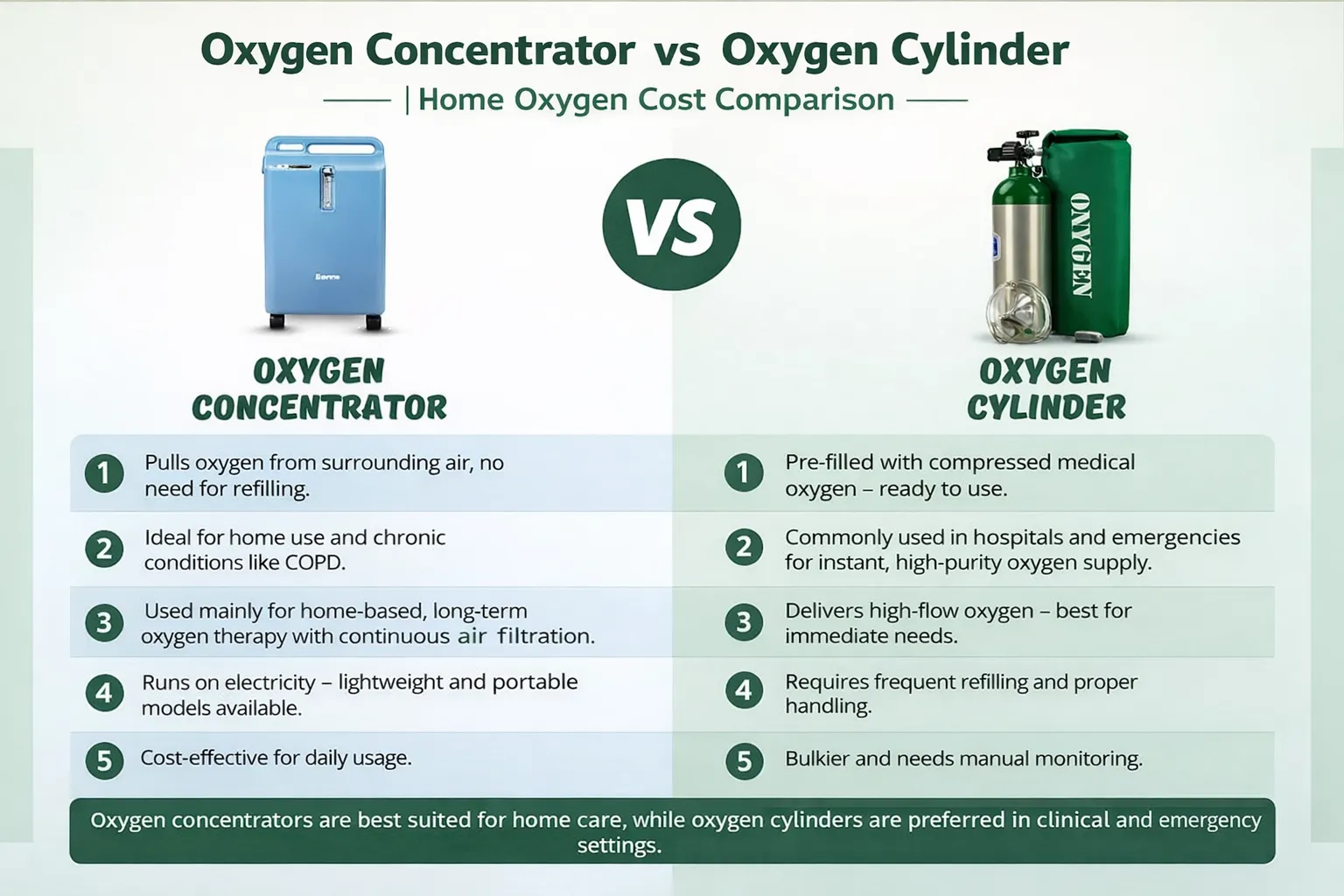
Oxygen cylinders are traditional metal tanks filled with
compressed medical oxygen. They are commonly used in hospitals, ambulances, and
emergency scenarios because they provide instant high-flow oxygen without
requiring electricity. For short-term emergencies or transport situations,
cylinders play an important role. However, their cost structure becomes
increasingly complex when used for home oxygen therapy beyond a few days.
The upfront cost of an oxygen cylinder setup typically
includes the cylinder itself, a regulator, a flow meter, and sometimes a
trolley for mobility. Depending on size and quality, this initial cost can
range from ₹4,000 to ₹15,000 or more. While this seems affordable compared to
buying a concentrator, this is only the beginning of the financial commitment.
The real cost of cylinder-based oxygen therapy lies in
refilling frequency. A standard 7-cubic-meter cylinder running at 2-3 liters
per minute may last only 10-14 hours. For patients requiring continuous oxygen
therapy, this means one to two refills per day, each costing anywhere between
₹400 and ₹1,200 depending on location, supplier, and delivery charges.
Over a single month, refill costs alone can easily exceed
₹15,000-₹30,000 or more, not including emergency surcharges, late-night
delivery fees, or weekend service premiums. Over multiple months, cylinder
therapy often becomes far more expensive than buying a concentrator outright.
Understanding Oxygen Concentrators: Cost Structure and
Long-Term Value
An oxygen concentrator is an electrically powered medical
device that extracts oxygen from room air and delivers concentrated oxygen
continuously through a nasal cannula or mask. Unlike cylinders, concentrators
do not store oxygen; they generate it on demand, which fundamentally changes
their cost profile.
The upfront purchase cost of a high-quality 5 LPM oxygen
concentrator in India typically ranges from ₹40,000 to ₹90,000 depending on
brand, noise level, oxygen purity stability, and service support. Portable
concentrators cost even more, often exceeding ₹1,50,000 for premium models. At
first glance, this price appears significantly higher than a cylinder setup,
making many families hesitate.
However, once purchased, an oxygen concentrator provides
unlimited oxygen supply as long as electricity is available. There are no
refilling charges, no delivery fees, no emergency procurement stress, and no
recurring fuel costs. The only ongoing expense is electricity, which typically
costs ₹6-₹10 per hour for a 5 LPM concentrator, translating to roughly ₹1,500-₹3,000
per month depending on usage duration and local electricity tariffs.
Over time, this stable and predictable cost structure makes
oxygen concentrators dramatically more economical for patients who require
oxygen therapy for more than 2-4 weeks.
Short-Term Cost Comparison: First 7-14 Days
- For extremely short-term oxygen needs, such as post-surgical recovery, temporary pneumonia, or acute COVID-19 support lasting less than one or two weeks, oxygen cylinders may appear cheaper initially. A family might spend ₹4,000-₹6,000 on initial setup and another ₹3,000-₹6,000 on refills over a week, resulting in a total cost of ₹7,000-₹12,000.
- During the same period, renting an oxygen concentrator would typically cost ₹2,000-₹5,000 per week, while buying one outright would require a much larger upfront investment. For patients who are medically confirmed to need oxygen for only a few days, rental concentrators or cylinders may be financially sensible.
- However, the risk lies in underestimating therapy duration. Many patients initially told they will recover in a week end up needing oxygen support for 3-8 weeks. In such cases, cylinder costs escalate rapidly and surpass concentrator costs far sooner than expected.
- This is why Aarogyaa Bharat often recommends rental concentrators for uncertain short-term needs and purchase concentrators for any therapy expected to exceed 2-3 weeks.
Medium-Term Cost Comparison: 1-3 Months
- This is where the financial advantage of oxygen concentrators becomes extremely clear. Over one month, a cylinder-based oxygen setup can easily cost ₹15,000-₹30,000 or more depending on flow rate and refill frequency. Over three months, this can balloon to ₹45,000-₹90,000, often exceeding the purchase price of a brand-new concentrator.
- By contrast, a purchased concentrator incurs a one-time cost of ₹40,000-₹90,000 and ongoing electricity costs of ₹1,500-₹3,000 per month. Over three months, the total cost typically remains far lower than repeated cylinder refills.
- Even when factoring in maintenance and servicing, which is usually required once a year, concentrators remain dramatically more economical for medium-term care.
- For families dealing with post-COVID lung damage, prolonged pneumonia recovery, or elderly respiratory decline lasting multiple months, oxygen concentrators are almost always the financially smarter choice.
- Long-Term Cost Comparison: 6 Months to Multiple Years
- For patients requiring long-term oxygen therapy due to COPD, pulmonary fibrosis, heart failure, or neuromuscular disorders, oxygen cylinders become financially unsustainable. Monthly refill expenses accumulate endlessly, often exceeding ₹3-5 lakhs over a single year.
- An oxygen concentrator, by contrast, typically pays for itself within 2-4 months of continuous use. After that point, ongoing costs are limited primarily to electricity and minor maintenance. Over multiple years, the total savings compared to cylinders can run into lakhs of rupees.
- From a financial planning perspective, concentrators provide predictable, budget-friendly oxygen therapy that allows families to allocate resources more efficiently toward medications, physiotherapy, nutrition, and nursing care rather than endless oxygen refills.
Hidden Costs That Most Families Overlook
- Many families make oxygen decisions based only on visible upfront costs, ignoring hidden expenses that significantly affect total spending. For oxygen cylinders, these hidden costs include emergency delivery surcharges, late-night refill premiums, transportation costs, physical handling injuries, regulator replacements, and occasional oxygen wastage due to leaks or mismanagement.
- There is also the psychological and logistical cost of constantly monitoring oxygen levels, scheduling refills, coordinating deliveries, and worrying about running out of oxygen during power cuts, holidays, or transport delays. These stress factors often push families into over-ordering cylinders, further increasing costs.
- For oxygen concentrators, hidden costs mainly involve electricity consumption, backup power systems, and occasional filter replacements. However, these costs are far more predictable and controllable than cylinder-based expenses.
- When evaluating true long-term cost, concentrators almost always emerge as the more economical and emotionally sustainable option.
Safety and Financial Risk Comparison
- From a safety perspective, oxygen cylinders carry inherent risks that can indirectly increase medical costs. High-pressure gas storage increases the risk of leaks, regulator failures, fire hazards, and physical injuries during cylinder handling. A single accident can result in hospital visits, equipment damage, and unexpected financial burden.
- Oxygen concentrators, while dependent on electricity, eliminate high-pressure storage risks and reduce physical strain on caregivers. Their built-in alarms, oxygen purity sensors, and safety shut-offs provide a much safer long-term oxygen delivery environment.
- However, concentrators do require power backup systems, which add to upfront cost. Even after factoring in inverter or UPS expenses, concentrators remain more cost-effective than cylinders for any therapy beyond a few weeks.
Rental vs Purchase Cost Logic for Concentrators
For families uncertain about therapy duration, renting a
concentrator offers a powerful middle ground. Rental costs typically range from
₹3,000-₹10,000 per month depending on model and service support.
If oxygen is needed for only 2-6 weeks, rental is usually
cheaper than buying. If therapy extends beyond 2-3 months, purchasing a
concentrator becomes more economical.
Aarogyaa Bharat offers flexible rental-to-purchase programs
that allow families to convert rental payments into partial ownership credit if
long-term therapy becomes necessary.
Cost Comparison Table: Oxygen Concentrator vs Oxygen
Cylinder
|
Cost
Factor |
Oxygen
Cylinder |
Oxygen
Concentrator |
|
Initial Setup
Cost |
₹4,000-₹15,000 |
₹40,000-₹90,000 |
|
Monthly
Operating Cost |
₹15,000-₹30,000+
(refills) |
₹1,500-₹3,000
(electricity) |
|
Refill / Fuel
Cost |
High and
recurring |
None |
|
Maintenance
Cost |
Low |
Low-Moderate |
|
Emergency
Cost Risk |
Very High |
Low |
|
3-Month Total
Cost |
₹45,000-₹90,000+ |
₹45,000-₹99,000 |
|
6-Month Total
Cost |
₹90,000-₹1.8
lakh+ |
₹50,000-₹1.1
lakh |
|
Long-Term
Cost (1 Year) |
₹2-4 lakhs+ |
₹55,000-₹1.3
lakh |
|
Best For |
Emergency /
Transport |
Home Therapy |
Which Option Makes Financial Sense for Different
Scenarios
For emergency use lasting less than 24-48 hours, oxygen
cylinders are practical and immediately available. For short-term therapy
lasting under two weeks, rental concentrators or limited cylinder use may be
cost-effective.
For medium-term therapy lasting 2-12 weeks, rental or
purchase of a concentrator is almost always cheaper than repeated cylinder
refills.
For long-term therapy lasting months or years, purchasing a
concentrator is by far the most economical, safest, and least stressful option.
For seniors living alone or home nursing care patients,
concentrators also offer superior safety and independence compared to heavy,
refill-dependent cylinders.
Conclusion
When comparing oxygen concentrators and oxygen cylinders
from a true cost perspective, the difference is far more dramatic than most
families initially realize. While cylinders appear cheaper upfront, their
recurring refill expenses, logistical challenges, safety risks, and long-term
financial drain quickly outweigh their initial affordability.
Oxygen concentrators, despite higher upfront cost, offer
unlimited oxygen supply, predictable monthly expenses, superior safety, and
unmatched long-term value. For any home oxygen therapy expected to last more
than 2-4 weeks, a concentrator almost always becomes the financially smarter
and emotionally safer choice.
At Aarogyaa Bharat, we specialize in helping families make
evidence-based oxygen therapy decisions tailored to their medical needs, budget
constraints, and lifestyle realities. Whether you need emergency cylinder
support, short-term concentrator rental, or long-term concentrator purchase,
our expert team ensures you get the safest and most economical solution
possible.
If you are struggling to choose between an oxygen
concentrator and an oxygen cylinder, Aarogyaa Bharat is always here to guide
you toward better breathing, smarter spending, and complete peace of mind.