What Is an Audiometer?
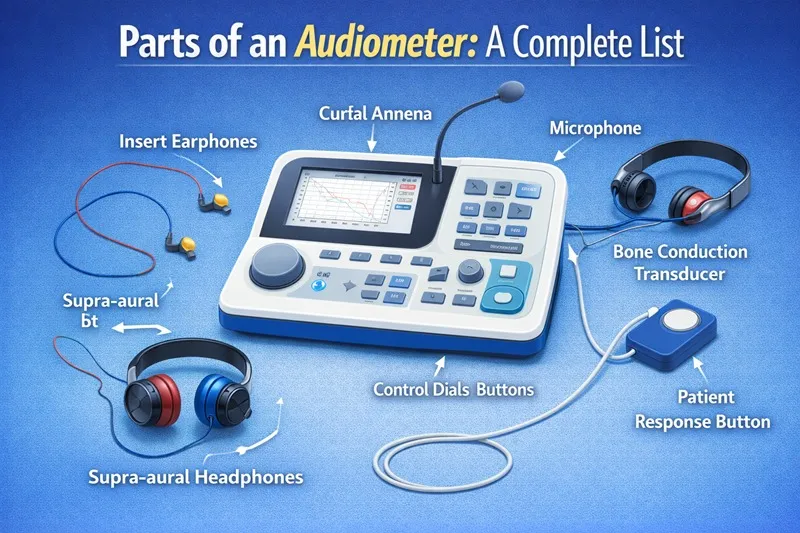
An audiometer is a medical device used to evaluate a
person’s hearing ability by generating sounds of different frequencies
(pitches) and intensities (loudness). These sounds are delivered through
headphones, insert earphones, or bone conduction devices, and the patient’s
responses are recorded to create an audiogram.
To achieve this accuracy, the audiometer relies on several
internal electronic components and external accessories each playing a critical
role.
Why Understanding Audiometer Parts Is Important
Knowing the parts of an audiometer helps in:
- Accurate
hearing assessment
- Proper
equipment handling and maintenance
- Troubleshooting
faulty readings
- Better
clinical training and education
- Informed
purchasing decisions
Even a minor issue in one component can affect the
reliability of hearing test results.
Main Parts of an Audiometer
The basic parts of an audiometer include the oscillator
(signal generator), amplifier, attenuator, and transducers, along with several
supporting components. Let’s explore each one in detail.
1. Oscillator (Signal Generator)
The oscillator, also called the signal generator, is the
core component of an audiometer.
Function
- Generates
pure tones of different frequencies
- Produces
test signals used during hearing evaluation
Why It’s Important
Audiometry relies on precise sound frequencies (usually
ranging from 125 Hz to 8000 Hz). The oscillator ensures that each tone is:
- Stable
- Accurate
- Consistent
Without a reliable oscillator, hearing thresholds cannot be
measured correctly.
2. Amplifier
The amplifier increases the strength of the sound signal
generated by the oscillator.
Function
- Boosts
weak signals to audible levels
- Ensures
sound clarity across intensity levels
Clinical Importance
The amplifier allows:
- Soft
sounds to remain clear
- Loud
sounds to stay distortion-free
A faulty amplifier can cause distorted tones, leading to
inaccurate test results.
3. Attenuator
The attenuator controls the loudness of the sound delivered
to the patient.
Function
- Adjusts
sound intensity in precise steps
- Allows
gradual increase or decrease in volume
Why It Matters
Audiometry measures the softest sound a person can hear, so
precise intensity control is critical. Attenuators usually work in standardized
steps (e.g., 5 dB increments).
Accurate attenuation ensures reliable hearing threshold
measurements.
4. Transducers
Transducers convert electrical signals into sound or
vibration.
Types of Transducers
- Air
conduction headphones
- Insert
earphones
- Bone
conduction vibrators
Function
- Deliver
test sounds to the patient
- Enable
different types of hearing tests
Clinical Role
Transducers help differentiate between:
- Conductive
hearing loss
- Sensorineural
hearing loss
They are essential for complete audiological evaluation.
5. Earphones / Headphones
Earphones are the most visible part of an audiometer.
Function
- Deliver
sound directly into the ears
- Isolate
each ear for independent testing
Why They Matter
Proper earphone placement ensures:
- Accurate
sound delivery
- Reduced
ambient noise interference
Incorrect placement can significantly affect test outcomes.
6. Bone Conduction Oscillator
This specialized transducer is placed behind the ear on the
mastoid bone.
Function
- Sends
sound vibrations directly to the inner ear
- Bypasses
the outer and middle ear
Clinical Importance
Bone conduction testing helps determine:
- Whether
hearing loss originates in the middle ear
- Or
is due to inner ear or nerve damage
7. Speech Input System (Microphone or Recorded Media)
Audiometers used for speech audiometry include a speech
input system.
Function
- Delivers
spoken words or recorded speech
- Assesses
speech recognition and clarity
Why It’s Important
Pure tones measure hearing sensitivity, but speech testing
evaluates real-life hearing ability, especially in conversations.
8. Control Panel / User Interface
The control panel allows the audiologist to operate the
audiometer.
Components
- Frequency
selection controls
- Intensity
adjustment dials
- Mode
selection buttons
Importance
An intuitive control panel ensures:
- Smooth
testing workflow
- Reduced
operator errors
Modern audiometers may include digital touchscreens or
software-based interfaces.
9. Display Unit
The display shows test parameters and patient responses.
Function
- Displays
frequency and intensity values
- Shows
test status and indicators
Clinical Value
Clear displays help audiologists monitor tests in real time
and maintain accuracy.
10. Power Supply
Audiometers require a stable power source.
Types
- AC
power (plug-in)
- Battery-powered
(portable models)
Why It Matters
Power fluctuations can affect signal accuracy. Reliable
power ensures consistent performance.
11. Calibration System
Calibration ensures that sound levels produced by the
audiometer are accurate.
Function
- Maintains
standardized output levels
- Ensures
compliance with audiology standards
Importance
Regular calibration is essential to avoid misdiagnosis.
How All Parts Work Together
- The
oscillator generates a sound signal
- The
amplifier strengthens the signal
- The
attenuator adjusts intensity
- Transducers
deliver sound or vibration
- The
patient responds
- Results
are displayed and recorded
Each part must function correctly for precise hearing
assessment.
Maintenance and Care of Audiometer Parts
- Handle
earphones and bone vibrators gently
- Store
cables neatly to avoid damage
- Calibrate
equipment regularly
- Keep
the device clean and dust-free
- Replace
worn-out transducers promptly
Proper maintenance extends equipment life and ensures patient safety.
Conclusion
Understanding the parts of an audiometer provides valuable insight into how hearing tests work and why accuracy depends on every component from the oscillator and amplifier to the transducers and control system. Each part plays a specific role in delivering reliable, meaningful hearing assessments.
At Aarogyaa Bharat, our goal is to empower healthcare
professionals and learners with clear, practical medical equipment knowledge.
When you understand the tools you use, you deliver better care, make smarter
decisions, and build greater confidence in clinical practice.