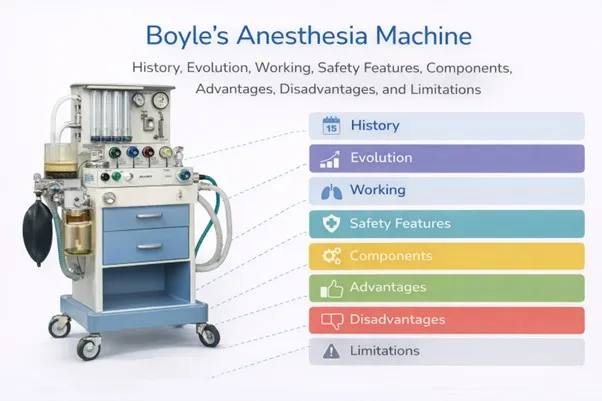
What Is Boyle’s Anesthesia Machine?
Boyle’s anesthesia machine is a continuous-flow anesthesia
apparatus designed to deliver a controlled mixture of oxygen and anesthetic
gases to a patient during surgery.
It is considered the foundation of modern anesthesia
machines, on which today’s advanced anesthesia workstations are based.
Boyle’s anesthesia machine, Boyle anesthesia apparatus, classic anesthesia
machine
History of Boyle’s Anesthesia Machine
Boyle’s anesthesia machine was developed by Henry Edmund
Gaskin Boyle, a British anaesthetist, in 1917.
Why It Was Revolutionary:
- Introduced
controlled gas flow
- Improved
safety over open-drop anesthesia
- Allowed
use of nitrous oxide and oxygen together
Before Boyle’s machine, anesthesia was unpredictable and
dangerous.
Evolution of Boyle’s Anesthesia Machine
Over time, Boyle’s machine evolved with:
- Addition
of oxygen flow meters
- Improved
pressure regulators
- Safer
breathing circuits
- Introduction
of vaporizers
Modern anesthesia machines still follow the same basic
principles, enhanced with electronics and automation.
Main Components of Boyle’s Anesthesia Machine
Boyle’s machine consists of simple yet critical components,
each performing a specific function.
Gas Supply System
Components:
- Oxygen
cylinder
- Nitrous
oxide cylinder
Function:
- Supplies
medical gases under high pressure
Each cylinder is color-coded and fitted with safety valves.
Gas Cylinders in Boyle’s Machine
Function:
- Reduce
high cylinder pressure
- Provide
safe working pressure
Without pressure regulators, gas delivery would be unsafe
and uncontrolled.
Flow Meters (Rotameters)
Components:
- Oxygen
flow meter
- Nitrous
oxide flow meter
Function:
- Control
and measure gas flow rates
- Allow
mixing of gases
Flow is read using a floating bobbin inside a transparent
tube.
flow meter in Boyle’s anesthesia machine
Flow Meters of Boyle’s Machine
Vaporizers
Early Boyle’s machines used:
- Ether
vaporizer
- Chloroform
vaporizer
Later versions supported:
- Halothane
- Isoflurane
Function:
- Convert
liquid anesthetic into vapor
- Deliver
controlled anaesthetic concentration
Breathing System
Components:
- Reservoir
(rebreathing) bag
- Corrugated
breathing tubes
- Face
mask
Function:
- Delivers
gas mixture to patient
- Allows
manual ventilation
Most Boyle’s machines use a semi-open or semi-closed system.
Breathing Circuit of Boyle’s Machine
Adjustable Pressure Limiting (APL) Valve
Function:
- Controls
pressure in breathing circuit
- Prevents
lung overinflation
APL valve is manually adjusted during ventilation.
Working Principle of Boyle’s Anesthesia Machine
Boyle’s anesthesia machine works on the principle of
continuous gas flow.
Step-by-Step Working:
- Gas
flows from cylinders
- Pressure
is reduced by regulators
- Flow
meters control gas quantity
- Gases
pass through vaporizers
- Anesthetic
gas mixture reaches breathing circuit
- Patient
inhales anesthetic gases
Ventilation is usually manual, using the reservoir bag.
Safety Features in Boyle’s Anesthesia Machine
Compared to modern machines, Boyle’s machine has limited
safety features, but still includes:
- Pressure relief valves
- Color-coded gas cylinders
- Non-interchangeable gas connectors
- However, it lacks advanced electronic alarms.
Advantages of Boyle’s Anesthesia Machine
- Simple and robust design
- Easy to understand and operate
- Low cost compared to modern machines
- Ideal for teaching anesthesia basics
- Works without electricity
These advantages make it suitable for rural and low-resource
settings.
Disadvantages of Boyle’s Anesthesia Machine
- No integrated ventilator
- Manual ventilation only
- No electronic monitoring
- Higher risk of human error
- Limited safety alarms
Boyle anesthesia machine disadvantages
Limitations of Boyle’s Anesthesia Machine
- Not
suitable for long or complex surgeries
- Not
ideal for paediatric or critical patients
- Cannot
support advanced ventilation modes
- Requires
continuous anaesthetist attention
Because of these limitations, it has largely been replaced
by modern anesthesia workstations in advanced hospitals.
Boyle’s Anesthesia Machine vs Modern Anesthesia Machine
|
Feature |
Boyle’s
Machine |
Modern
Machine |
|
Ventilation |
Manual |
Automatic |
|
Monitoring |
Minimal |
Advanced |
|
Safety alarms |
Limited |
Extensive |
|
Cost |
Low |
High |
|
Usage |
Teaching/basic |
Advanced
surgery |
Current Clinical Use of Boyle’s Anesthesia Machine
Today, Boyle’s machine is used:
- In
teaching hospitals (demonstration)
- In
rural healthcare centers
- As
backup anesthesia equipment
- In
low-resource countries
Maintenance Requirements
- Regular
cylinder inspection
- Leak
testing
- Flow
meter calibration
- Valve
and tubing checks
Proper maintenance is essential due to manual operation.
Conclusion
Boyle’s Anesthesia Machine represents the foundation of
safe, controlled anesthesia delivery. While modern anesthesia workstations have
far surpassed it in technology and safety, Boyle’s machine remains a milestone
in medical history and a powerful educational tool.
For students and clinicians, understanding Boyle’s
anesthesia machine provides deep insight into anesthesia principles, gas flow
mechanics, and patient safety fundamentals.
At Aarogyaa Bharat, we support both modern anesthesia
solutions and educational resources, helping healthcare providers build strong
clinical foundations while advancing toward safer, smarter surgical care.