Why the Right Hospital Bed Mattress Matters
A hospital mattress must do far more than a normal mattress.
It needs to:
- Support
the body evenly for long hours
- Reduce
pressure on sensitive areas
- Adapt
to adjustable bed positions
- Support
medical recovery and comfort
- Remain
easy to clean and hygienic
Many families unknowingly place a regular household mattress
on a hospital bed. This leads to:
- Poor
alignment when the bed is raised
- Increased
pressure points
- Higher
bedsore risk
- Reduced
effectiveness of bed adjustments
Key Factors to Consider When Choosing a Hospital Bed
Mattress
1. Patient Mobility Level
Mobility is the most important factor.
- Fully
mobile or semi-mobile patients need comfort and posture support
- Partially
mobile patients need pressure redistribution
- Fully
bedridden patients need active pressure-relief solutions
Choosing the mattress based on mobility prevents pain,
stiffness, and complications.
2. Risk of Bedsores (Pressure Ulcers)
One of the highest-searched concerns in hospital mattresses
is bedsore prevention.
Patients at high risk include:
- Long-term
bedridden individuals
- Elderly
patients with fragile skin
- Stroke
and paralysis patients
- Patients
with poor circulation or diabetes
A good hospital mattress reduces continuous pressure on:
- Hips
- Tailbone
- Shoulders
- Heels
3. Mattress Compatibility with Hospital Beds
Hospital beds adjust in multiple sections. The mattress
must:
- Bend
smoothly at the head and leg sections
- Maintain
shape during elevation
- Not
slide or fold improperly
Incompatible mattresses reduce comfort and negate the
benefits of an adjustable bed.
Types of Mattresses for Hospital Beds
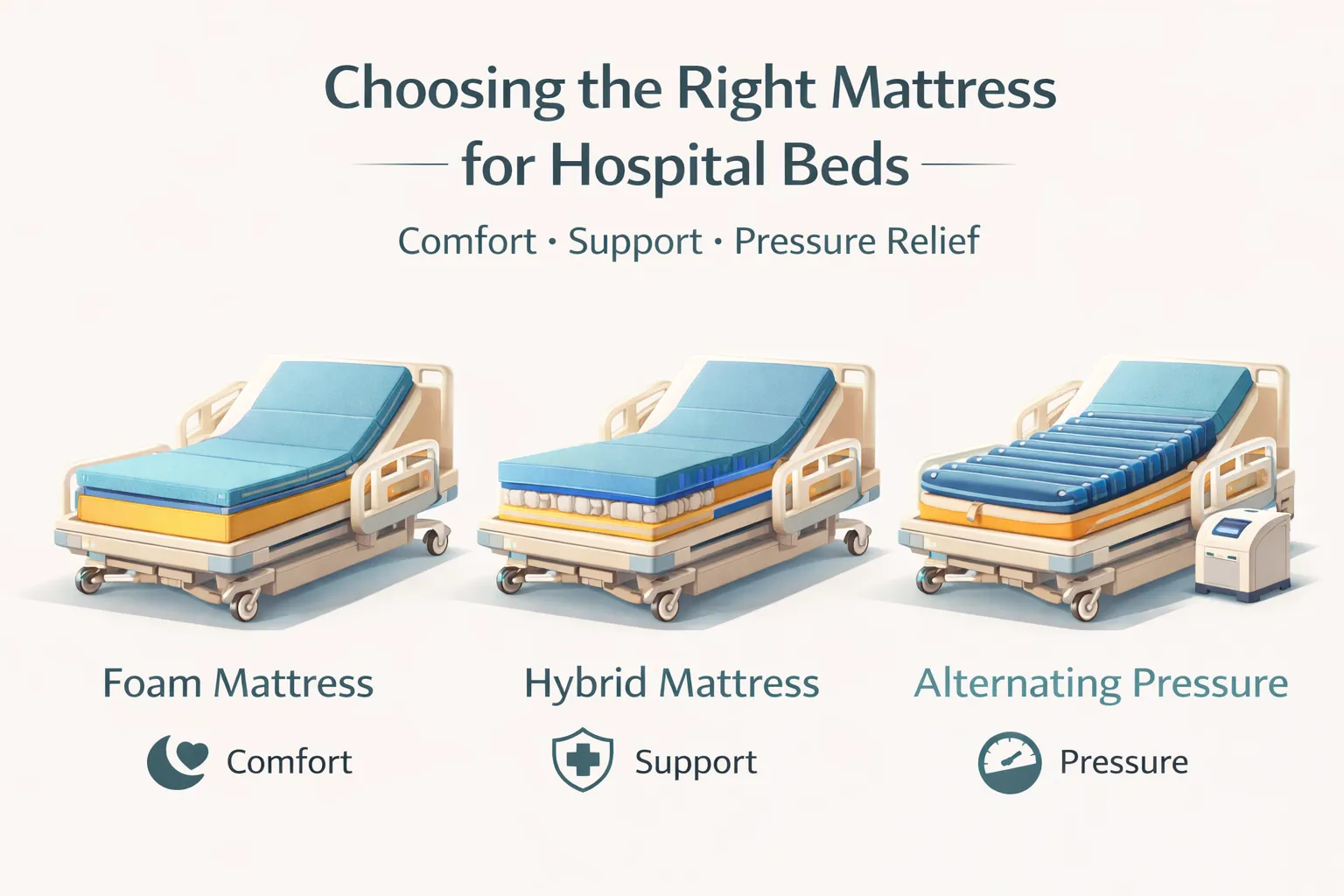
Foam Mattress for Hospital Beds
Foam mattresses are commonly used for short-term or moderate
care.
Benefits
- Affordable
- Lightweight
- Suitable
for mobile or semi-mobile patients
Limitations
- Limited
pressure relief
- Not
ideal for long-term bedridden patients
Best for: post-surgery recovery, mild illness, short-term
home care.
Orthopaedic Mattress for Hospital Beds
Orthopaedic mattresses focus on spinal alignment and
firmness.
Benefits
- Reduces
back pain
- Supports
posture
- Suitable
for elderly patients
Limitations
- Limited
pressure redistribution
- Not
sufficient for bedsore prevention
Best for: elderly care, arthritis, back pain patients.
Air Mattress (Anti-Bedsore Mattress)
Air mattresses are among the most searched hospital
mattresses in India.
Benefits
- Alternating
air pressure reduces bedsores
- Excellent
for fully bedridden patients
- Improves
blood circulation
Limitations
- Requires
electricity
- Slight
noise from pump
- Higher
cost than foam
Best for: long-term bedridden patients, paralysis, stroke
recovery.
Alternating Pressure Mattress
This is an advanced form of air mattress.
Key Advantages
- Automatically
shifts pressure points
- Reduces
skin breakdown
- Ideal
for long-duration immobility
This mattress is often recommended by doctors for high
bedsore risk patients.
Hybrid Mattress (Foam + Air)
Hybrid mattresses combine comfort and medical support.
Benefits
- Better
comfort than air alone
- Improved
pressure distribution
- Suitable
for extended home care
Best for: patients who spend most of the day in bed but
still move occasionally.
Choosing the Right Mattress Firmness
Firmness is critical but misunderstood.
- Too
soft → sinking, poor posture, difficulty turning
- Too
hard → pressure points, pain, bedsores
For most hospital beds:
- Medium-firm
to firm mattresses work best
- Bedsores
require pressure-relief rather than softness
Waterproof, Breathable & Hygienic Covers
Hospital mattresses must support hygiene.
Look for:
- Waterproof
outer cover
- Breathable
fabric to reduce sweating
- Easy-to-clean
surfaces
- Resistance
to fluids and stains
This is essential for infection control and daily care
convenience.
Mattress Thickness and Size Considerations
- Standard
hospital mattress thickness: 4–6 inches
- Too
thin → poor pressure relief
- Too
thick → restricts side rails
Always match the mattress size to the hospital bed frame to
prevent gaps and movement.
Mattress Selection Based on Patient Condition
- Elderly
patients → orthopaedic or hybrid mattress
- Post-surgery
recovery → foam or orthopaedic mattress
- Long-term
bedridden → air or alternating pressure mattress
- Chronic
illness → hybrid or pressure-relief mattress
Caregiver Benefits of the Right Mattress
A suitable mattress:
- Reduces
repositioning frequency
- Makes
turning easier
- Lowers
risk of caregiver back strain
- Improves
patient comfort, reducing agitation
This results in less physical and emotional strain for
caregivers.
Cost vs Value: Long-Term Perspective
While specialized mattresses may cost more initially, they:
- Prevent
expensive complications like bedsores
- Reduce
hospital readmissions
- Lower
caregiver workload
- Improve
patient recovery and comfort
Over time, the right mattress is a medical investment, not a
luxury.
Conclusion: The Mattress Is the Foundation of Patient
Care
A hospital bed can only perform as well as the mattress
placed on it.
Choosing the right mattress for a hospital bed directly
affects:
- Patient
comfort
- Bedsore
prevention
- Sleep
quality
- Recovery
speed
- Caregiver
workload
For elderly patients, chronic illness care, post-surgery
recovery, or long-term bedridden individuals, a carefully chosen hospital
mattress transforms the bed into a safe, supportive, and healing environment.
When comfort, hygiene, pressure relief, and compatibility come together, care becomes easier, safer, and more humane for both patient and caregiver
This guide by Aarogyaa Bharat helps you choose the right mattress for hospital beds, ensuring comfort, safety, and better home care for patients.