In Indian
households, where bathroom layouts, flooring, and accessibility often create
hidden risks, the wrong choice can lead to falls, pain, emotional distress, and
repeated hospital visits. At Aarogyaa Bharat, we frequently encounter families
who assume that installing a western toilet seat automatically solves mobility
problems, only to later realise that it does not adequately address real-world
challenges such as night-time urgency, joint pain, balance loss, or long
walking distances. Understanding the practical differences between a commode
chair and a western toilet seat is essential for making a safe and informed
decision.
Understanding What a Commode Chair Is and How It Is Used
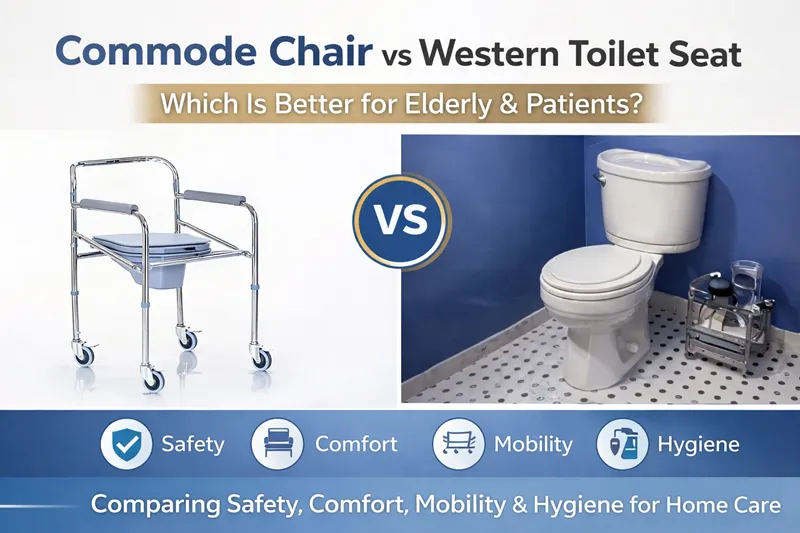
A commode chair is a portable toileting aid designed to be
placed in the bedroom or any safe area of the home, allowing patients to use
the toilet without walking to the bathroom. It consists of a stable frame, seat
with an opening, removable waste bucket, and supportive armrests, often with
adjustable height. The key advantage of a commode chair is proximity, as it
brings toileting access closer to the patient, reducing physical effort and
fall risk. In Indian homes, commode chairs are commonly used for elderly
individuals, arthritis patients, post-surgery recovery, stroke rehabilitation,
paralysis care, and night-time toileting. Because the chair is movable, it
adapts to changing patient needs and home layouts without requiring structural
modifications.
Understanding What a Western Toilet Seat Offers
A western toilet seat is a fixed bathroom fixture designed
for seated toileting. Compared to traditional Indian squat toilets, western
seats are more comfortable and accessible for people who cannot squat. However,
they still require the user to walk to the bathroom, navigate wet floors, sit
down on a fixed height surface, and stand up using limited support. While
western toilet seats improve comfort over squatting, they do not eliminate
movement, balance challenges, or night-time risks. In many Indian homes,
western toilets are installed in compact bathrooms that may lack grab bars,
proper lighting, or anti-slip flooring, which limits their effectiveness for
patients with mobility issues.
Mobility and Movement Requirements: A Critical Difference
The most significant difference between a commode chair and
a western toilet seat is the amount of movement required. A commode chair
drastically reduces or eliminates walking by being placed near the bed, while a
western toilet seat requires the user to walk from the bedroom to the bathroom
every time. For elderly patients, arthritis sufferers, and individuals with
balance issues, repeated walking increases fatigue, pain, and fall risk. This
difference becomes even more critical at night, when vision is reduced and
reflexes are slow. From a mobility standpoint, a commode chair offers far
greater safety and practicality for home care.
Impact on Joint Pain and Sit-to-Stand Difficulty
Sitting down and standing up is one of the most painful
movements for people with knee, hip, or spinal problems. A western toilet seat
has a fixed height, which may be too low for arthritis patients or post-surgery
users, forcing deep knee bending and joint strain. In contrast, a commode chair
often has adjustable height and strong armrests, allowing users to sit and
stand with minimal pain by using upper body support. This makes commode chairs
far more suitable for individuals experiencing joint stiffness, inflammation,
or weakness.
Night-Time Toileting Safety Comparison
Most home-care falls occur during the night or early morning
due to urgency, poor lighting, and drowsiness. A western toilet seat requires
navigating dark hallways and slippery bathroom floors, increasing the risk of
serious injury. A commode chair placed beside the bed eliminates these hazards
entirely by allowing safe night-time toileting without leaving the bedroom. For
families concerned about night-time safety, especially for elderly parents or
recovering patients, this single factor often makes commode chairs the safer
choice.
Bathroom Design Limitations in Indian Homes
Indian bathrooms are often compact, with limited turning
space, raised thresholds, and wet floors. Even with a western toilet seat, the
surrounding environment may not be safe for mobility-limited users. Installing
grab bars or widening doorways may not always be possible in rented apartments
or older homes. A commode chair bypasses these architectural limitations by
removing the need to enter the bathroom, offering a practical solution without
renovation.
Hygiene Management and Practical Cleaning
Western toilet seats rely on the bathroom’s hygiene
conditions, which may not always be ideal in shared households. Commode chairs
use removable buckets that can be cleaned in a controlled manner, allowing
caregivers to maintain hygiene without repeated bathroom visits. While both
options can be hygienic when maintained properly, commode chairs offer more
flexibility in small homes where bathroom access is limited or shared among
multiple family members.
Emotional Comfort, Dignity, and Confidence
Toileting dependency can deeply affect a patient’s
self-esteem. Struggling to reach the bathroom in time or fearing falls can lead
to anxiety and embarrassment. A commode chair restores confidence by ensuring
safe and timely access, reducing panic and urgency. While western toilet seats
are familiar and socially accepted, they do not address the emotional stress
caused by mobility limitations. In many cases, patients feel more secure using
a commode chair discreetly in their room than risking an accident while walking
to the bathroom.
Caregiver Effort and Physical Strain
Caregivers play a crucial role in assisting patients during
toileting. Helping someone walk to the bathroom, especially at night, involves
lifting, balancing, and rushing, which increases caregiver injury risk. A
commode chair simplifies caregiving by reducing movement and allowing
controlled transfers using armrests and proper height adjustment. Western
toilet seats often require more physical support, especially in unsafe bathroom
environments.
Long-Term Care and Changing Patient Needs
Patient mobility often changes over time due to recovery,
aging, or disease progression. A commode chair adapts easily to these changes,
as it can be repositioned, height-adjusted, or removed when no longer needed. A
western toilet seat is fixed and cannot adapt to temporary or fluctuating needs
without additional aids. For long-term or evolving care situations, commode
chairs offer greater flexibility.
Comparison Table: Commode Chair vs Western Toilet Seat
|
Aspect |
Commode
Chair |
Western
Toilet Seat |
|
Distance to
toilet |
Minimal,
bedside |
Requires
walking |
|
Night-time
safety |
Very high |
Low |
|
Joint strain |
Low due to
height adjustment |
High if seat
is low |
|
Fall risk |
Very low |
Moderate to
high |
|
Caregiver
effort |
Reduced |
Higher |
|
Home
modification |
Not required |
Often
required |
|
Adaptability |
High |
Fixed |
Cost and Practical Value Over Time
While installing a western toilet seat may seem like a
permanent solution, it often requires additional safety modifications such as
grab bars, anti-slip flooring, and lighting upgrades. A commode chair, on the
other hand, is a one-time investment that delivers immediate safety benefits
without structural changes. Over time, preventing falls and hospital visits
makes commode chairs a highly cost-effective choice for many families.
Which Option Is Better for Indian Home Care
For patients with mild mobility issues who can walk safely
and have well-designed bathrooms, a western toilet seat may be sufficient.
However, for elderly individuals, arthritis patients, post-surgery recovery,
obese patients, or those requiring night-time toileting support, a commode
chair offers significantly greater safety, comfort, and peace of mind. In many
Indian home-care scenarios, the commode chair is not a replacement for a
western toilet seat but a complementary solution that fills critical safety
gaps.
Why Aarogyaa Bharat Recommends Condition-Based Selection
Aarogyaa Bharat believes there is no single solution
suitable for every patient. Our approach focuses on matching the toileting aid
to the patient’s medical condition, home layout, and caregiving needs. By
educating families on the practical differences between commode chairs and
western toilet seats, we help them avoid unsafe assumptions and choose
solutions that genuinely improve daily living.
Conclusion
The choice between a commode chair and a western toilet seat should never be based on convenience or assumption alone. It must be guided by patient mobility, safety risks, home design, and caregiving realities. While western toilet seats improve comfort compared to squatting, they do not eliminate movement, fall risk, or night-time danger. A commode chair, by bringing toileting closer and reducing physical strain, often provides a safer and more dignified solution for home care in India. Aarogyaa Bharat remains committed to helping families make informed, safety-first decisions that protect their loved ones and simplify caregiving, ensuring comfort, confidence, and dignity every single day.