Let’s understand the difference between drypads and
underpads and why drypads are increasingly becoming the preferred choice in
modern healthcare.
What Are Underpads?
Underpads are absorbent sheets placed under patients to
protect bedding and furniture from urine, sweat, or accidental spills. They are
commonly used in hospitals, elderly care, and post-surgery recovery.
Typical characteristics of underpads:
- Disposable
or reusable
- Absorbent
middle layer
- Waterproof
plastic backing
- Basic
moisture protection
Underpads are affordable and widely available, but they
often fall short in comfort and moisture control.
What Are Drypads?
Drypads are advanced absorbent pads designed specifically to
keep the surface dry even after absorbing fluids. They use better absorption
technology and moisture locking layers to prevent wetness from coming back to
the surface.
Key features of drypads:
- Fast
absorption rate
- Dry-touch
top surface
- Improved
airflow and breathability
- Reduced
skin contact with moisture
Drypads are commonly used in ICUs, geriatric care, maternity
wards, and long-term home nursing.
Why Drypads Are Better Than Underpads
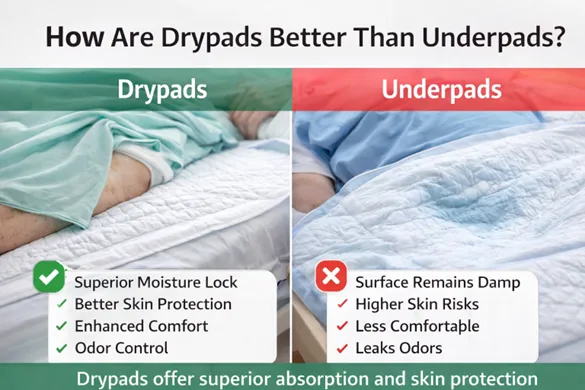
1. Superior Moisture Absorption
Drypads absorb fluids quickly and lock them into inner
layers, preventing leakage or backflow. Underpads may absorb fluid initially
but often leave the surface damp.
This keeps the patient dry for longer periods.
2. Better Skin Protection
Prolonged exposure to moisture can lead to:
- Skin
rashes
- Fungal
infections
- Bed
sores and pressure ulcers
Drypads significantly reduce skin contact with moisture,
making them ideal for bedridden and incontinent patients.
3. Enhanced Comfort
Drypads are generally softer, stay flat on the bed, and
reduce friction. Underpads can wrinkle or shift, causing discomfort and
irritation.
4. Reduced Risk of Bed Sores
By keeping the skin dry and reducing friction, drypads help
lower the risk of pressure sores especially important in long-term care and ICU
settings.
5. Improved Odor Control
Many drypads come with odor locking layers that reduce
unpleasant smells, improving hygiene and maintaining patient dignity.
6. Cost-Effective Over Time
Although drypads may cost more initially, they:
- Reduce
frequent pad changes
- Lower
skin treatment and medication costs
- Decrease
laundry and cleaning effort
This makes them more economical in long-term use.
Drypads vs Underpads: Quick Comparison
|
Feature |
||
|
Absorption
speed |
High |
Moderate |
|
Surface
dryness |
Excellent |
Limited |
|
Skin
protection |
Superior |
Basic |
|
Comfort level |
High |
Average |
|
Odor control |
Better |
Minimal |
|
Long-term
care suitability |
Ideal |
Less suitable |
Where Are Drypads Most Useful?
Drypads are especially beneficial in:
- Hospital
ICUs and wards
- Elderly
and geriatric care
- Post-surgical
recovery
- Home
nursing and long-term care
- Maternity
and neonatal care
Frequently Asked Questions (FAQs)
Q1. Are drypads reusable or disposable?
Drypads are available in both reusable and disposable
options depending on care requirements.
Q2. Can drypads be used at home?
Yes. Drypads are commonly used for home care, especially for
elderly or immobile patients.
Q3. Are drypads safe for sensitive skin?
Yes. Drypads are designed to minimize moisture contact, making them suitable for sensitive skin.
Conclusion: Why Drypads Are the Better Choice
While underpads provide basic protection, drypads offer
superior absorption, better skin protection, enhanced comfort, and improved
hygiene. For hospitals, caregivers, and families focused on quality care,
drypads are a smarter and safer option, especially in long-term and critical
care situations.
Choosing the right pad is not just about protecting the bed it’s
about protecting the patient’s comfort, health, and dignity.
Enter your content here...
Enter your content here...
Enter your content here...