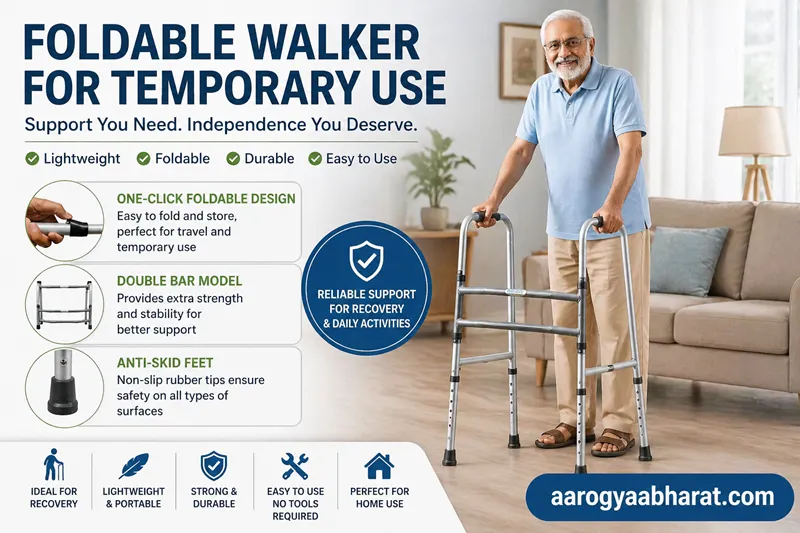
Why a Foldable Walker is Ideal for Temporary Mobility
Needs?
A foldable walker is an excellent solution for individuals
who require mobility support for a short period, such as after surgery, injury,
or illness. Unlike permanent mobility aids, a temporary-use walker is designed
with convenience and flexibility in mind, making it easy to use, store, and
transport. In many cases, elderly individuals or patients recovering at home do
not need long-term support but still require a reliable aid during their
recovery phase. A foldable walker fulfils this requirement by offering
stability without occupying permanent space in the home. It can be quickly
unfolded when needed and folded away once recovery improves. This is especially
beneficial in modern homes where space management is important. Additionally,
temporary mobility needs often arise unexpectedly, and having a foldable walker
ensures that users can adapt quickly without disrupting their daily routine. As
home healthcare continues to expand with a focus on flexibility and
convenience, foldable walkers have become a preferred choice for short-term
mobility support.
Key Features of Foldable Walkers Designed for Temporary
Use
Foldable walkers for temporary use come equipped with
features that prioritize ease of handling and quick usability. One of the most
important features is the simple folding mechanism, which allows the walker to
be collapsed and unfolded within seconds without requiring technical knowledge.
Lightweight construction, typically using aluminium frames, ensures that the
walker is easy to carry and reposition, even for elderly users. Adjustable
height settings are included to accommodate different user requirements and
maintain proper posture during use. Many models feature ergonomic hand grips
that reduce pressure on the hands and provide better control, especially during
extended use. Some foldable walkers also include front wheels or gliders, which
make movement smoother and reduce the effort required to lift the walker.
Compact design ensures that the walker occupies minimal space when folded,
making it ideal for storage in small apartments or during travel. With the
availability of options under categories such as mobility aids, rehabilitation
equipment, and orthopaedic supports, users can easily find a foldable walker
that meets their temporary mobility needs.
Benefits of Using a Foldable Walker for Short-Term
Recovery
Using a foldable walker during short-term recovery offers
numerous benefits that improve both safety and convenience. One of the primary
advantages is portability, as the walker can be easily transported between
locations such as home, hospital, or physiotherapy centers. This ensures
continuity in mobility support during the recovery process. Another key benefit
is space efficiency, as the walker can be folded and stored when not in use,
preventing clutter in the living space. Foldable walkers also provide the same
level of stability and support as standard models, ensuring safety during
movement. They help reduce strain on muscles and joints by supporting body
weight and improving balance. For individuals recovering from surgery or
injury, regular use of a walker encourages gradual movement, which is essential
for healing and preventing stiffness. Additionally, foldable walkers promote
independence by allowing users to move without constant assistance. When
combined with other home healthcare solutions such as hospital beds, patient
monitoring systems, and healthcare calculators, they contribute to a
comprehensive and effective recovery environment.
How to Choose the Best Foldable Walker for Temporary Use
Selecting the right foldable walker for temporary use
involves evaluating several factors to ensure it meets both mobility and
convenience requirements. The first consideration should be the ease of folding
and unfolding, as the mechanism should be simple enough for elderly users to
operate without assistance. Weight and material are also important, as a
lightweight yet sturdy frame ensures both portability and durability.
Adjustable height settings are essential to maintain proper posture and prevent
strain on the body. The type of walker should also be considered, with options
including standard foldable walkers, walkers with front wheels, or glider
models. For temporary use, models with smooth movement features are often
preferred, as they reduce effort during use. Additional features such as
ergonomic grips, storage pouches, and compact folding design can enhance
overall convenience. It is also important to consider the available categories
such as elderly care products, physiotherapy equipment, and mobility aids to
compare different models and select the most suitable option for short-term
use.
Comparison Table: Foldable Walker vs Non-Foldable Walker
|
Feature |
Foldable
Walker |
Non-Foldable
Walker |
|
Storage |
Compact and
space-saving |
Requires
fixed space |
|
Portability |
Easy to carry
and transport |
Less portable |
|
Weight |
Lightweight |
Moderate to
heavy |
|
Convenience |
High |
Moderate |
|
Best Use |
Temporary
mobility support |
Long-term use |
|
Flexibility |
High |
Limited |
Role of Foldable Walkers in Temporary Home Healthcare
Solutions
Foldable walkers play a crucial role in temporary home
healthcare solutions by providing flexible and reliable mobility support. They
are particularly useful for patients who require assistance during a specific
phase of recovery, such as post-surgery rehabilitation or injury healing. In
such cases, the need for mobility aids is temporary, and a foldable walker
offers a practical solution without requiring long-term commitment. In home
care settings, these walkers ensure that users can move safely while maintaining
a clutter-free environment. They are also commonly used in situations where
multiple family members may need access to mobility aids at different times, as
the foldable design allows easy sharing and storage. With the expansion of
healthcare services across different city-based platforms and hospital support
systems, foldable walkers have become easily accessible to users in various
locations. They are often used alongside other healthcare equipment such as orthopaedic
supports, exercise therapy tools, and monitoring devices, ensuring a
comprehensive approach to patient care.
Extended Insights: Practical Use Cases of Foldable
Walkers for Temporary Needs
Foldable walkers are widely used in a variety of temporary
situations where mobility support is required for a limited duration. For
example, elderly individuals recovering from minor surgeries or fractures often
need a walker only during the initial recovery phase. Similarly, patients
undergoing physiotherapy may use a foldable walker during their exercise
routines and discontinue use once strength and balance improve. These walkers
are also beneficial for individuals traveling or visiting healthcare facilities,
as they can be easily transported without taking up much space. In emergency
situations where sudden mobility issues arise, having a foldable walker readily
available can provide immediate support and prevent complications.
Additionally, caregivers find foldable walkers convenient as they can be
quickly stored or moved when not in use. This adaptability makes them a
versatile solution for temporary mobility challenges, ensuring that users
receive the support they need without compromising on convenience or space.
Bullet Points: Key Advantages of Foldable Walkers for
Temporary Use
- Easy
to fold and unfold for quick use
- Lightweight
and highly portable
- Saves
space when not in use
- Provides
reliable support and stability
- Ideal
for short-term recovery and rehabilitation
- Convenient
for travel and transportation
- Enhances
independence and confidence
- Suitable
for modern compact homes
Conclusion
A foldable walker for temporary use is a highly practical mobility solution that combines convenience, safety, and flexibility. Its compact design and ease of use make it ideal for individuals who require short-term support without committing to a permanent mobility aid. By offering reliable stability and portability, foldable walkers help users maintain independence and confidence during recovery. Whether used for post-surgery rehabilitation, injury recovery, or occasional mobility support, they provide a versatile and efficient solution. As home healthcare continues to evolve with a focus on adaptability and user convenience, choosing the right foldable walker can make a significant difference in ensuring a smooth and effective recovery process.