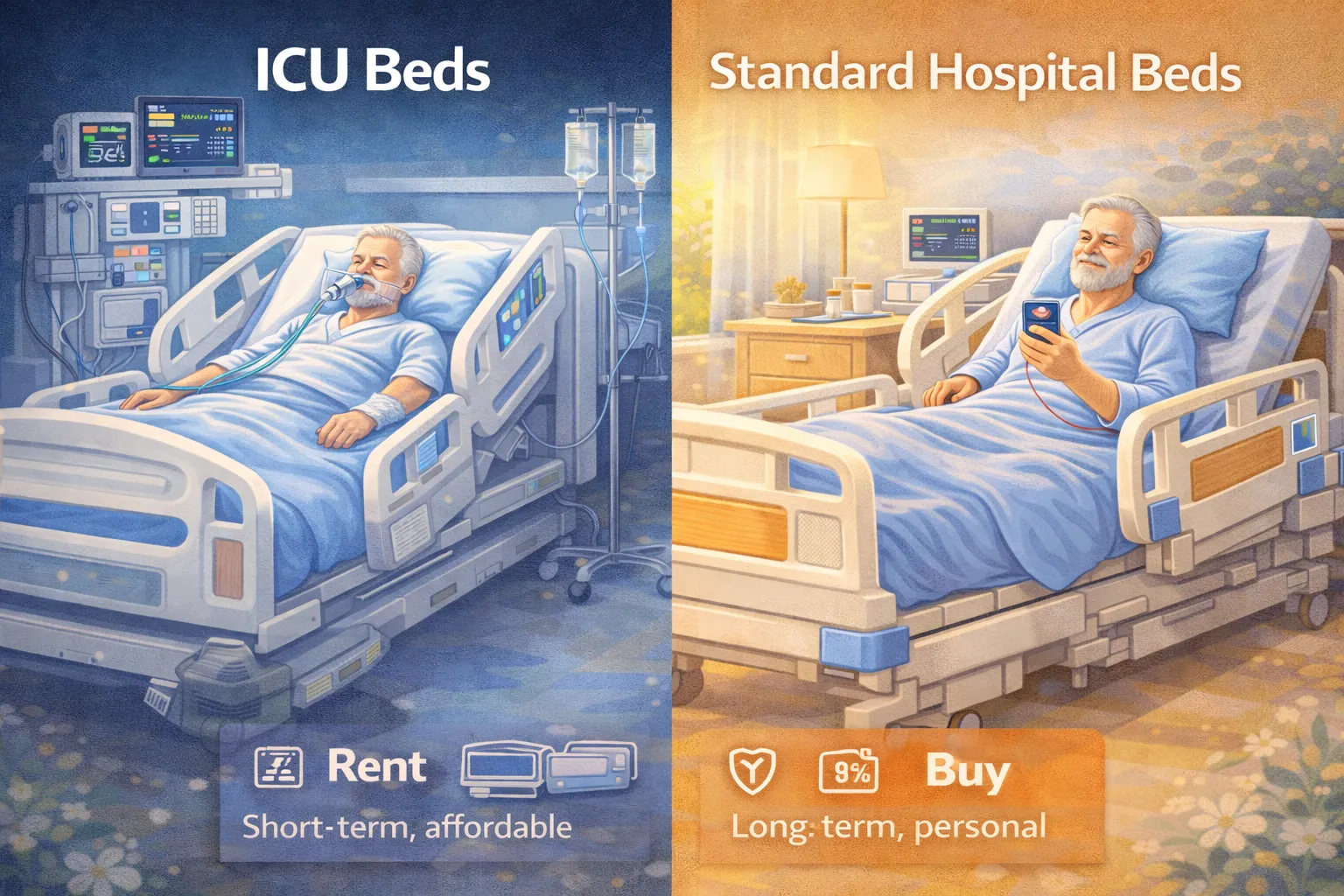
What Is a Standard Hospital Bed?
A standard hospital bed is designed primarily for:
- General patient care
- Comfort and basic support
- Adjustable positioning of the back and legs
Key Features:
- Manual or Electric adjustments for head and leg positions
- Side
rails for safety
- Compatibility
with foam or pressure-relief mattresses
- Lockable
wheels for stability
Best Suited For:
- Elderly
patients
- Post-surgery
recovery
- Chronic
illness management at home
What Is an ICU Bed?
An ICU (Intensive Care Unit) bed is designed for critically
ill patients who require constant monitoring and advanced medical support.
Key Features:
Multi-position adjustments (head, legs, Trendelenburg, reverse Trendelenburg)
Advanced electric controls with memory functions
Integrated side rails with additional safety features
Compatibility with medical devices like ventilators, monitors, and suction
systems
Enhanced durability and weight capacity
Best Suited For:
- Critical
care at home
- Patients
needing respiratory support
- Post-ICU
recovery
- Continuous
monitoring for severe conditions
Key Differences Between ICU Beds and Standard Hospital
Beds
|
Feature |
ICU Bed |
Standard
Hospital Bed |
|
Intended Use |
Critical
care, intensive monitoring |
General home
care, recovery, elderly care |
|
Adjustability |
Multi-directional,
Trendelenburg & reverse Trendelenburg |
Head and leg
adjustments only |
|
Electric
Functions |
Advanced,
often with memory presents |
Basic
electric or manual adjustments |
|
Safety
Features |
Enhanced side
rails, fall prevention, lockable casters |
Standard side
rails and lockable wheels |
|
Accessories |
Compatible
with ventilators, monitors, suction devices |
Compatible
with standard mattresses and basic accessories |
|
Patient
Monitoring |
Designed for
continuous critical care |
Limited
monitoring support |
|
Cost |
High |
Moderate |
Benefits of Standard Hospital Beds
1. Affordable and Accessible
- Lower upfront cost compared to ICU beds
- Available in manual and electric variants
2. Comfortable for General Home Care
- Adjustable backrest and leg rest
- Pressure-relief mattress compatibility
- Ideal for short-term and long-term care
3. Safe and Easy to Use
- Side rails prevent accidental falls
- Lockable wheels ensure stability
- Easy for caregivers to assist patients
Benefits of ICU Beds for Home Use
1. Advanced Medical Support
Supports critical patients requiring continuous care
Compatible with ventilators, oxygen supply, and monitors
2. Enhanced Adjustability
Multiple angles for head, legs, and full body
Trendelenburg positions help improve circulation and lung function
3. Maximum Safety
Heavy-duty side rails prevent falls
Lockable wheels and reinforced frames provide stability
4. Durability for Intensive Use
Built for long-term continuous use
Can support higher weight capacities
How to Decide Between ICU and Standard Hospital Beds
Consider the following factors:
- Patient
Condition
- Critically
ill patients, post-ICU transfers, or those requiring respiratory support →
ICU bed
- Elderly,
post-surgery, or recovering patients → Standard hospital bed
- Medical
Equipment Requirements
- Need
for ventilators, monitors, or suction devices → ICU bed
- No
continuous monitoring required → Standard hospital bed
- Care
Duration
- Short-term
home care → Standard hospital bed often sufficient
- Long-term
critical care → ICU bed recommended
- Budget
- Standard
beds are more cost-effective
- ICU
beds are more expensive but necessary for critical care
- Home
Space
- ICU
beds require more space due to size and attachments
- Standard
beds are compact and easier to fit in regular rooms
Practical Tips for Home ICU Beds
- Ensure room is ventilated and has easy access for caregivers
- Keep emergency medical supplies nearby
- Train caregivers on bed functions, safety features, and patient monitoring
- Regularly clean and sanitize bed and mattress
- Use compatible accessories like trapeze bars and pressure-relief mattresses
When Standard Beds Are Enough
- Patients
are mostly mobile
- Recovery
is from minor surgery or illness
- Long-term
critical care is not required
- Budget
and space constraints exist
Conclusion: Choosing the Right Bed for Home Care
Standard hospital beds are ideal for general care, elderly
support, and post-surgery recovery.
ICU beds are necessary for critically ill patients needing intensive monitoring
and specialized support.
The right choice ensures:
- Patient safety and comfort
- Effective caregiving
- Optimal recovery
- Peace of mind for families
With Aarogyaa Bharat, families gain trusted guidance,
high-quality beds, and a complete home care solution ensuring patients receive
the best possible care in the comfort of their home.