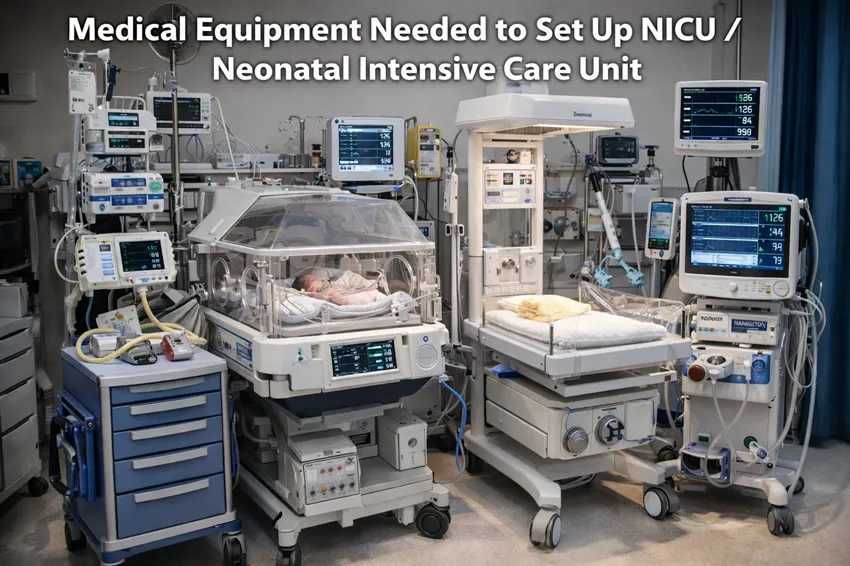
A well-equipped NICU not only improves survival rates but
also reduces long-term complications and provides parents with reassurance
during an emotionally challenging time. In this detailed guide, we walk you
through the essential medical equipment needed to set up a NICU, along with
their functions and importance.
What Is a NICU (Neonatal Intensive Care Unit)?
A NICU is a specialized unit within a hospital dedicated to
providing intensive medical care to newborns, especially those born prematurely
or with health complications such as respiratory distress, infections,
congenital disorders, or birth asphyxia.
NICUs operate 24/7 and are staffed by neonatologists,
paediatric nurses, respiratory therapists, and trained support staff. However,
even the most skilled professionals rely heavily on advanced neonatal medical
equipment to deliver effective care.
Importance of Proper NICU Setup
- Supports
fragile newborns during critical early days
- Enables
accurate monitoring of vital parameters
- Prevents
hypothermia and infections
- Improves
survival and recovery outcomes
- Meets
regulatory and accreditation standards
A poorly equipped NICU can compromise patient safety, making
equipment selection a top priority.
Essential Medical Equipment Required to Set Up a NICU
1. Radiant Warmer
A radiant warmer helps maintain a newborn’s body temperature
immediately after birth and during procedures. Newborns, especially preterm
babies, lose heat rapidly and are unable to regulate body temperature
effectively.
Key functions:
- Prevents
hypothermia
- Allows
easy access for medical procedures
- Often
equipped with temperature sensors and alarms
2. Neonatal Incubator
An incubator provides a controlled environment for premature
babies, regulating temperature, humidity, and sometimes oxygen levels.
Why it’s essential:
- Mimics
the womb environment
- Reduces
infection risk
- Supports
weight gain and growth
3. Phototherapy Machine
Phototherapy units are used to treat neonatal jaundice by
reducing bilirubin levels in the blood using specific light wavelengths.
Benefits:
- Non-invasive
treatment
- Prevents
complications like kernicterus
- Safe
and effective for newborns
4. Bubble CPAP (Continuous Positive Airway Pressure)
Bubble CPAP is commonly used for newborns with breathing
difficulties. It delivers constant air pressure to keep the lungs open.
Advantages:
- Reduces
need for invasive ventilation
- Improves
oxygenation
- Cost-effective
respiratory support
5. Neonatal Ventilator
For babies who cannot breathe adequately on their own, a
neonatal ventilator provides life-saving respiratory support.
Features to look for:
- Gentle
ventilation modes
- Precise
oxygen delivery
- Alarms
for pressure and volume changes
6. Infusion Pumps and Syringe Pumps
These pumps ensure accurate and controlled delivery of
fluids, medications, and nutrition.
Why accuracy matters:
- Newborns
require extremely precise dosages
- Prevents
overdose or underdose
- Supports
long-term IV therapy
7. Oxygen Hoods
Oxygen hoods provide supplemental oxygen to newborns who
need respiratory support without invasive methods.
Benefits:
- Comfortable
for infants
- Allows
controlled oxygen concentration
- Useful
for mild to moderate respiratory distress
8. Neonatal Patient Monitors
Continuous monitoring is vital in a NICU. Neonatal monitors
track heart rate, oxygen saturation (SpO₂), respiration, and blood pressure.
Importance:
- Early
detection of complications
- Continuous
real-time data
- Alarm
systems for emergencies
9. Transport Ventilator
A transport ventilator is essential when critically ill
newborns need to be moved within or between hospitals.
Use cases:
- Intra-hospital
transfers
- Ambulance
or air transport
- Emergency
referrals
10. Transport Incubator
A transport incubator ensures that newborns remain warm and
stable during transfer.
Key features:
- Battery-operated
systems
- Shock
absorption
- Integrated
monitoring and oxygen support
Additional NICU Equipment and Supplies
- Neonatal
suction machines
- Pulse
oximeters
- Blood
gas analyzers
- Resuscitation
equipment
- IV
stands and tubing
- Sterilization
and infection control supplies
Safety, Compliance, and Quality Standards
When setting up a NICU, ensure:
- Equipment
meets national and international standards
- Regular
calibration and maintenance
- Availability
of backup power supply
- Proper
staff training
Reliable healthcare platforms like Aarogyaa Bharat support
hospitals by providing access to quality-certified neonatal medical equipment
and essential healthcare solutions.
Factors to Consider When Purchasing NICU Equipment
- Equipment
reliability and accuracy
- Ease
of use and maintenance
- Availability
of service support
- Cost-effectiveness
- Scalability
for future expansion
Frequently Asked Questions (FAQs)
Q1. Is it mandatory to have all equipment in a NICU?
Yes, essential equipment is required to ensure complete neonatal care and meet
safety standards.
Q2. Can small hospitals set up a basic NICU?
Yes, with essential equipment and trained staff, a Level II NICU can be
established.
Q3. How often should NICU equipment be serviced?
Regular preventive maintenance and calibration are critical for patient safety.
Q4. Can NICU equipment be rented or refurbished?
Some equipment may be rented or refurbished, provided it meets quality and
safety standards.
Conclusion
Setting up a Neonatal Intensive Care Unit is a life-saving
investment that demands careful planning, reliable equipment, and a commitment
to quality care. Each piece of NICU equipment from radiant warmers to transport
incubators plays a vital role in supporting the fragile lives entrusted to the
healthcare system. By choosing certified, high-quality medical equipment and
following best practices, hospitals can create a NICU that truly makes a
difference.
Because every newborn deserves the best possible start to
life.