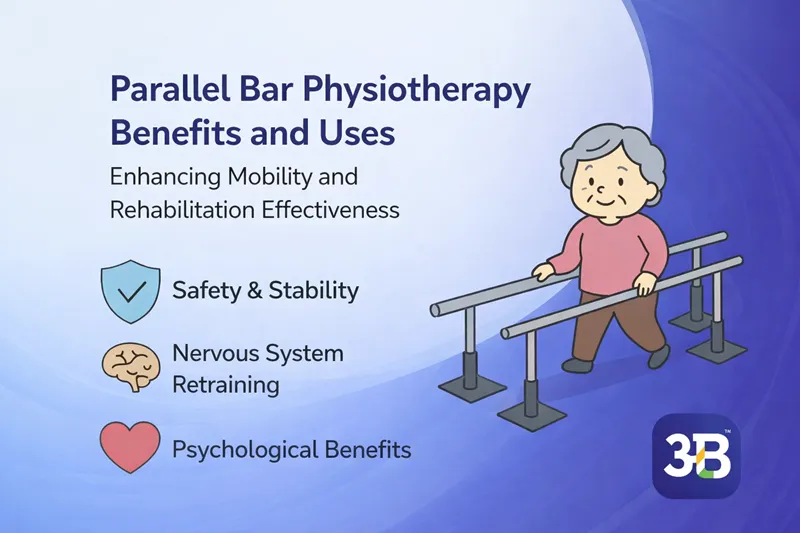
What Is a Parallel Bar in Physiotherapy and Why It Is
Important in Rehabilitation
Parallel bars are supportive rehabilitation structures
consisting of two horizontal rails fixed at adjustable heights, designed to
provide stability and balance assistance during walking practice, standing
exercises, and physiotherapy training. These bars are commonly used by
physiotherapists to help patients regain confidence in movement after injuries,
surgeries, strokes, spinal cord conditions, or age-related weakness, allowing
individuals to practice weight-bearing activities without the fear of falling.
The controlled environment created by parallel bars allows therapists to guide
posture correction, muscle strengthening, and gait retraining while ensuring
patient safety throughout the rehabilitation process. In home healthcare
settings across India, families increasingly install compact parallel bar
systems to support long-term physiotherapy routines for elderly individuals or
patients recovering from orthopaedics procedures. Unlike walkers or mobility
aids that move with the patient, parallel bars provide a fixed support
structure that promotes correct walking mechanics and gradual muscle
activation, making them an essential tool in early-stage rehabilitation. Their
simplicity, durability, and adaptability make them suitable for both clinical
environments and home physiotherapy setups supported by Aarogyaa Bharat’s range
of rehabilitation equipment.
Key Benefits of Using Parallel Bar Physiotherapy for
Patients and Caregivers
One of the most significant benefits of parallel bar
physiotherapy is the ability to rebuild walking confidence in a controlled and
secure environment, which is particularly important for patients who feel
anxious after experiencing falls or surgeries. The bars provide bilateral
support, allowing patients to distribute weight evenly and focus on improving
posture, balance, and coordination during therapy sessions. For elderly
patients or individuals recovering from stroke, parallel bars reduce the risk of
injury by offering stable hand support that prevents sudden loss of balance.
Caregivers also benefit from the structured support system because they can
assist patients without needing to physically bear the entire body weight,
reducing strain and improving safety during rehabilitation exercises. Regular
use of parallel bars encourages gradual strengthening of leg muscles, improved
joint flexibility, and enhanced proprioception, which refers to the body’s
ability to sense movement and position. Over time, consistent therapy sessions
can help patients transition from assisted walking to independent mobility,
improving confidence and overall quality of life. In Indian home care
environments where professional physiotherapy sessions may not always be
accessible daily, parallel bars allow families to maintain continuity of
rehabilitation between clinical visits.
Table: Parallel Bar Physiotherapy Benefits by Patient
Condition
|
Patient
Condition |
Benefit of
Parallel Bars |
Rehabilitation
Outcome |
|
Stroke
Recovery |
Supports gait
training |
Improves
walking confidence |
|
Post-Surgery
Rehab |
Allows
gradual weight bearing |
Reduces
injury risk |
|
Parkinson’s
Disease |
Stabilizes
balance training |
Enhances
coordination |
|
Elderly
Weakness |
Prevents
falls during exercise |
Builds muscle
strength |
|
Spinal Injury
Recovery |
Enables
controlled movement practice |
Supports
mobility progression |
Common Uses of Parallel Bars in Physiotherapy and Home
Rehabilitation
Parallel bars are used for a wide variety of rehabilitation
activities, ranging from basic standing exercises to advanced gait retraining
programs tailored to individual patient needs. One of the primary uses is
assisted walking practice, where patients learn to shift weight from one leg to
another while maintaining balance through the bars. Physiotherapists often
incorporate exercises such as step training, side walking, and posture
correction to improve stability and strengthen lower body muscles. For patients
recovering from knee or hip surgery, parallel bars provide a safe environment
to begin movement without placing excessive stress on healing joints.
Neurological rehabilitation programs frequently rely on parallel bars to
retrain motor patterns affected by stroke or nerve damage, helping patients
regain coordination through repetitive guided movement. In home settings,
families use parallel bars to support daily exercise routines that maintain
mobility and prevent muscle stiffness, especially for elderly individuals who
may not attend physiotherapy clinics regularly. Because the bars are
adjustable, they can accommodate different heights and therapy stages, making
them a versatile investment for long-term rehabilitation needs.
Table: Parallel Bar Exercises and Their Rehabilitation
Goals
|
Exercise
Type |
Description |
Therapy
Goal |
|
Assisted
Walking |
Slow walking
between bars |
Improves gait
pattern |
|
Sit-to-Stand
Practice |
Using bars to
stand safely |
Builds leg
strength |
|
Side Stepping |
Moving
sideways along bars |
Enhances
balance control |
|
Heel-to-Toe
Training |
Practicing
step alignment |
Improves
coordination |
|
Static
Standing |
Holding bars
while standing |
Builds
endurance |
Safety Advantages of Parallel Bar Physiotherapy Compared
to Other Mobility Aids
Unlike walkers or canes that move along with the patient and
may create instability if not used correctly, parallel bars remain fixed in
place, providing a secure support system that allows patients to focus entirely
on movement training rather than balancing equipment. This fixed structure is
especially beneficial for individuals in early rehabilitation stages who may
lack the strength or coordination required to manage mobile aids safely. The
ability to adjust bar height ensures proper ergonomic alignment, reducing
strain on shoulders and wrists while promoting natural walking posture. Many
parallel bar systems also feature anti-slip bases and sturdy metal frames that
enhance stability even during intensive therapy sessions. For caregivers,
parallel bars reduce the physical effort required to assist patients because
the equipment absorbs much of the body weight support, allowing therapy to be
performed safely at home without specialized lifting equipment. In India’s
growing home healthcare landscape, these safety advantages make parallel bars a
preferred choice for families seeking reliable rehabilitation solutions that
minimize the risk of falls.
Who Should Consider Using Parallel Bars at Home for
Physiotherapy
Parallel bars are particularly beneficial for elderly
patients experiencing balance issues, individuals recovering from orthopaedic
surgeries, stroke survivors undergoing neurological rehabilitation, and
patients with chronic mobility challenges who require consistent physical
therapy. Families caring for loved ones with Parkinson’s disease, spinal
injuries, or muscle weakness often find that having parallel bars at home
encourages regular exercise and faster recovery progress. Children undergoing
physical therapy for developmental conditions may also benefit from adjustable
parallel bar systems under professional supervision, as they provide a safe
space for practicing movement skills. In Indian homes where space
considerations are important, compact foldable parallel bars offer flexibility
without compromising functionality, allowing therapy equipment to integrate
seamlessly into daily living environments. Choosing high-quality physiotherapy
equipment through Aarogyaa Bharat ensures durability, safety compliance, and
long-term usability, making parallel bars a practical investment for ongoing
rehabilitation needs.
How Parallel Bar Physiotherapy Supports Long-Term
Mobility and Independence
One of the most powerful aspects of parallel bar physiotherapy is its ability to transition patients from assisted movement to independent walking over time, creating a structured pathway toward regained mobility and confidence. By providing consistent support during early rehabilitation stages, the bars help patients overcome fear of falling and focus on rebuilding strength gradually. As muscle control improves, therapy sessions can incorporate more advanced exercises that challenge balance and coordination, encouraging patients to rely less on external support. Many physiotherapists emphasize the importance of repetitive practice, and parallel bars offer a stable platform for performing these exercises safely without interruption. Over weeks and months of regular use, patients often experience improved posture, stronger leg muscles, and greater endurance during daily activities such as standing, walking, or climbing stairs. For elderly individuals aiming to maintain independence within their homes, parallel bar physiotherapy can be a transformative tool that promotes active living while reducing reliance on constant caregiver assistance.