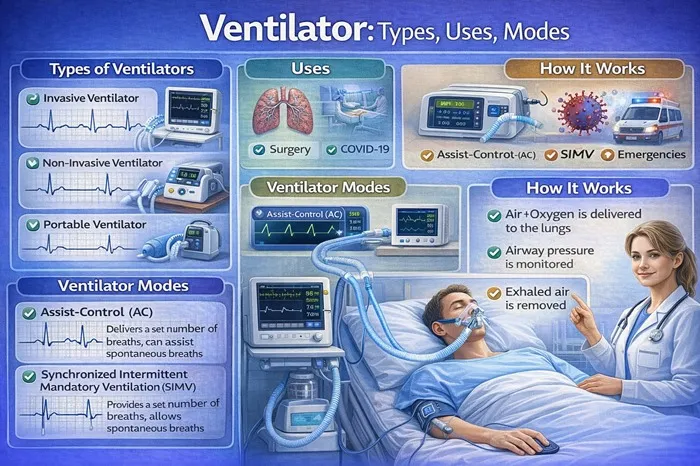
What Is a Ventilator?
A ventilator is a medical device that supports or replaces a
patient’s natural breathing. It delivers oxygen-rich air into the lungs and
helps remove carbon dioxide from the body.
A patient may need a ventilator when:
- Breathing
is too weak or irregular
- Oxygen
levels cannot be maintained
- Carbon
dioxide builds up in the blood
- The
body is under extreme stress
Ventilators can be used short-term (during surgery or acute
illness) or long-term (in chronic respiratory failure).
Why Ventilators Are So Important
Ventilators are not just machines they are bridges between
life and recovery.
They help by:
- Maintaining
oxygen delivery to vital organs
- Reducing
the effort required to breathe
- Preventing
organ damage due to low oxygen
- Allowing
time for treatment of the underlying disease
Without ventilatory support, many critically ill patients
would not survive.
Common Medical Conditions That Require Ventilators
Ventilators are used in a wide range of conditions,
including:
- Severe
pneumonia
- Acute
respiratory distress syndrome (ARDS)
- Chronic
obstructive pulmonary disease (COPD) exacerbation
- COVID-19
and other viral respiratory illnesses
- Severe
asthma attacks
- Stroke
or brain injury affecting breathing control
- Major
trauma or chest injury
- During
general anaesthesia in surgery
How Does a Ventilator Work? (Simple Explanation)
Under normal conditions, breathing is controlled
automatically by the brain. A ventilator supports or replaces this process.
Basic Working of a Ventilator
- Air/Oxygen
Delivery
The ventilator pushes air (often mixed with oxygen) into the lungs. - Pressure
or Volume Control
It controls how much air enters the lungs and at what pressure. - Breath
Cycles
The ventilator delivers breaths at a set rate or in sync with the patient’s own breathing. - Exhalation
Carbon dioxide-rich air is allowed to leave the lungs. - Monitoring
and Alarms
The machine continuously monitors breathing parameters and alerts staff to problems.
The goal is to support breathing safely without causing lung
injury.
Main Components of a Ventilator
Although designs vary, most ventilators include:
- Air
and oxygen supply system
- Control
panel and display
- Breathing
circuit (tubing)
- Humidifier
(to warm and moisten air)
- Alarms
and monitoring sensors
Each component ensures precise and safe ventilation.
Types of Ventilators
Ventilators are classified based on where they are used and
how they deliver breathing support.
1. Invasive Ventilators
These require an artificial airway, such as:
- Endotracheal
tube (through the mouth)
- Tracheostomy
tube (through the neck)
Used In
- Intensive
Care Units (ICUs)
- Emergency
situations
- Long-term
ventilation
Key Feature
Provides full control over breathing.
2. Non-Invasive Ventilators (NIV)
These deliver breathing support without inserting a tube.
Common Interfaces
- Face
mask
- Nasal
mask
Used In
- COPD
exacerbations
- Sleep
apnea
- Mild
to moderate respiratory failure
Advantage
Lower risk of infection and more patient comfort.
3. ICU Ventilators
Advanced, highly precise machines used in critical care.
Features
- Multiple
ventilation modes
- Detailed
monitoring
- High
safety standards
4. Transport Ventilators
Portable ventilators used during patient transfer.
Used In
- Ambulances
- Air
medical transport
- Inter-hospital
transfers
5. Neonatal and Paediatric Ventilators
Specially designed for infants and children.
Key Feature
- Very
precise volume and pressure control
Modes of Ventilation (Simplified for Understanding)
Ventilator modes define how breaths are delivered and how
much effort comes from the patient versus the machine.
1. Volume-Controlled Ventilation (VCV)
- A
fixed volume of air is delivered with each breath
- Pressure
may vary
Used when: Precise air volume is critical
2. Pressure-Controlled Ventilation (PCV)
- A
fixed pressure is applied
- Volume
varies depending on lung condition
Used when: Lung protection is a priority
3. Assist-Control Ventilation (AC)
- Ventilator
delivers breaths at a set rate
- Also
assists patient-initiated breaths
Common in: ICU patients
4. SIMV (Synchronized Intermittent Mandatory Ventilation)
- Combines
mandatory breaths with spontaneous breathing
- Helps
in weaning from ventilator
5. Pressure Support Ventilation (PSV)
- Patient
initiates breaths
- Ventilator
provides extra support
Used during: Recovery and weaning phase
6. CPAP and BiPAP (Non-Invasive Modes)
- CPAP:
Constant pressure to keep airways open
- BiPAP:
Different pressures for inhalation and exhalation
Commonly used in sleep apnea and respiratory failure.
Uses of Ventilators in Different Settings
- Emergency
rooms: Immediate life support
- ICUs:
Continuous respiratory management
- Operation
theatres: Controlled breathing during anaesthesia
- Home
care: Long-term respiratory support
- Neonatal
units: Premature or sick newborns
Risks and Complications of Ventilator Use
While ventilators save lives, prolonged use can have risks:
- Lung
injury from high pressure
- Infections
like ventilator-associated pneumonia
- Muscle
weakness
- Difficulty
in weaning
That’s why ventilators are used only when medically
necessary and closely monitored.
Weaning Off a Ventilator
Weaning means gradually reducing ventilator support.
Doctors assess:
- Lung
recovery
- Oxygen
levels
- Breathing
strength
- Overall
medical stability
Successful weaning is a major milestone in recovery.
Ventilators in Home Care
Some patients with chronic conditions require long-term
ventilator support at home.
Home ventilators are:
- Compact
- User-friendly
- Designed
for safety
Caregivers receive proper training to manage them.
Conclusion
A ventilator is one of the most critical life-support
machines in modern medicine. From emergency care to intensive care and even
home settings, ventilators help sustain life when the body cannot breathe on
its own.
Understanding ventilator types, uses, modes, and working
principles removes fear and confusion especially for patients and families
facing critical illness. Ventilators are not about replacing life, but about
protecting it while healing takes place.
At Aarogyaa Bharat, we are committed to making medical
knowledge clear, compassionate, and accessible so everyone can understand the
tools that save lives when it matters most.