When hospitals or diagnostic centers plan to purchase an MRI
system, one question dominates every discussion:
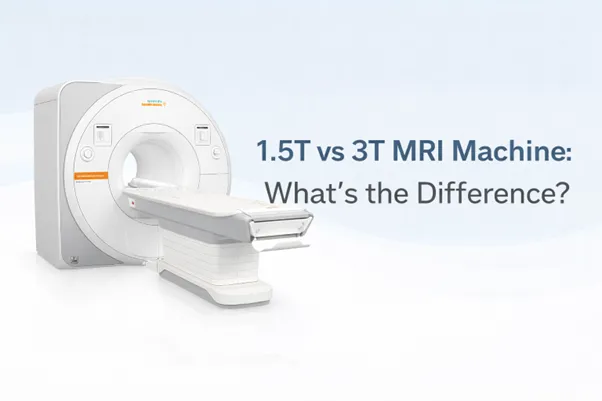
Should we choose a 1.5 Tesla MRI or a 3 Tesla MRI machine?
Both are high-end imaging systems, but they differ
significantly in magnetic strength, image quality, scan speed, clinical
applications, cost, infrastructure needs, and patient suitability.
At Aarogyaa Bharat, we help healthcare institutions make
ROI-driven, clinically appropriate imaging decisions. This in-depth guide
explains the difference between 1.5T and 3T MRI machines, covering technology,
advantages, limitations, clinical use cases, cost considerations, and FAQs.
What Is an MRI Machine? (Quick Overview)
An MRI (Magnetic Resonance Imaging) machine uses a strong
magnetic field, radiofrequency waves, and computer processing to create highly
detailed images of organs and tissues inside the body.
Unlike X-rays or CT scans, MRI:
- Does
not use ionizing radiation
- Provides
excellent soft tissue contrast
- Is
ideal for neurological, orthopaedic, cardiac, and oncological imaging
MRI machine
What Does “Tesla (T)” Mean in MRI?
The term Tesla (T) refers to the strength of the magnetic
field generated by the MRI machine.
- 1.5
Tesla MRI = 1.5T magnetic field
- 3
Tesla MRI = 3T magnetic field (twice as strong)
A stronger magnetic field generally means:
Higher signal strength
Better image resolution
Faster scans
But higher strength also comes with greater complexity and
cost.
Tesla MRI meaning
Overview: 1.5T vs 3T MRI Machines
|
Feature |
1.5T MRI |
3T MRI |
|
Magnetic
Strength |
Medium |
High |
|
Image
Resolution |
High |
Very High |
|
Scan Speed |
Moderate |
Faster |
|
Cost |
Lower |
Higher |
|
Power
Consumption |
Lower |
Higher |
|
Clinical
Versatility |
Excellent |
Advanced/Specialized |
1.5 Tesla MRI Machine: Detailed Overview
The 1.5T MRI machine is the global workhorse of MRI imaging
and remains the most widely installed MRI system worldwide.
Key Characteristics
- Stable
magnetic field
- Excellent
image quality
- Broad
clinical acceptance
- Proven
technology
Clinical Applications of 1.5T MRI
- Brain
MRI
- Spine
MRI
- Joint
& musculoskeletal imaging
- Abdominal
imaging
- Pelvic
imaging
- Cardiac
MRI (standard protocols)
1.5T MRI is sufficient for 90%+ routine clinical cases.
Advantages of 1.5T MRI
Reliable and consistent imaging
Lower artifact issues
Suitable for most implants
Better patient comfort
Lower installation and operating costs
Limitations of 1.5T MRI
Slightly lower resolution than 3T
Longer scan times for advanced protocols
Limited in ultra-high-detail neuro imaging
1.5 Tesla MRI in Hospital
3 Tesla MRI Machine: Detailed Overview
The 3T MRI machine offers double the magnetic field
strength, resulting in higher signal-to-noise ratio (SNR) and superior image
detail.
Clinical Applications of 3T MRI
- Advanced
neuroimaging
- Functional
MRI (fMRI)
- Epilepsy
and stroke evaluation
- High-resolution
angiography
- Advanced
musculoskeletal imaging
- Research
and academic studies
Advantages of 3T MRI
Exceptional image clarity
Faster scan times
Improved detection of small lesions
Better functional and vascular imaging
Ideal for research and super-specialty hospitals
Limitations of 3T MRI
Higher cost (purchase + maintenance)
Increased susceptibility to artifacts
Higher acoustic noise
Not suitable for some implants
Greater power and cooling requirements
3 Tesla MRI Advanced Imaging
Image Quality Comparison: 1.5T vs 3T
|
Aspect |
1.5T MRI |
3T MRI |
|
Signal-to-Noise
Ratio |
Good |
Excellent |
|
Spatial
Resolution |
High |
Ultra-high |
|
Small Lesion
Detection |
Good |
Superior |
|
Artifact
Sensitivity |
Lower |
Higher |
In real-world practice, radiologist expertise often matters
more than raw Tesla strength.
Scan Speed & Patient Throughput
- 3T
MRI can complete certain scans 30-40% faster
- Faster
scans improve patient comfort and throughput
- However,
protocol optimization is required
For high-volume centers, 3T may offer operational
advantages.
Patient Safety & Comfort Considerations
1. Acoustic Noise
- 3T
MRI is noisier
- Requires
better ear protection
2. Claustrophobia
- Both
machines use similar bore sizes
- Comfort
depends more on machine design
3. Implant Compatibility
- 1.5T
MRI is compatible with more implants
- Some
implants are not approved for 3T
Infrastructure & Installation Requirements
|
Requirement |
1.5T MRI |
3T MRI |
|
Room Size |
Moderate |
Larger |
|
RF Shielding |
Standard |
Advanced |
|
Cooling
System |
Moderate |
Heavy-duty |
|
Power Load |
Lower |
Higher |
|
Installation
Cost |
Lower |
Higher |
MRI installation requirements
Cost Comparison & ROI
Approximate Cost Difference
- 1.5T
MRI: Lower acquisition & AMC cost
- 3T
MRI: 30-60% higher overall cost
ROI Consideration
- 1.5T
MRI → Faster ROI, wider patient base
- 3T
MRI → Higher revenue per scan, niche diagnostics
For many centers, 1.5T offers better cost-to-benefit
balance.
Which MRI Machine Should You Choose?
Choose 1.5T MRI If:
You are a general hospital or diagnostic centre
You handle routine imaging
Budget and ROI matter
You need broad implant compatibility
Choose 3T MRI If:
You are a super-specialty or academic centre
You perform advanced neuro or research imaging
You have high-end referral cases
Budget and infrastructure are not constraints
Future Trends in MRI Technology
- AI-assisted
image reconstruction
- Faster
sequences
- Silent
MRI technology
- Wide-bore
and patient-friendly designs
- Hybrid
imaging systems
Tesla strength is important but smart imaging is the future.
Conclusion
The choice between 1.5T and 3T MRI machines is not about
which is “better” but which is more appropriate for your clinical objectives,
patient profile, and business model.
- 1.5T
MRI offers versatility, affordability, and reliability
- 3T
MRI delivers cutting-edge detail for specialized applications
At Aarogyaa Bharat, we recommend aligning MRI investment
with clinical demand, referral patterns, and long-term ROI, ensuring
sustainable growth and diagnostic excellence.