Why Healthcare Business Models Cannot Follow Conventional
Commerce Logic
Unlike traditional consumer businesses, healthcare cannot be
optimized purely for speed, margins, or volume. Every operational decision
influence recovery outcome, caregiver stress, and emotional stability within
households. In India, many healthcare-related businesses failed because they
applied retail or marketplace logic to deeply sensitive care situations.
Aarogyaa Bharat was built on the understanding that healthcare requires
patience, predictability, and ethical alignment. Its business model is designed
to support trust over time rather than extracting short-term value during
emergencies. This fundamental distinction separates sustainable healthcare
platforms from opportunistic sellers.
The Deep Fragmentation of India’s Home Healthcare Market
India’s home healthcare market evolved in silos. Medical
equipment suppliers, rental providers, logistics partners, and caregivers
functioned independently without coordination. Families were forced to act as
project managers during moments of medical stress, juggling vendors,
negotiating prices, and managing quality risks without expertise. This
fragmentation created inefficiencies, increased costs, and led to frequent care
breakdowns. Aarogyaa Bharat’s business model exists specifically to resolve this
fragmentation by centralizing coordination, standardizing service delivery, and
absorbing operational complexity so families do not have to.
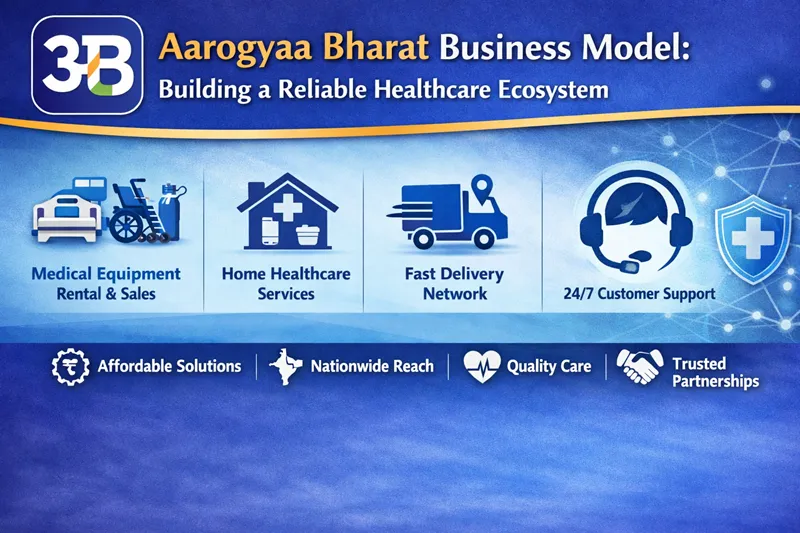
Ecosystem Thinking as the Core of Aarogyaa Bharat’s Model
Aarogyaa Bharat does not treat itself as a seller of
equipment but as an ecosystem orchestrator. The business is designed around the
idea that home healthcare only works when equipment access, logistics,
installation, and support function together seamlessly. Instead of optimizing
individual components in isolation, the model ensures that each element
reinforces the others. This ecosystem-first thinking creates resilience,
because failures in one area are absorbed and corrected within the system
rather than cascading into patient harm.
Structural Pillars of the Aarogyaa Bharat Business Model
|
Pillar |
Strategic
Purpose |
|
Equipment
access |
Enable safe
care at home |
|
Rental-first
design |
Align cost
with care duration |
|
Logistics
& installation |
Ensure
usability and safety |
|
Maintain
continuity of care |
|
|
Trust-based
relationships |
Drive
long-term sustainability |
Rental-First Strategy as a Financial and Ethical
Innovation
One of the most critical innovations in Aarogyaa Bharat’s
business model is its rental-first approach. In healthcare, demand is often
temporary or unpredictable, making ownership inefficient and emotionally
driven. By prioritizing rentals, the platform aligns revenue generation with
real care timelines instead of exploiting urgency. This strategy reduces
financial stress for families while creating predictable, recurring revenue
streams for the business. The ethical advantage of this approach strengthens trust,
which in healthcare translates directly into long-term viability.
Aligning Revenue with Recovery, Not Vulnerability
Traditional healthcare commerce often monetizes
vulnerability by charging high prices during emergencies. Aarogyaa Bharat
deliberately rejects this approach. Its business model aligns revenue with
duration of use rather than emotional pressure. Families pay for what they use,
for as long as they use it, without fear of waste or regret. This alignment
transforms the customer relationship from adversarial to collaborative, where
both the platform and the family share the same goal: effective recovery.
Operational Reliability as a Revenue Driver, not a Cost
In healthcare, reliability is not an operational expense it
is the product itself. Aarogyaa Bharat invests in predictable delivery, correct
installation, and responsive support because operational failures directly
erode trust. This investment reduces churn, increases repeat usage, and
generates organic referrals. Over time, operational excellence becomes a
competitive moat that is difficult for fragmented vendors to replicate. The
business model treats reliability as a growth engine rather than a cost centre.
Designing Scalability Without Diluting Care Quality
Scaling healthcare businesses is uniquely challenging
because growth often introduces inconsistency. Aarogyaa Bharat addresses this
by standardizing processes rather than improvising services. Care pathways,
equipment categories, and support protocols are designed to scale uniformly
across geographies. This process-driven scalability ensures that expansion does
not compromise service quality. Growth strengthens the ecosystem instead of
weakening it, which is essential for long-term success in healthcare.
Trust as the Central Business Asset
Trust is not a marketing outcome for Aarogyaa Bharat; it is
a deliberate business asset. Transparent pricing, predictable processes, and
respectful communication are embedded into operations. Families who trust the
platform are more likely to return, recommend, and rely on it during future
healthcare needs. This trust-driven growth reduces dependency on aggressive
advertising and creates organic demand, lowering acquisition costs over time.
Value Creation Across the Healthcare Ecosystem
|
Stakeholder |
Value
Created |
|
Patients |
Safe,
dignified recovery at home |
|
Reduced
physical and emotional burden |
|
|
Families |
Financial
predictability and clarity |
|
Confident
discharge planning |
|
|
Healthcare
system |
Reduced
institutional strain |
Complementing Hospitals Instead of Competing with Them
Aarogyaa Bharat’s business model is intentionally
complementary to hospitals. Hospitals focus on diagnosis and acute treatment,
while Aarogyaa Bharat ensures continuity after discharge. This non-competitive
positioning allows hospitals to reduce inpatient load without compromising care
quality. Over time, this integration strengthens the entire healthcare delivery
chain rather than fragmenting it further.
Relationship-Centric Growth Over Transactional Sales
Healthcare needs recur across life stages. Aarogyaa Bharat
designs its model around long-term relationships rather than one-time
transactions. Families who experience reliable home care once are more likely
to return for future needs, increasing lifetime value organically. This
lifecycle-based approach creates sustainable growth without compromising
ethical responsibility.
Cost Efficiency Without Ethical Compromise
Healthcare businesses often face pressure to cut costs at
the expense of care quality. Aarogyaa Bharat avoids this trap by improving
efficiency through shared utilization, standardized logistics, and process
optimization rather than reducing service quality. Rentals allow equipment to
be used where it is needed most, improving capital efficiency while maintaining
safety standards.
Enabling India’s Shift Toward Distributed Healthcare
India’s healthcare future depends on distributed care rather
than centralized institutions. Aarogyaa Bharat’s business model supports this
shift by making homes viable care environments. By decentralizing recovery and
long-term care, the platform reduces systemic pressure while maintaining
consistency and safety. This alignment with national healthcare needs positions
Aarogyaa Bharat as infrastructure rather than just a service provider.
Long-Term Vision of the Aarogyaa Bharat Ecosystem
The long-term vision extends beyond equipment access into
building a dependable home healthcare infrastructure. As the ecosystem matures,
standardized care, reliable operations, and trusted relationships will allow
home healthcare to function as a permanent pillar of India’s healthcare system.
The business model is designed for resilience, not just growth.
Conclusion: A Business Model Built for Care, Not Just
Commerce