Understanding Mobility Challenges in Parkinson’s Disease
Parkinson’s disease affects the nervous system’s ability to regulate smooth and coordinated muscle movement, leading to symptoms such as tremors, muscle rigidity, bradykinesia (slow movement), shuffling gait, and freezing episodes where the individual temporarily feels unable to step forward. These symptoms significantly increase the risk of falls, especially during directional changes, uneven flooring, or sudden stops. Elderly individuals with Parkinson’s often develop a forward-leaning posture, shortened step length, and reduced arm swing, all of which compromise balance stability. In later stages, unpredictable freezing episodes may occur when approaching doorways or obstacles, causing sudden loss of momentum. Because the condition affects motor planning and coordination rather than pure muscle strength alone, mobility support must address both stability and movement cueing. A properly selected walker provides bilateral support, enhances weight distribution, and offers structured assistance that improves gait rhythm while reducing the psychological fear of falling. Selecting a walker tailored to Parkinson’s mobility patterns is therefore essential for maintaining safety and independence.
Why Standard Walkers May Not Be Enough
While standard walkers provide basic frame support, they may not adequately address the specific gait disturbances associated with Parkinson’s disease, particularly freezing of gait and impaired stride initiation. Traditional walkers require lifting with each step, which may be difficult for individuals experiencing bradykinesia or tremors. Additionally, narrow frames and lack of visual cueing can limit effectiveness during freezing episodes. Parkinson’s patients often benefit more from rollator-style walkers equipped with larger wheels, smooth gliding mechanisms, and cue-based assistance systems. Some advanced models include laser lines or rhythmic cueing features that visually stimulate forward stepping, helping overcome freezing moments. Moreover, standard walkers may not offer sufficient brake responsiveness or stability during sudden stops, increasing fall risk. Therefore, selecting a mobility aid specifically suited to neurological gait disturbances enhances both safety and functionality for elderly Parkinson’s patients.
Key Features to Look for in a Parkinson’s Walker
| Feature | Why It Matters |
|---|---|
| Four-Wheel Rollator Design | Provides smooth forward movement without lifting |
| Laser or Visual Cueing System | Helps overcome freezing episodes |
| Hand Brakes with Easy Grip | Supports controlled stopping |
| Wide Base Frame | Enhances lateral stability |
| Adjustable Height | Maintains upright posture |
| Seat with Backrest | Allows safe resting during fatigue |
Walkers designed for Parkinson’s care often incorporate features that encourage rhythmic stepping and controlled movement, reducing instability and promoting confidence.
How Walkers Improve Gait and Stability
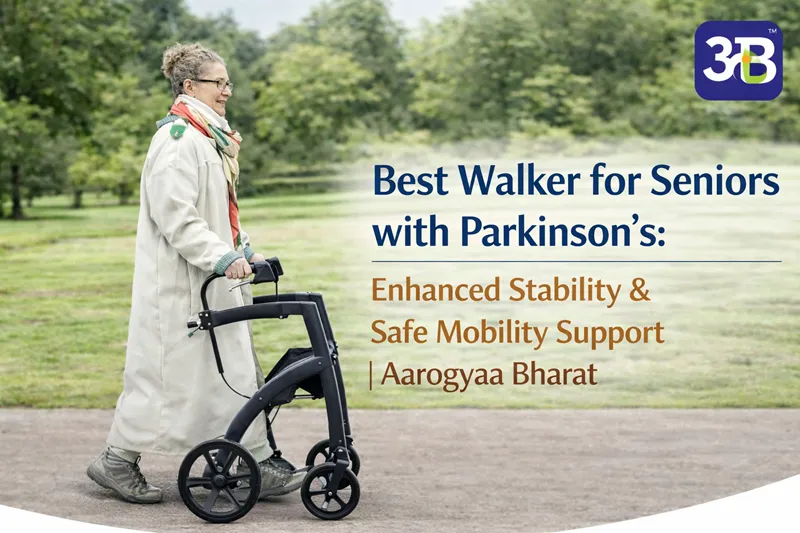
A properly selected walker stabilizes the center of gravity by widening the base of support and distributing body weight evenly across both arms, which reduces forward leaning and improves posture alignment during movement. Rollators with large wheels glide smoothly over uneven surfaces, minimizing the need for lifting and reducing muscle strain. Visual cueing features, such as laser lines projected on the floor, stimulate the brain’s movement planning centers and encourage forward stepping during freezing episodes. Additionally, ergonomic hand grips reduce tremor-related grip fatigue while responsive brake systems ensure immediate stopping control. By improving step length, reducing shuffling, and supporting rhythmic walking patterns, walkers help restore a more natural gait flow. These benefits significantly decrease fall risk and increase the user’s confidence when navigating indoor and outdoor environments.
Safety Considerations for Indoor and Outdoor Use
When selecting a walker for a Parkinson’s patient, environmental factors must be considered carefully, as uneven pavements, door thresholds, carpets, and crowded spaces can trigger instability. For indoor use, compact rollators with smooth maneuverability are ideal, while outdoor use requires larger wheels capable of handling uneven terrain. Brake systems must be easy to engage without excessive hand strength, as tremors or rigidity may affect grip control. The walker should also include a secure locking mechanism for safe seated rest breaks. Regular maintenance of wheels and brake cables is essential to ensure consistent performance. Caregivers should provide initial supervised training to help the user adapt to walker use, especially during turns and obstacle navigation. Choosing the correct walker configuration reduces environmental risk factors and promotes safer daily mobility.
Comparing Walker Types for Parkinson’s Patients
| Walker Type | Suitability for Parkinson’s | Stability Level |
|---|---|---|
| Standard Folding Walker | Limited | Moderate |
| Two-Wheel Walker | Basic support | Moderate |
| Four-Wheel Rollator | Highly recommended | High |
| Rollator with Laser Cue | Best for freezing episodes | Very High |
| Heavy-Duty Rollator | For higher weight users | High |
Rollators with visual cueing systems are often the most beneficial for managing freezing of gait and improving mobility rhythm.
Impact on Independence and Quality of Life
Mobility challenges associated with Parkinson’s disease often lead to reduced physical activity, social withdrawal, and psychological fear of falling, which can accelerate functional decline. Introducing a properly designed walker restores confidence, encourages safe ambulation, and supports active daily participation. The ability to move independently within the home and community enhances mental well-being and reduces caregiver burden. Structured mobility support also helps maintain muscle tone, joint flexibility, and cardiovascular health. Over time, consistent use of a suitable walker can delay complications related to immobility and significantly improve overall quality of life for elderly individuals living with Parkinson’s disease.
Conclusion
Choosing the right walker for elderly individuals with Parkinson’s disease requires careful evaluation of gait patterns, freezing episodes, stability needs, and environmental factors. Rollators with smooth gliding wheels, wide base support, responsive brakes, and visual cueing systems provide the most comprehensive mobility assistance. By addressing both neurological and mechanical mobility challenges, the correct walker enhances safety, reduces fall risk, and promotes long-term independence. Aarogyaa Bharat offers mobility solutions designed to support elderly individuals with neurological conditions through durable, safety-focused walker options.