Understanding BiPAP Therapy (Quick Overview)
A BiPAP (Bilevel Positive Airway Pressure) machine is a
non-invasive ventilation device that delivers two levels of air pressure:
- IPAP
(Inspiratory Positive Airway Pressure) - higher pressure during inhalation
- EPAP
(Expiratory Positive Airway Pressure) - lower pressure during exhalation
BiPAP therapy helps patients who struggle to breathe out
against continuous pressure, making it ideal for more severe or complex
respiratory conditions.
BiPAP machine, BiPAP therapy
What Is an Oxygen Concentrator?
An oxygen concentrator is a medical device that:
- Draws
in room air
- Removes
nitrogen
- Delivers
concentrated oxygen (usually 90-95%)
It is commonly prescribed when a patient’s SpO₂ levels fall
below normal ranges, even with assisted ventilation.
oxygen concentrator
Why Some Patients Need BiPAP + Oxygen Together
BiPAP improves ventilation (movement of air in and out of
lungs), while oxygen concentrators improve oxygenation (oxygen level in blood).
Some patients suffer from both problems simultaneously.
Common Conditions Requiring Combined Therapy
- COPD
with hypoxemia
- Severe
obstructive sleep apnea
- Obesity
hypoventilation syndrome
- Interstitial
lung disease
- Neuromuscular
disorders
- Post-ICU
or post-COVID lung damage
In such cases, BiPAP alone may not maintain adequate oxygen
saturation, making oxygen supplementation necessary.
So, Can You Use a BiPAP Machine with an Oxygen
Concentrator?
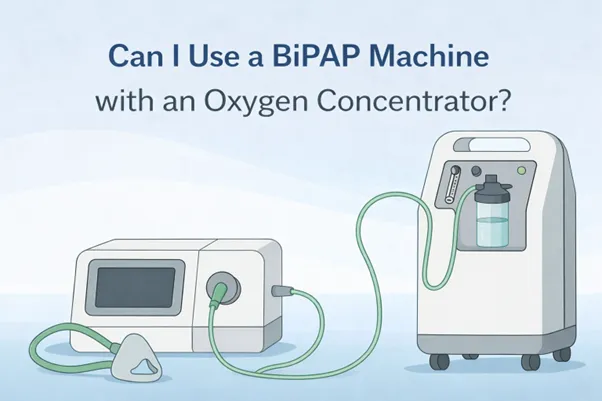
Yes, BiPAP machines CAN be used with oxygen concentrators,
provided:
- The
BiPAP machine supports oxygen entrainment
- Oxygen
flow is prescribed by a doctor
- Proper
connectors and setup are used
- Continuous
monitoring is done
This combination is widely used in hospitals, ICUs, and
home-care settings.
BiPAP with oxygen concentrator
Home Setup: BiPAP + Oxygen
How to Connect an Oxygen Concentrator to a BiPAP Machine
There are two common methods, depending on the BiPAP model.
Method 1: Using Oxygen Port on BiPAP Machine
Many modern BiPAP machines have a dedicated oxygen inlet
port.
Steps:
- Connect
oxygen tubing from concentrator
- Insert
tubing into BiPAP oxygen port
- Set
prescribed oxygen flow (LPM)
- BiPAP
mixes oxygen with pressurized air
Most stable and recommended method
Method 2: Using Oxygen Bleed-In Adapter
If no built-in port is available, a bleed-in adapter is used
between:
- BiPAP
tubing and
- Mask
or humidifier
Oxygen concentration may vary with pressure changes.
Important: Doctor-Prescribed Oxygen Flow Matters
Oxygen flow is usually prescribed in liters per minute
(LPM).
Typical ranges:
- Mild
hypoxemia: 1-2 LPM
- Moderate
hypoxemia: 2-4 LPM
- Severe
cases: As per specialist advice
Never self-adjust oxygen flow without medical guidance.
oxygen flow with BiPAP
Benefits of Using BiPAP with Oxygen Concentrator
1. Improved Oxygen Saturation
- Maintains
healthy SpO₂ levels
- Reduces
breathlessness
2. Reduced Work of Breathing
- BiPAP
assists ventilation
- Oxygen
improves gas exchange
3. Better Sleep Quality
- Fewer
night-time awakenings
- Reduced
fatigue and morning headaches
4. Reduced Hospitalization
- Effective
home therapy
- Better
disease control
Comfortable Respiratory Therapy at Home
Is It Safe to Use BiPAP with Oxygen at Home?
Yes, if safety guidelines are followed.
Key Safety Precautions
- Use
only medical-grade oxygen concentrators
- Ensure
proper tubing connections
- Avoid
smoking or open flames nearby
- Keep
oxygen away from heat sources
- Regularly
monitor oxygen saturation
Potential Risks & Mistakes to Avoid
- Excess oxygen without prescription (risk of CO₂ retention)
- Loose tubing connections
- Incorrect mask fit causing leaks
- Poor machine maintenance
- Using non-compatible BiPAP models
Does BiPAP Reduce the Need for Oxygen?
In some patients:
- Yes,
over time, improved ventilation may reduce oxygen dependence
In others:
- Oxygen
requirement may remain long-term
Each patient’s condition is unique and progressive.
BiPAP + Oxygen vs CPAP + Oxygen
|
Aspect |
CPAP +
Oxygen |
BiPAP +
Oxygen |
|
Pressure
Levels |
Single |
Dual |
|
Severe COPD |
Limited |
Better |
|
CO₂ Retention |
Risk |
Lower |
|
Comfort |
Moderate |
Higher |
|
Clinical Use |
Mild cases |
Moderate-severe
cases |
Who Should NOT Combine BiPAP and Oxygen Without Caution?
Patients with:
- Chronic
CO₂ retention
- Certain
neuromuscular disorders
- Unmonitored
respiratory failure
These cases require strict medical supervision.
Maintenance Tips for Combined Therapy
- Clean
BiPAP mask and tubing daily
- Replace
filters regularly
- Check
oxygen tubing for kinks
- Service
machines annually
- Monitor
SpO₂ using pulse oximeter
Future Trends in Respiratory Home Care
- Smart
BiPAP machines with oxygen tracking
- Cloud-based
compliance monitoring
- AI-driven
therapy adjustments
- Portable
combined ventilator-oxygen systems
Home respiratory care is becoming smarter and safer.
Conclusion
Using a BiPAP machine with an oxygen concentrator is a
clinically proven and widely accepted therapy for patients who need both
ventilation support and oxygen supplementation. When used correctly, this
combination significantly improves breathing efficiency, oxygen levels, sleep
quality, and overall quality of life.
At Aarogyaa Bharat, we strongly advise that combined
BiPAP-oxygen therapy be:
Doctor-prescribed
Properly set up
Regularly monitored
This ensures maximum benefit with minimum risk, especially
in long-term home-care scenarios.