What Is Sleep Apnea? (Quick Recap)
Sleep apnea is a sleep disorder in which breathing
repeatedly stops and starts during sleep due to airway collapse or improper
brain signalling.
Common Symptoms
- Loud
snoring
- Choking
or gasping during sleep
- Excessive
daytime sleepiness
- Morning
headaches
- Poor
concentration
Untreated sleep apnea can be life-threatening over time.
What Is a CPAP Machine?
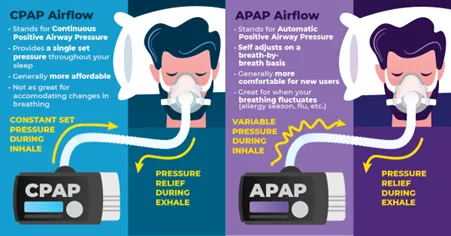
A CPAP (Continuous Positive Airway Pressure) machine
delivers a fixed, constant air pressure throughout the night to keep the airway
open.
How CPAP Works
- Doctor
determines a single pressure value (e.g., 8 or 10 cmH₂O)
- Machine
delivers the same pressure all night
- Prevents
airway collapse during sleep
CPAP machine
Advantages of CPAP Machine
- Proven and time-tested therapy
- Simple technology
- Lower cost than APAP
- Highly effective when pressure is correctly set
- Widely recommended by sleep specialists
Limitations of CPAP Machine
- Pressure remains constant even when not needed
- May feel uncomfortable during certain sleep stages
- Less adaptive to position or weight changes
- Some patients find exhalation difficult
CPAP Therapy at Home
What Is an APAP Machine?
An APAP (Automatic Positive Airway Pressure) machine
automatically adjusts air pressure throughout the night based on the patient’s
breathing pattern.
How APAP Works
- Uses
flow and pressure sensors
- Detects
apnea events, snoring, flow limitation
- Increases
pressure when needed
- Reduces
pressure when airway is stable
APAP machine
Advantages of APAP Machine
- Automatic pressure adjustment
- Greater comfort
- Lower average pressure exposure
- Adapts to sleep position and REM sleep
- Ideal for patients with variable pressure needs
Limitations of APAP Machine
- Higher cost than CPAP
- Not suitable for all apnea types
- Slight delay in pressure response
- Requires more advanced algorithms
APAP Automatic Sleep Therapy
Key Difference Between CPAP and APAP Machines
|
Feature |
CPAP |
APAP |
|
Pressure Type |
Fixed |
Auto-adjusting |
|
Comfort Level |
Moderate |
High |
|
Adaptability |
Low |
High |
|
Cost |
Lower |
Higher |
|
Doctor
Titration |
Mandatory |
Sometimes
optional |
|
Ideal for |
Stable apnea |
Variable
apnea |
|
Technology |
Simple |
Advanced |
Pressure Behaviour: CPAP vs APAP
- CPAP:
Delivers the same pressure whether you are on your back, side, or in REM
sleep
- APAP:
Increases pressure only when airway obstruction is detected
This makes APAP more comfortable for long-term therapy,
especially for sensitive users.
Who Should Use a CPAP Machine?
CPAP is ideal if:
- You have mild to moderate OSA
- Your pressure requirement is stable
- You want a budget-friendly solution
- You are comfortable with fixed pressure
- Your sleep study clearly defines pressure needs
Who Should Use an APAP Machine?
APAP is ideal if:
- Your pressure requirement varies
- You sleep in different positions
- You experience REM-related apnea
- You want maximum comfort
- You are using PAP therapy long-term
CPAP vs APAP in Home Care Settings
For home use, APAP machines are increasingly
preferred because:
- They
adapt automatically
- Reduce
discomfort
- Improve
therapy compliance
- Require
fewer pressure adjustments
However, CPAP remains a reliable and effective choice when
properly prescribed.
Cost Comparison: CPAP vs APAP
|
Aspect |
CPAP |
APAP |
|
Initial Cost |
Lower |
Higher |
|
Long-Term
Comfort |
Moderate |
High |
|
Need for
Re-Titration |
Possible |
Minimal |
|
Therapy
Dropout Risk |
Higher |
Lower |
Compliance & Patient Comfort
One of the biggest challenges in sleep therapy is patient
compliance.
Studies show:
- Patients
using APAP are more likely to continue therapy
- Lower
pressure exposure improves comfort
- Auto
adjustment reduces awakenings
Comfort = Compliance = Better outcomes.
Can APAP Replace CPAP Completely?
Not always.
CPAP is still preferred in:
- Certain
cardiac conditions
- Central
sleep apnea
- Severe
COPD cases
- Patients
sensitive to pressure changes
Final selection should always be doctor-guided.
Maintenance & Care (Both Machines)
- Clean
mask and tubing daily
- Replace
filters regularly
- Check
for air leaks
- Use
humidifier to prevent dryness
- Annual
servicing recommended
Good maintenance ensures accurate therapy delivery.
Future of PAP Therapy
- Smart
APAP machines with AI algorithms
- Mobile
app monitoring
- Cloud-based
compliance reporting
- Integration
with oxygen concentrators
- Tele-sleep
medicine
Sleep therapy is rapidly becoming personalized and
intelligent.
Conclusion
The choice between CPAP and APAP machines is not about which
is “better,” but which is right for you.
- CPAP
is simple, reliable, and cost-effective
- APAP
is adaptive, comfortable, and future-ready
At Aarogyaa Bharat, we recommend selecting PAP devices based
on clinical diagnosis, lifestyle, comfort preference, and long-term therapy
goals, ensuring better sleep, better health, and better quality of life.