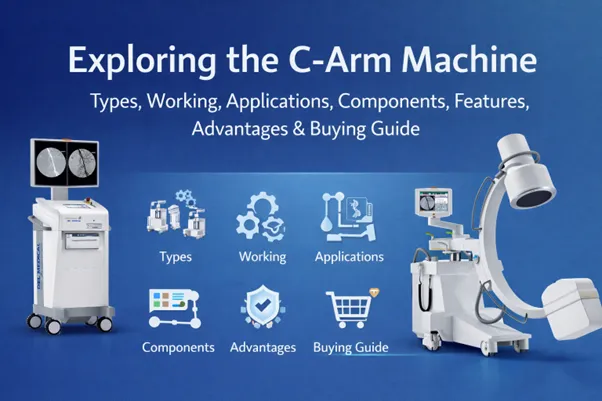
What Is a C-Arm Machine?
A C-Arm machine is a medical imaging device based on
fluoroscopy technology that provides real-time X-ray images of a patient during
diagnostic or surgical procedures.
The name “C-Arm” comes from its distinctive C-shaped arm,
which connects:
- An
X-ray source on one end
- An
image intensifier or flat-panel detector on the other
This C-shaped design allows the imaging system to rotate
around the patient, capturing images from multiple angles without moving the
patient.
C Arm machine, C Arm fluoroscopy system, medical imaging equipment
Why Is the C-Arm Machine So Important in Modern
Healthcare?
Unlike static imaging systems (X-ray, CT, MRI), C-Arm
machines offer:
- Real-time imaging
- Dynamic visualization during
procedures
- High surgical precision
- Reduced guesswork for surgeons
This makes C-Arm machines indispensable in minimally
invasive and interventional procedures.
Working Principle of a C-Arm Machine
The C-Arm works on the principle of fluoroscopy, which uses
continuous or pulsed X-ray beams to create live images.
Step-by-Step Working:
- X-ray
tube emits controlled radiation
- X-rays
pass through the patient’s body
- Dense
structures absorb more radiation
- Remaining
X-rays reach the detector
- Detector
converts X-rays into digital images
- Images
appear in real time on a monitor
Doctors can move the C-Arm, rotate angles, zoom, and adjust
contrast during the procedure.
C-Arm Working Diagram
Main Components of a C-Arm Machine
Understanding components is crucial for buyers and
biomedical engineers.
1. X-Ray Tube
- Generates
X-rays
- High
heat resistance
- Determines
image penetration
2. Image Intensifier / Flat Panel Detector
- Converts
X-rays into visible images
- Flat
panel detectors offer superior clarity
3. C-Shaped Arm
- Enables
rotational movement
- Allows
multiple viewing angles
4. Control Console
- Adjusts
exposure, brightness, contrast
- Stores
and retrieves images
5. Monitor Display
- Shows
live fluoroscopic images
- Often
dual-screen in advanced models
6. Power Generator
- Supplies
stable high voltage
- Impacts
image quality and safety
C Arm machine parts, C Arm components
Types of C-Arm Machines
1. Mini C-Arm Machine
- Compact
size
- Lower
radiation dose
- Used
for extremities (hand, foot, wrist)
- Common
in orthopaedics
2. Standard Mobile C-Arm
- Most
widely used
- Suitable
for OT procedures
- High
mobility
3. Fixed C-Arm System
- Installed
in cath labs or hybrid OTs
- Advanced
cardiology & vascular use
4. Full-Size Digital C-Arm
- Flat
panel detector
- Superior
image resolution
- High
cost, high performance
|
Type |
Best For |
|
Mini C-Arm |
Orthopaedic
clinics |
|
Mobile C-Arm |
Multi-speciality
hospitals |
|
Fixed C-Arm |
Cardiology
& vascular |
|
Digital C-Arm |
Advanced
surgical centres |
Clinical Applications of C-Arm Machines
1. Orthopaedics
- Fracture
fixation
- Joint
replacement
- Spine
surgery
2. Pain Management
- Epidural
injections
- Nerve
blocks
- Radiofrequency
ablation
3. Cardiology
- Angiography
- Pacemaker
implantation
4. Urology
- Stone
removal (PCNL)
- Stent
placement
5. Gastroenterology
- ERCP
procedures
6. Neurosurgery
- Spine
stabilization
- Brain
interventions
C Arm machine uses, C Arm applications
C-Arm Used in Surgery
Key Features of Modern C-Arm Machines
- Digital
image processing
- Dose
reduction technology
- Flat
panel detectors
- Touch-screen
controls
- Image
storage & PACS integration
- Mobile
& compact design
These features enhance patient safety and diagnostic
accuracy.
Advantages of C-Arm Machines
- Real-Time Imaging
- High Surgical Accuracy
- Reduced Operating Time
- Minimally Invasive Procedures
- Improved Patient Outcomes
Limitations of C-Arm Machines
- Radiation
exposure (controlled)
- Requires
trained operators
- Higher
cost than basic X-ray
- Maintenance
& calibration required
Despite limitations, benefits far outweigh risks when used
correctly.
Radiation Safety in C-Arm Usage
Modern C-Arm machines include:
- Low-dose
fluoroscopy
- Pulsed
imaging
- Lead
shielding compatibility
Operators must follow ALARA principles (As Low as Reasonably
Achievable).
Buying Guide: How to Choose the Right C-Arm Machine
Consider:
- Clinical
application
- Image
quality
- Detector
type
- Radiation
dose control
- After-sales
support
- Service
availability
- Budget
& ROI
At Aarogyaa Bharat, we recommend selecting C-Arm machines
aligned with actual clinical workload, not just specifications.
C-Arm Machine Price Range in India (Indicative)
|
Type |
Approx
Price |
|
Mini C-Arm |
₹20-40 lakhs |
|
Mobile C-Arm |
₹40-90 lakhs |
|
Digital Flat
Panel |
₹1-2+ crore |
(Prices vary by brand & configuration)
Maintenance & Servicing Tips
- Regular
calibration
- Tube
health monitoring
- Detector
cleaning
- Software
updates
- Annual
AMC
Proper maintenance ensures long machine life & image
accuracy.
Future of C-Arm Technology
- AI-assisted
imaging
- Ultra-low
dose systems
- Hybrid
OT integration
- 3D
fluoroscopy
C-Arm machines are evolving into smart surgical imaging
platforms.
Conclusion
The C-Arm machine has become a cornerstone of modern
interventional medicine. Its ability to deliver real-time, multi-angle imaging
significantly improves surgical precision, patient safety, and procedural
efficiency.
For hospitals, clinics, and surgical centres, investing in
the right C-Arm machine is not just a purchase it is a long-term clinical and
financial decision.
At Aarogyaa Bharat, we help healthcare providers choose
reliable, high-performance C-Arm systems that match their clinical needs and
growth plans.