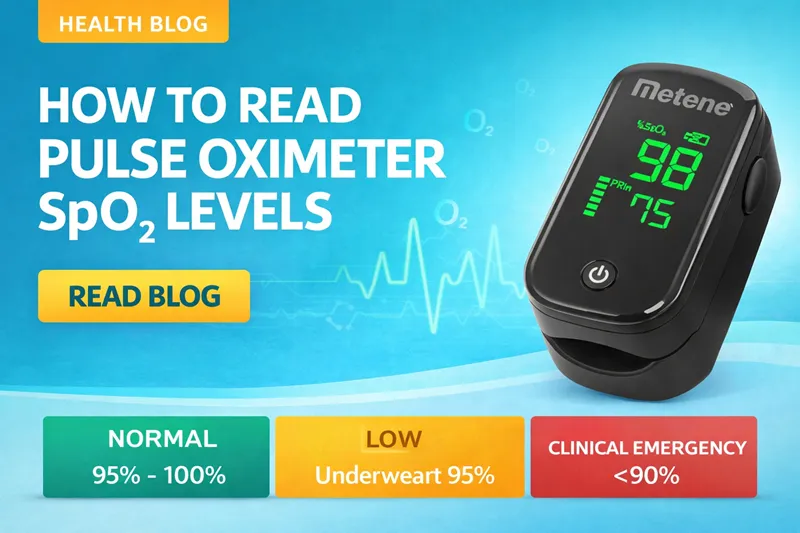
A Complete Home-Care Guide to Understanding Oxygen
Readings and What They Mean for Your Health
During the COVID-19 pandemic, pulse oximeters became
household essentials almost overnight. Families used them to detect falling
oxygen levels early and monitor silent hypoxia before symptoms became severe.
Even after the pandemic, doctors continue to recommend pulse oximeters for
elderly individuals, respiratory patients, heart patients, and people
recovering from infections or surgery. However, many users still feel confused
when they look at the numbers displayed on their pulse oximeter screen.
A very common question people ask is: “How do I read pulse
oximeter SpO₂ levels correctly, and when should I worry?” Some users panic over
small fluctuations in readings, while others ignore dangerously low values due
to lack of awareness. Misinterpreting oxygen saturation numbers can lead to
unnecessary anxiety, delayed medical care, or even life-threatening situations.
At Aarogyaa Bharat - Live Healthy, Live Better, we regularly
guide families on choosing and using pulse oximeters correctly as part of
complete home-care monitoring. In this extremely detailed guide, you will learn
what SpO₂ means, how a pulse oximeter works, how to read and interpret SpO₂
levels step by step, what is considered normal or dangerous, how readings vary
by age and condition, what factors affect accuracy, when to seek medical help,
and how to use SpO₂ data safely for long-term health monitoring.
What Is SpO₂ and Why Is It So Important?
SpO₂ stands for peripheral capillary oxygen saturation,
which refers to the percentage of haemoglobin in your blood that is carrying
oxygen. Haemoglobin is the protein in red blood cells responsible for
transporting oxygen from the lungs to the rest of the body. A healthy SpO₂
level ensures that all organs and tissues receive sufficient oxygen to function
properly.
Oxygen is critical for every cell in the body. When oxygen
levels fall too low, the brain, heart, kidneys, and other vital organs begin to
suffer damage. This can lead to symptoms such as shortness of breath, chest
pain, confusion, dizziness, fatigue, and bluish lips or fingertips. In severe
cases, dangerously low oxygen levels can result in organ failure or death.
What makes SpO₂ especially important is the phenomenon of
silent hypoxia, where oxygen levels drop dangerously low without obvious
symptoms. Patients may feel “normal” while their organs are actually being
starved of oxygen. This was widely observed during COVID-19, but it can also
occur in conditions such as pneumonia, COPD, asthma, and heart failure.
Monitoring SpO₂ using a pulse oximeter allows early
detection of falling oxygen levels and timely medical intervention, which can
prevent complications, hospitalizations, and life-threatening emergencies.
What Is a Pulse Oximeter and How Does It Measure SpO₂?
A pulse oximeter is a small, non-invasive medical device
that measures SpO₂ and pulse rate within seconds. It is usually clipped onto a
fingertip, toe, or earlobe and provides instant digital readings without the
need for needles or blood samples.
Pulse oximeters work using a technology called
photoplethysmography. The device emits two different wavelengths of light red
and infrared through your fingertip. These light beams pass through your blood
and are partially absorbed by oxygenated and deoxygenated haemoglobin.
Oxygenated haemoglobin absorbs more infrared light, while
deoxygenated haemoglobin absorbs more red light. By analysing how much light is
absorbed at each wavelength, the pulse oximeter calculates the ratio between
oxygenated and deoxygenated blood and estimates your SpO₂ level.
This entire process happens in seconds, making pulse
oximeters incredibly fast, convenient, and non-invasive for real-time oxygen
monitoring at home.
How to Read a Pulse Oximeter Screen: Step-by-Step
Understanding the pulse oximeter display is the first step
toward reading SpO₂ levels correctly. Most fingertip pulse oximeters show at
least two main values: SpO₂ (%) and pulse rate (BPM).
The SpO₂ value is usually displayed as a percentage, such as
97% or 94%. This number represents the percentage of haemoglobin in your blood
that is carrying oxygen. The pulse rate is displayed as beats per minute and
shows how fast your heart is beating.
Some advanced pulse oximeters also display additional
information such as a plethysmograph waveform, perfusion index (PI), or signal
strength bar. These indicators help assess measurement reliability and blood
flow quality.
When reading your pulse oximeter, always wait for the
numbers to stabilize for at least 5-10 seconds before recording them. Rapidly
changing values often indicate poor signal quality or motion interference
rather than true oxygen level changes.
What Is a Normal SpO₂ Level?
Understanding what is considered a normal SpO₂ level is
essential for accurate interpretation. For most healthy adults, a normal oxygen
saturation level typically ranges between 95% and 100%.
|
SpO₂ Level |
Meaning |
|
95% - 100% |
Normal oxygen
level |
|
92% - 94% |
Mildly low
(monitor closely) |
|
88% - 91% |
Moderately
low (medical advice needed) |
|
Below 88% |
Dangerously
low (emergency) |
It is important to note that individual baselines may vary.
Some COPD patients may have a stable SpO₂ around 90-92% under medical
supervision. Always consult your doctor to determine what is normal for your
specific condition.
For elderly individuals, slight reductions in SpO₂ may occur
due to age-related lung changes, but levels should still remain above 92% in
most cases.
How to Interpret SpO₂ Levels in Different Health
Conditions
SpO₂ readings must always be interpreted in the context of a
person’s overall health and medical condition. A reading that is normal for one
person may be concerning for another.
For healthy individuals, SpO₂ levels should consistently
remain between 95% and 100%. Occasional drops to 93-94% may occur during sleep
or at high altitudes but should return to normal quickly.
For asthma patients, mild drops in SpO₂ during attacks are
common. Persistent readings below 92% indicate poor asthma control and require
medical attention.
For COPD patients, doctors often accept lower baseline SpO₂
levels such as 90-92%. However, sudden drops below the patient’s usual baseline
are a warning sign of a flare-up.
For post-COVID patients, fluctuating SpO₂ levels are common
during recovery. Persistent readings below 94% may indicate lung damage or
complications and should be evaluated by a doctor.
For heart patients, low SpO₂ levels may indicate poor
circulation or worsening heart failure and should never be ignored.
SpO₂ vs Pulse Rate: Why You Must Read Both Together
Many users focus only on SpO₂ and ignore the pulse rate
displayed on their pulse oximeter. However, reading both values together
provides a more complete picture of a person’s health.
Pulse rate indicates how hard the heart is working to
deliver oxygen to the body. A normal adult pulse rate typically ranges between
60 and 100 beats per minute (BPM).
|
Pulse Rate
(BPM) |
Meaning |
|
60 - 100 |
Normal |
|
101 - 120 |
Elevated |
|
121 - 140 |
High |
|
Below 50 |
Abnormally
low |
A low SpO₂ combined with a high pulse rate often indicates
respiratory distress or infection. A low SpO₂ with a normal pulse rate may
indicate silent hypoxia. A normal SpO₂ with a high pulse rate may indicate
fever, anxiety, dehydration, or heart stress.
Reading both values together helps identify early warning
signs and reduces misinterpretation.
Factors That Can Affect SpO₂ Readings
Pulse oximeter readings can be influenced by several
external and physiological factors. Understanding these factors helps users
interpret readings correctly and avoid unnecessary panic.
Cold fingers reduce blood flow to the fingertips, making it
difficult for the device to detect accurate signals. Warming your hands before
measurement significantly improves accuracy.
Nail polish, artificial nails, and henna interfere with
light transmission, leading to falsely low or inconsistent readings. Always
remove nail polish and avoid using fingers with heavy henna stains.
Motion and talking during measurement cause reading
fluctuations. Keeping your hand still and resting calmly for a few minutes
before measurement improves reliability.
Poor circulation, dehydration, anaemia, and low blood
pressure can also affect SpO₂ accuracy.
Bright ambient light can interfere with the sensor.
Measuring in a shaded indoor environment helps minimize this issue.
How to Take an Accurate SpO₂ Reading at Home
To get the most reliable SpO₂ reading, follow these simple
steps. Sit calmly and rest for at least five minutes before measurement. Avoid
checking oxygen levels immediately after physical activity, smoking, or
climbing stairs.
Make sure your hands are warm and relaxed. Remove nail
polish or artificial nails from the finger you plan to use.
Place the pulse oximeter on a clean fingertip and keep your
hand still at heart level. Avoid talking or moving during measurement.
Wait for the reading to stabilize for at least 10 seconds
before recording it. Take two or three readings and average them for better
accuracy.
Use the same finger consistently for daily monitoring to
track trends more reliably.
When Should You Worry About Low SpO₂ Levels?
Knowing when to seek medical help based on SpO₂ readings is
critical for patient safety.
- SpO₂
92%-94%: Monitor closely and repeat the reading after rest.
- SpO₂
88%-91%: Consult a doctor as soon as possible.
- SpO₂
below 88%: Medical emergency seeks immediate care.
Always consider symptoms along with SpO₂ values. If a person
experiences severe breathlessness, chest pain, confusion, bluish lips, or
fainting, seek medical help immediately even if SpO₂ appears borderline normal.
SpO₂ Readings During Sleep and Exercise
SpO₂ levels naturally fluctuate during sleep and physical
activity. During sleep, mild drops of 1-2% are normal due to changes in
breathing patterns. However, repeated drops below 90% during sleep may indicate
sleep apnea or lung disease.
During exercise, SpO₂ levels may drop slightly in unfit
individuals or people with lung disease. In healthy people, SpO₂ should remain
above 94% even during moderate physical activity.
Monitoring SpO₂ trends during sleep and exercise provides
valuable insights into lung and heart health.
SpO₂ at Different Altitudes
SpO₂ levels decrease naturally at higher altitudes due to
lower oxygen availability in the air. People living in hill stations or
traveling to high-altitude areas may see SpO₂ readings in the range of 88%-94%
without any illness.
At altitudes above 2,000 meters, lower SpO₂ levels are
considered normal. However, sudden drops accompanied by symptoms such as
headache, nausea, dizziness, or breathlessness require medical evaluation.
Common Mistakes People Make While Reading SpO₂ Levels
Many users panic over minor fluctuations or take readings
immediately after physical activity, leading to inaccurate results.
Relying on a single low reading without rechecking can cause
unnecessary anxiety. Always take multiple readings and look for consistent
patterns.
Using cheap, unbranded pulse oximeters with poor sensors
results in unreliable data.
Ignoring symptoms and relying only on SpO₂ values is also
dangerous. Always consider the patient’s overall condition.
How to Choose a Reliable Pulse Oximeter for Accurate SpO₂
Monitoring
Choosing a reliable pulse oximeter is essential for
trustworthy SpO₂ readings. Always look for medical certification, clear display
quality, and positive customer feedback. Avoid extremely cheap unbranded
devices, as they often show inconsistent readings.
Mid-range and premium models with OLED displays,
plethysmograph waveform, and perfusion index (PI) indicators provide better
reliability for daily home monitoring.
Rechargeable models offer long-term convenience and cost
savings. Always buy from a trusted seller like Aarogyaa Bharat to ensure
genuine products, warranty coverage, and after-sales support.
Conclusion
Understanding how to read pulse oximeter SpO₂ levels correctly is just as
important as owning the device itself. Knowing what the numbers mean, how to
interpret them in different conditions, and when to seek medical help can save
lives.
At Aarogyaa Bharat - Live Healthy, Live Better, we believe that proactive health monitoring empowers families to take control of their well-being. Our goal is to help families choose reliable pulse oximeters and use them safely for long-term home health monitoring.