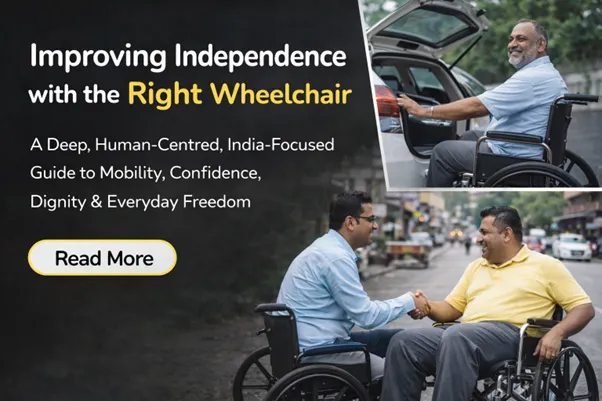
At Aarogyaa Bharat, we often tell
families and users:
“The right wheelchair doesn’t
just move the body-it restores choice.”
This in-depth guide explains how
the right wheelchair improves independence, what features truly matter, how
Indian homes and environments affect independence, and how families can support
autonomy instead of unintentionally reducing it.
What Does “Independence” Mean
for a Wheelchair User?
Independence is not always about
doing everything alone. It means:
- Choosing when to move
- Feeling safe while moving
- Reducing unnecessary dependence
- Participating in family and social life
- Maintaining self-respect
For some, independence means
self-propelling outdoors.
For others, it means moving comfortably indoors without fear of falling.
Who Benefits Most from an Independence-Focused Wheelchair?
Independence-focused wheelchairs
are critical for:
- Elderly individuals who fear falling
- Stroke and neurological recovery patients
- Long-term wheelchair users
- Home-bound individuals
- People transitioning from rehab to daily life
Principle 1: Fit = Freedom
A wheelchair that fits well:
- Moves easily
- Feels stable
- Reduces pain
- Encourages use
Poor Fit Causes Dependence
- Too wide → hard to turn
- Too narrow → pain
- Too heavy → caregiver reliance
Correct sizing restores
confidence to move.
Principle 2: Weight & Manoeuvrability Matter More Than Style
Why Lightweight Frames Improve
Independence
- Easier self-propulsion
- Less caregiver effort
- Safer handling indoors
Aluminium foldable wheelchairs
are often the sweet spot for Indian homes.
Principle 3: Self-Propelled vs
Assisted-Choosing the Right Balance
Self-Propelled Wheelchairs
- Build confidence
- Improve upper-body strength
- Encourage autonomy
Best for:
Users with adequate arm strength and balance.
Attendant-Propelled
Wheelchairs
- Safer for elderly indoors
- Reduce fatigue
- Still allow choice & control
Independence does not disappear
with assistance-it changes form.
Principle 4: Comfort Enables Independence
Discomfort discourages movement.
Comfort Features That Promote
Use
- Pressure-relief cushion
- Supportive backrest
- Correct armrest height
- Proper foot positioning
A comfortable user moves more,
not less.
Principle 5: Safety =
Confidence
Fear of falling is the biggest
enemy of independence.
Must-Have Safety Features
- Reliable brakes
- Stable frame
- Anti-tip support
- Proper transfers
When users feel safe, they
initiate movement themselves.
Principle 6: Indoor Independence in Indian Homes
Indian homes demand:
- Compact width
- Tight turning radius
- Foldability
A wheelchair that fits the home
encourages frequent, confident use.
Principle 7: Outdoor Independence & Social Participation
Outdoor movement restores:
- Social interaction
- Mental health
- Sense of normalcy
Choose
wheelchairs with:
- Stable tyres
- Shock absorption
- Easy transport
Even short outdoor trips improve
emotional independence.
Principle 8: Caregiver
Behaviour Can Increase or Reduce Independence
Common Mistake
Doing everything for the
user-even when unnecessary.
Better Approach
- Offer support, not control
- Ask before assisting
- Encourage safe self-action
Independence grows when families
trust capability.
Principle 9: Independence Evolves Over Time
Recovery and ageing are dynamic.
The wheelchair should:
- Adapt to changing strength
- Support rehab progress
- Not lock the user into dependence
Adjustability is key.
Common Mistakes That Reduce
Independence
- Choosing overly heavy wheelchairs
- Prioritising looks over fit
- Ignoring comfort
- Rushing assistance
- Limiting movement “for safety”
Signs the Right Wheelchair Is
Improving Independence
- User initiates movement
- Reduced fear
- Less caregiver fatigue
- Increased participation
- Better mood and confidence
Conclusion
True independence is not about
walking-it is about living fully within one’s abilities.
The right wheelchair:
- Restores choice
- Reduces fear
- Encourages participation
- Preserves dignity
- Mobility is freedom.
- Freedom is dignity.
- And dignity is health.