Yet, for patients, caregivers, and even junior healthcare
staff, a monitor screen filled with numbers, waveforms, colours, and alarms can
be confusing or intimidating.
At Aarogyaa Bharat, we believe medical technology should be
understandable, not overwhelming. This detailed guide explains how to read a
patient monitor screen step by step, covering each vital parameter, waveforms,
alarms, colour codes, common symbols, clinical meaning, mistakes to avoid, and
FAQs in simple, human language.
What Is a Patient Monitor?
A patient monitor is an electronic medical device that
continuously measures and displays a patient’s vital physiological parameters.
These values help healthcare professionals assess a patient’s condition, detect
deterioration early, and respond immediately.
Patient monitors are commonly used in:
- ICUs
and CCUs
- Emergency
departments
- Operation
theatres
- Ambulances
- Post-operative
wards
- Home
healthcare
patient monitor
Why Patient Monitor Screens Are So Important
Vital signs can change within seconds, especially in
critically ill patients. Continuous monitoring allows clinicians to:
- Detect
abnormalities early
- Prevent
medical emergencies
- Adjust
treatment instantly
- Improve
patient survival
For caregivers and patients, understanding the monitor
screen helps reduce anxiety and improves cooperation with treatment.
patient monitoring system
Patient Monitoring in ICU
Main Components of a Patient Monitor Screen
Although layouts vary by brand and model, most patient
monitor screens display similar information.
Common Screen Sections
- Numeric
values (vital signs)
- Waveforms
(graphical signals)
- Alarm
indicators
- Color-coded
parameters
- Patient
information
Understanding each section makes reading the screen much
easier.
Key Vital Signs Displayed on a Patient Monitor
Let’s break down each parameter one by one.
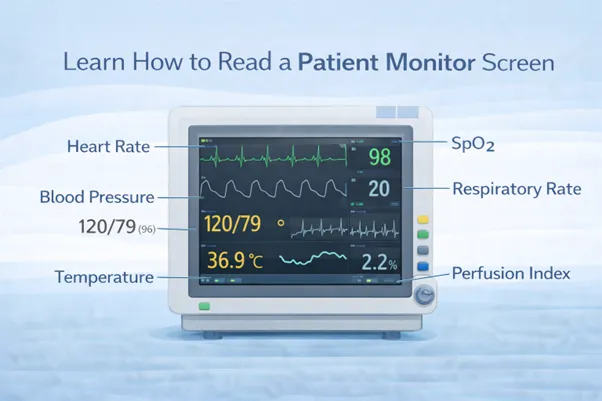
1. Heart Rate (HR)
What It Shows
Heart rate indicates how many times the heart beats per
minute (bpm).
Normal Range
- Adults:
60-100 bpm
- Children:
Higher ranges depending on age
Where It Appears
- Large
numeric value on the screen
- Often
shown in green
Clinical Meaning
- High
HR (tachycardia): stress, fever, pain, dehydration
- Low
HR (bradycardia): heart block, medication effects
heart rate monitor
Heart Rate Display on Monitor
2. ECG Waveform (Electrocardiogram)
What It Shows
The ECG waveform represents the heart’s electrical activity.
Key Components
- P
wave - atrial activity
- QRS
complex - ventricular contraction
- T
wave - ventricular recovery
Why It Matters
- Detects
arrhythmias
- Identifies
cardiac abnormalities
- Helps
monitor heart rhythm continuously
ECG waveform patient monitor
3. Blood Oxygen Saturation (SpO₂)
What It Shows
SpO₂ indicates the percentage of oxygen-saturated haemoglobin
in blood.
Normal Range
- 95-100%
(adults at sea level)
Colour Code
- Usually
displayed in blue or light blue
Clinical Meaning
- Low
SpO₂ (<90%) suggests hypoxia
- Critical
for respiratory and cardiac patients
SpO2 monitoring
SpO₂ Monitoring on Patient Monitor
What It Shows
Blood pressure readings are displayed as:
- Systolic
/ Diastolic (Mean Arterial Pressure)
Example: 120 / 80 (93)
Measurement Types
- Non-invasive
BP (NIBP) - cuff-based
- Invasive
BP (IBP) - arterial line
Clinical Importance
- Indicates
circulatory health
- Helps
manage shock, hypertension, bleeding
blood pressure monitoring
5. Respiratory Rate (RR)
What It Shows
Number of breaths taken per minute.
Normal Range
- Adults:
12-20 breaths/min
Why It Matters
- Early
indicator of respiratory distress
- Often
changes before other vitals
respiratory rate monitor
Respiratory Monitoring on Screen
6. Temperature (TEMP)
What It Shows
Body temperature via probe or sensor.
Normal Range
- 36.5°C
- 37.5°C
Clinical Importance
- Fever
detection
- Infection
monitoring
- Post-surgical
assessment
temperature monitoring patient
Understanding Waveforms on a Patient Monitor
Waveforms provide real-time visual information.
Common Waveforms
- ECG
waveform - cardiac rhythm
- Pleth
waveform - SpO₂ signal quality
- Respiration
waveform - breathing pattern
Waveforms help clinicians confirm accuracy of numeric
values.
Colour Coding on Patient Monitor Screens
Colours are standardized to improve clarity:
|
Colour |
Parameter |
|
Green |
Heart rate /
ECG |
|
Blue |
Oxygen
saturation |
|
Yellow |
Blood
pressure |
|
White |
Respiratory
rate |
|
Red |
Alarms /
critical alerts |
Color-Coded Patient Monitor Screen
Understanding Patient Monitor Alarms
Alarms are designed to alert caregivers instantly.
Types of Alarms
- Physiological
alarms - abnormal vital signs
- Technical
alarms - sensor disconnection
- Critical
alarms - life-threatening values
Important Tip
Never ignore alarms even false alarms require verification.
patient monitor alarms
Common Symbols & Indicators on Monitor Screens
- Battery
icon - power status
- Sensor
icon - probe placement issue
- Alarm
bell - alert status
- Trend
graph - vital changes over time
Common Mistakes While Reading Patient Monitors
Relying only on numbers without waveforms
Ignoring alarm limits
Misinterpreting artifacts as real data
Not correlating with patient condition
Patient monitors support clinical judgment, they do not
replace it.
Patient Monitor Use in Home Healthcare
With the rise of home care, simplified patient monitors are
used for:
- Elderly
care
- Post-surgery
recovery
- Chronic
illness management
Understanding the screen empowers caregivers and improves
safety.
home patient monitoring
Future of Patient Monitoring Technology
- Wireless
& wearable monitors
- AI-driven
alerts
- Cloud-based
remote monitoring
- Smartphone
integration
Patient monitoring is becoming smarter, predictive, and patient-centric.
Conclusion
Patient monitor screens play a critical role in modern
healthcare, providing continuous insight into a patient’s vital functions.
Learning how to read and interpret these screens empowers patients, caregivers,
and healthcare staff to respond faster, reduce risks, and improve outcomes.
At Aarogyaa Bharat, we believe knowledge saves lives.
Understanding patient monitors is a powerful step toward safer, more informed
healthcare whether in hospitals, ambulances, or at home.