Why Choosing the Right Hearing Aid Matters
Not all hearing loss is the same and neither are hearing
aids. Selecting the right type helps:
- Improve
speech understanding
- Increase
comfort during long hours of use
- Match
your daily lifestyle and activity level
- Boost
confidence in social situations
The wrong choice, on the other hand, may lead to discomfort
or underuse.
Understanding Hearing Loss Before Choosing a Hearing Aid
Before selecting a hearing aid, it’s important to
understand:
- Degree
of hearing loss (mild, moderate, severe, profound)
- Type
of hearing loss (conductive, sensorineural, mixed)
- One
ear or both ears affected
A professional hearing test ensures the hearing aid is
programmed correctly for your needs.
Main Types of Hearing Aids
Hearing aids are generally classified by where and how they
are worn. Each type has its own advantages and limitations.
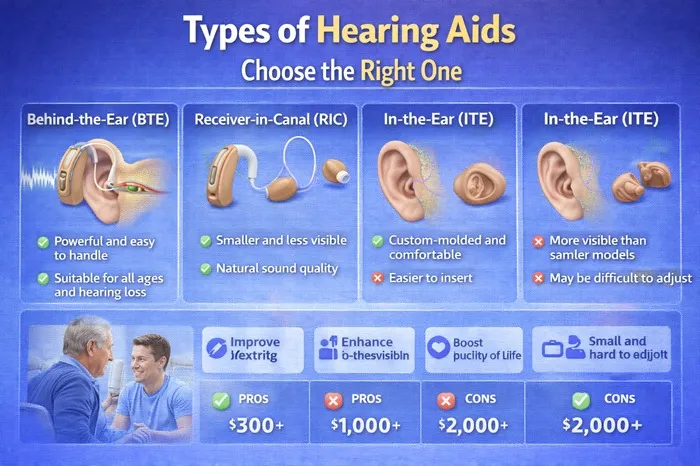
1. Behind-The-Ear (BTE) Hearing Aids
BTE hearing aids sit comfortably behind the ear and connect
to an earmold or thin tube.
Best For
- Mild
to profound hearing loss
- Children
and adults
Advantages
- Powerful
sound amplification
- Durable
and easy to handle
- Suitable
for long-term use
Considerations
- Slightly
more visible than smaller styles
2. Receiver-In-Canal (RIC) / Receiver-In-The-Ear (RITE)
RIC hearing aids are a slim version of BTE, with the speaker
placed inside the ear canal.
Best For
- Mild
to severe hearing loss
Advantages
- Clear,
natural sound quality
- Lightweight
and discreet
- Comfortable
for all-day wear
Considerations
- Receiver
may require more frequent cleaning
3. In-The-Ear (ITE) Hearing Aids
ITE hearing aids are custom-made to fit the outer ear.
Best For
- Mild
to moderate hearing loss
Advantages
- Easy
to insert and remove
- Larger
size allows additional features
Considerations
- More
visible than canal-type hearing aids
4. In-The-Canal (ITC) Hearing Aids
ITC hearing aids fit partly inside the ear canal.
Best For
- Mild
to moderate hearing loss
Advantages
- Smaller
and less noticeable
- Natural
sound experience
Considerations
- Limited
space for advanced features
5. Completely-In-Canal (CIC) Hearing Aids
CIC hearing aids sit deep inside the ear canal and are
nearly invisible.
Best For
- Mild
to moderate hearing loss
Advantages
- Highly
discreet
- Minimal
visibility
Considerations
- Smaller
batteries
- Not
suitable for severe hearing loss
6. Invisible-In-Canal (IIC) Hearing Aids
These are the smallest hearing aids available today.
Best For
- Mild
hearing loss
Advantages
- Virtually
invisible
- Natural
listening experience
Considerations
- Not
ideal for all ear shapes
- Fewer
features
7. Body-Worn Hearing Aids (Traditional Type)
These were the earliest portable hearing aids.
Current Use
- Rare
today
- Occasionally
used for severe hearing loss
Modern digital hearing aids have largely replaced them.
Advanced Features in Modern Hearing Aids
Technology has transformed hearing aids into smart devices.
Popular Features
- Digital
noise reduction
- Directional
microphones
- Feedback
(whistling) suppression
- Bluetooth
connectivity
- Smartphone
app control
- Rechargeable
batteries
These features significantly improve comfort and speech
understanding.
How to Choose the Right Hearing Aid for You
When choosing a hearing aid, consider:
- Severity
of hearing loss
- Daily
lifestyle and environment
- Comfort
and cosmetic preference
- Budget
and long-term costs
- Availability
of service and support
Trying different models and professional guidance make the
decision easier.
Adjusting to a New Hearing Aid
It’s normal to need time to adapt.
What to Expect
- Sounds
may feel louder initially
- Brain
adapts over days or weeks
- Gradual
improvement in clarity
Regular use and follow-up adjustments improve results.
Conclusion
Choosing the right hearing aid can transform how you hear,
communicate, and engage with the world. With today’s wide range of styles and
smart features, there is a hearing aid for every need, preference, and
lifestyle.
Understanding the types of hearing aids empowers you to make
a confident, informed decision one that improves not just hearing, but quality
of life.
At Aarogyaa Bharat, we are committed to making healthcare
knowledge clear, human, and accessible so you can hear better, live better, and
stay connected.