What Is an OT Table and Why Its Type Matters
An OT table (Operation Theatre table) is the central surgical platform designed to position, stabilize, and support patients during procedures. It allows height adjustment, tilt movements, Trendelenburg and reverse Trendelenburg positioning, lateral tilting, longitudinal sliding, and specialty attachments depending on surgical requirements. As surgical techniques have evolved from general open procedures to minimally invasive, image-guided, and robotic surgeries the need for precise positioning, stability under load, imaging compatibility, and ergonomic controls has increased significantly. Selecting the right OT table type ensures proper surgical access, enhanced patient safety during long procedures, smoother workflow for the surgical team, reduced staff fatigue, and compatibility with C-arm, fluoroscopy, or advanced imaging systems. The choice between hydraulic, electro-hydraulic, and electric OT tables should be based on surgical complexity, hospital infrastructure, power reliability, case mix, and long-term expansion goals.
Types of OT Tables: Overview
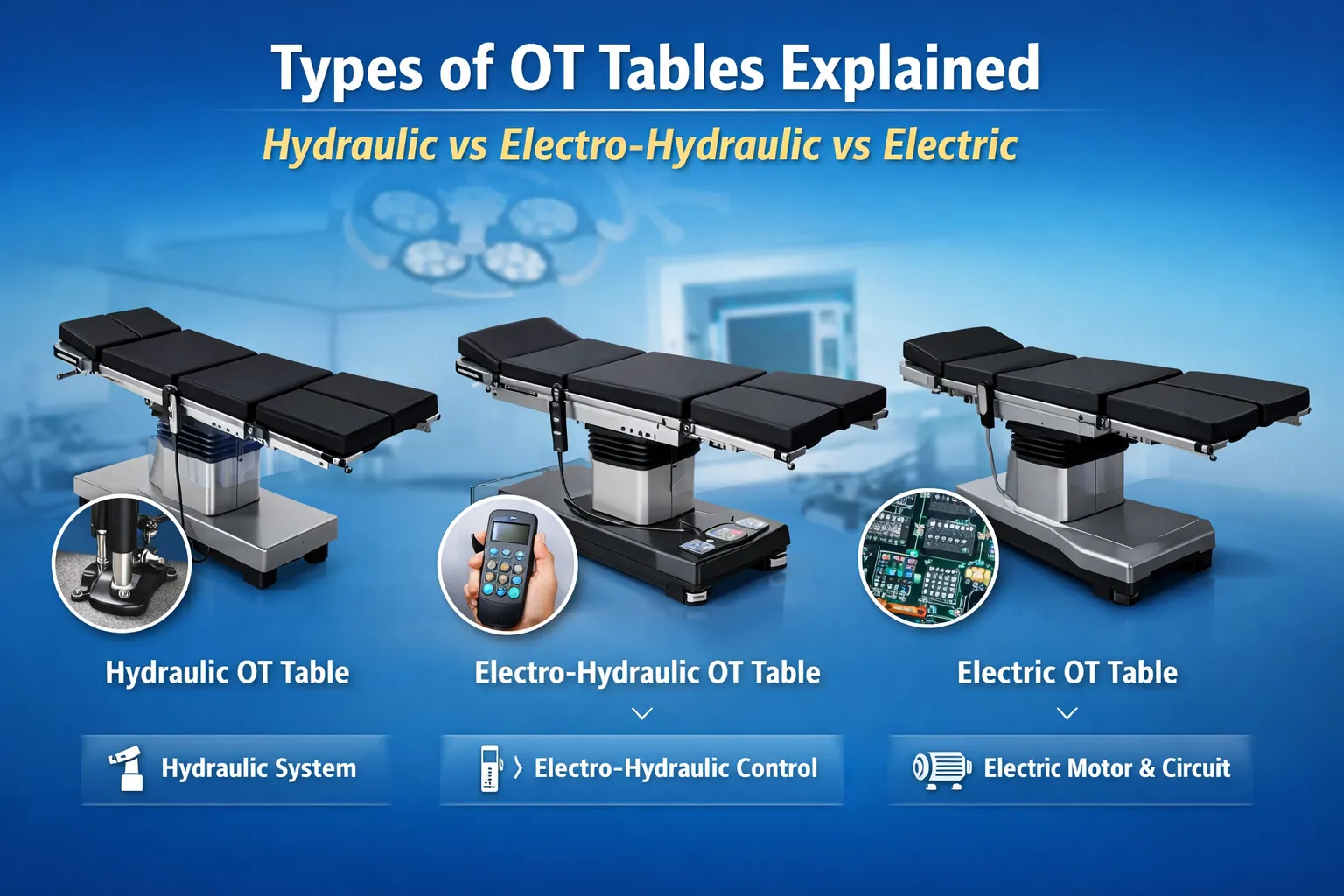
Modern hospitals typically choose between three primary OT table categories:
-
Hydraulic OT Tables
-
Electro-Hydraulic OT Tables
-
Electric OT Tables
Each type serves a specific operational need and budget bracket.
Hydraulic OT Tables
How They Work
Hydraulic OT tables operate using a manual hydraulic pump mechanism, usually controlled by foot pedals. These systems do not require electricity and rely purely on mechanical force to create lifting and positioning movements.
Why They Exist
Hydraulic tables were developed as reliable, cost-effective solutions for surgical environments where simplicity and durability are priorities. With fewer electronic components, they offer lower risk of technical malfunction.
Best For
Hydraulic OT tables are ideal for small hospitals, nursing homes, rural surgical centers, gynecology procedures, minor orthopedic cases, emergency surgeries, and general surgical applications where frequent repositioning is not required.
Advantages
They are budget-friendly, mechanically robust, capable of handling high patient weight loads, and independent of electrical supply. In areas with unstable power or frequent outages, hydraulic tables offer dependable performance.
Limitations
Manual operation makes adjustments slower and less precise. They lack advanced features like programmable positions, motorized longitudinal slides, or advanced imaging compatibility in many models. Extended manual operation can also cause physical strain to OT staff during longer surgeries.
When to Choose Hydraulic
Choose hydraulic OT tables if your facility handles primarily basic procedures, operates under budget constraints, or faces unreliable power infrastructure.
Electro-Hydraulic OT Tables
How They Work
Electro-hydraulic OT tables combine hydraulic lifting strength with electric-powered motor controls. Instead of manual pumping, electric motors drive the hydraulic system. Adjustments are managed via hand control or remote.
Why They Exist
These tables bridge the gap between traditional hydraulic models and fully electric systems. They provide the strength and stability of hydraulic systems with the precision and convenience of electric control.
Best For
Electro-hydraulic tables are well suited for multi-specialty hospitals performing orthopedic, neurosurgical, urological, cardiothoracic, and other complex procedures. They are particularly useful when frequent patient repositioning is required.
Advantages
They offer smooth and precise adjustments, reduced manual effort, better ergonomics, high load-bearing capacity, radiolucent tabletops for C-arm compatibility, modular sections for specialty procedures, and faster OT turnover.
Limitations
They are more expensive than purely hydraulic models and depend on electricity, requiring backup systems for critical surgeries. Maintenance is moderately complex due to combined hydraulic and electrical components.
When to Choose Electro-Hydraulic
If your facility performs diverse surgeries and values operational flexibility, patient comfort, imaging integration, and efficiency, electro-hydraulic OT tables provide an excellent balance between performance and cost.
Electric OT Tables
How They Work
Electric OT tables rely entirely on electric actuators and motor systems to control all movements including height, tilt, slide, and specialty positioning. Controls are managed via digital panels or advanced remote systems.
Why They Exist
Modern surgical environments demand speed, repeatability, programmable positions, seamless imaging integration, and robotic compatibility. Electric OT tables are designed to meet these advanced requirements.
Best For
They are ideal for minimally invasive surgeries, laparoscopic procedures, image-guided operations, robotic-assisted surgeries, and tertiary care hospitals with advanced OT infrastructure.
Advantages
Electric tables offer exceptional positioning precision, programmable memory settings, seamless imaging compatibility, improved workflow efficiency, and reduced physical strain on OT staff.
Limitations
They involve higher upfront investment, require stable electrical infrastructure, and have higher maintenance complexity due to electronic systems.
When to Choose Electric
If your hospital focuses on advanced surgical procedures and long-term modernization, electric OT tables are the premium, future-ready option.
Quick Comparison: Hydraulic vs Electro-Hydraulic vs Electric OT Tables
| Feature | Hydraulic | Electro-Hydraulic | Electric |
|---|---|---|---|
| Power Source | Manual pump | Electric-driven hydraulics | Fully electric actuators |
| Control | Mechanical | Remote/hand control | Digital remote/panel |
| Positioning Precision | Basic | High | Very High |
| Imaging Compatibility | Limited | Good | Excellent |
| Load Capacity | High | Very High | Moderate to High |
| Power Dependency | None | Partial | Full |
| Maintenance Complexity | Low | Moderate | High |
| Cost Range | Low | Mid to High | Premium |
How to Choose the Right OT Table
Selecting the correct OT table should align with surgical volume, procedure complexity, hospital infrastructure, and long-term growth plans. Small clinics or facilities with limited budgets may benefit from hydraulic tables. Multi-specialty hospitals should consider electro-hydraulic tables for versatility and efficiency. Advanced surgical centers focused on imaging-guided and minimally invasive procedures should invest in electric OT tables for precision and future readiness. It is critical to evaluate load capacity, adjustment range, modular attachments, C-arm compatibility, and after-sales service support before finalizing a purchase. Power backup systems should also be considered for electric and electro-hydraulic models.
Why Aarogyaa Bharat Recommends Electro-Hydraulic and Electric OT Tables
At Aarogyaa Bharat, we emphasize modern, durable, and performance-oriented OT solutions that align with evolving surgical standards. Electro-hydraulic and electric tables enhance precision, reduce surgeon fatigue, improve patient positioning accuracy, and increase OT throughput efficiency. Their compatibility with imaging systems and modular surgical accessories ensures long-term relevance as hospitals upgrade technology. While the initial investment may be higher, the return on investment through operational efficiency, safety enhancement, and surgical precision makes them strategically superior choices for progressive healthcare facilities.
Conclusion
Choosing the right OT table is a strategic decision that influences surgical efficiency, patient safety, and long-term operational success. Hydraulic OT tables remain dependable for basic surgical environments with limited resources. However, electro-hydraulic and electric OT tables provide superior precision, flexibility, ergonomic advantage, and imaging compatibility essential for modern surgical workflows. Hospitals should assess their current case mix, infrastructure capabilities, and future expansion plans before investing. At Aarogyaa Bharat, we guide healthcare institutions toward solutions that deliver performance today while remaining future-ready for tomorrow’s surgical advancements.