What Is a Non-Invasive Ventilator?
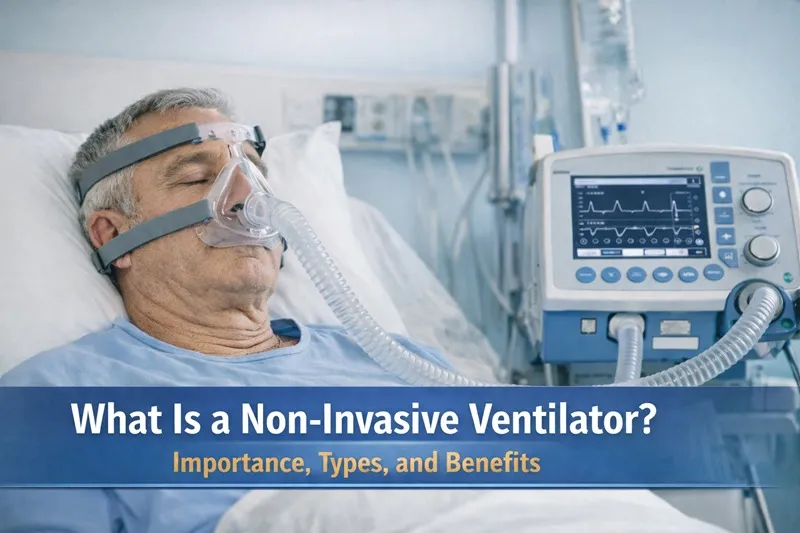
A Non-Invasive Ventilator (NIV) is a medical device that
supports breathing without inserting a tube into the windpipe. Instead, it
delivers pressurized air and oxygen through an external interface such as:
- A
face mask
- A
nasal mask
- A
nasal pillow system
Non-invasive ventilation helps patients breathe more
effectively while allowing them to remain awake, communicative, and
comfortable.
How Non-Invasive Ventilation Is Different from Invasive
Ventilation
|
Aspect |
Non-Invasive
Ventilation |
Invasive
Ventilation |
|
Airway access |
Mask or nasal
interface |
Tube inside
airway |
|
Patient
comfort |
High |
Lower |
|
Infection
risk |
Lower |
Higher |
|
Need for
sedation |
Usually not
required |
Often
required |
|
Speech and
eating |
Often
possible |
Not possible |
Because of these advantages, NIV is often the first choice
when ventilatory support is needed but intubation can be avoided.
Why Non-Invasive Ventilation Is Important
Non-invasive ventilators play a crucial role in modern
healthcare because they:
- Reduce
complications linked to invasive ventilation
- Provide
early respiratory support
- Improve
patient comfort and dignity
- Shorten
hospital stays
In many cases, timely NIV can prevent the need for
intubation altogether.
When Is a Non-Invasive Ventilator Used?
Non-invasive ventilators are used across hospitals,
emergency departments, ICUs, and home-care settings.
Common Medical Conditions
- Chronic
Obstructive Pulmonary Disease (COPD) exacerbations
- Obstructive
sleep apnea
- Central
sleep apnea
- Acute
respiratory failure
- Asthma
attacks
- Pneumonia
(mild to moderate cases)
- Neuromuscular
disorders
- Obesity
hypoventilation syndrome
They are also widely used in post-operative care and home
respiratory therapy.
How Does a Non-Invasive Ventilator Work? (Simple
Explanation)
A non-invasive ventilator works by assisting natural
breathing rather than replacing it.
Step-by-Step Working
- Air
Delivery
The machine delivers pressurized air or oxygen through a mask. - Pressure
Support
The pressure helps open the airways and inflate the lungs. - Improved
Gas Exchange
Oxygen enters the bloodstream more effectively, and carbon dioxide is expelled. - Patient-Triggered
Breaths
Many NIV modes respond to the patient’s own breathing effort. - Monitoring
and Alarms
The device monitors breathing patterns and alerts caregivers to issues.
The aim is to reduce breathing effort while improving oxygen
levels.
Main Types of Non-Invasive Ventilators
Non-invasive ventilators are categorized based on how they
deliver pressure.
1. CPAP (Continuous Positive Airway Pressure)
What It Does
- Delivers
constant pressure throughout the breathing cycle
Best Used For
- Obstructive
sleep apnea
- Snoring
related to airway collapse
Key Benefit
- Keeps
airways open during sleep
2. BiPAP (Bilevel Positive Airway Pressure)
What It Does
- Provides two pressure levels
- Higher pressure during inhalation
- Lower pressure during exhalation
Best Used For
- COPD
- Respiratory
failure
- Neuromuscular
disorders
Key Benefit
- Reduces
breathing effort significantly
3. Adaptive Servo-Ventilation (ASV)
What It Does
- Automatically
adjusts pressure based on breathing patterns
Best Used For
- Central
sleep apnea
- Complex
sleep-related breathing disorders
4. Portable and Home NIV Machines
What They Offer
- Compact
size
- Battery
backup
- Quiet
operation
Best Used For
- Long-term
home respiratory care
- Travel
and emergency backup
Benefits of Non-Invasive Ventilation
1. Greater Patient Comfort
Since no tube is placed in the airway, patients can:
- Talk
- Eat
(with breaks)
- Remain
alert
This preserves dignity and reduces anxiety.
2. Lower Risk of Infections
Non-invasive ventilation avoids direct airway access,
reducing:
- Ventilator-associated
pneumonia
- Throat
and lung infections
3. Avoids Sedation and Intubation
Most patients using NIV:
- Do not require sedation
- Stay conscious and responsive
- This speeds up recovery.
4. Faster Recovery and Shorter Hospital Stay
By supporting breathing early, NIV:
- Reduces
ICU admission rates
- Shortens
hospital stays
- Improves
overall outcomes
5. Effective for Long-Term Home Care
Many chronic respiratory patients live full lives using NIV
at home with proper support.
6. Cost-Effective Solution
Compared to invasive ventilation:
- Lower
hospital costs
- Reduced
complications
- Less
need for intensive monitoring
Limitations of Non-Invasive Ventilation
While NIV has many benefits, it is not suitable for all
patients.
Not Recommended When
- Patient
is unconscious
- Severe
facial trauma is present
- Excessive
secretions cannot be cleared
- Immediate
airway protection is required
In such cases, invasive ventilation may be necessary.
Role of Non-Invasive Ventilators in Home Healthcare
Home NIV has transformed chronic respiratory care by:
- Reducing
hospital visits
- Improving
sleep quality
- Enhancing
quality of life
Patients and caregivers receive training for safe and
effective use.
Caring for a Patient on Non-Invasive Ventilation
Key aspects include:
- Proper
mask fitting
- Regular
skin checks
- Cleaning
and maintenance
- Monitoring
comfort and breathing
Small adjustments make a big difference.
Conclusion
A Non-Invasive Ventilator represents a major advancement in
respiratory care offering effective breathing support without the risks and
discomfort of invasive methods. From emergency care to long-term home therapy,
NIV has improved survival, comfort, and quality of life for millions of
patients worldwide.
Understanding the importance, types, and benefits of
non-invasive ventilation helps patients, families, and healthcare professionals
make confident decisions during critical moments.
At Aarogyaa Bharat, our goal is to simplify healthcare
knowledge and empower better care because informed choices save lives.