A properly selected wheelchair:
- Prevents falls
- Supports posture and weak limbs
- Encourages movement without risk
- Reduces caregiver strain
- Improves confidence and dignity
Why Stroke Patients Need
Specialized Wheelchairs
Stroke patients have unique
mobility needs that differ from general elderly or post-surgery users.
Common post-stroke challenges
include:
- One-sided weakness (left or right)
- Poor trunk control
- Limited hand grip
- Unequal weight distribution
Using a standard wheelchair without
proper support can lead to:
- Leaning to one side
- Shoulder pain
- Poor circulation
- Increased fall risk
Hence, stroke-specific wheelchair
features are essential.
Key Wheelchair Features for Stroke Patients
1. Proper Arm & Shoulder
Support
After stroke, one arm may be weak
or flaccid.
Look for:
- Desk-length armrests
- Adjustable arm supports
- Shoulder positioning aids
This prevents shoulder subluxation
and pain.
2. Lateral (Side) Support for
Trunk Stability
Stroke patients often lean to one
side.
Side supports help:
- Maintain upright posture
- Prevent slipping
- Improve sitting balance
3. Reclining or Tilt-in-Space
Function
Highly recommended for:
- Severe weakness
- Poor trunk control
- Long sitting hours
Benefits include:
- Pressure relief
- Reduced fatigue
- Safer resting positions
4. Strong Brakes & Anti-Tip
Wheels
Stroke survivors have:
- Delayed reactions
- Balance issues
Safety features prevent sudden
movement and tipping.
Best Types of Wheelchairs for
Stroke Patients
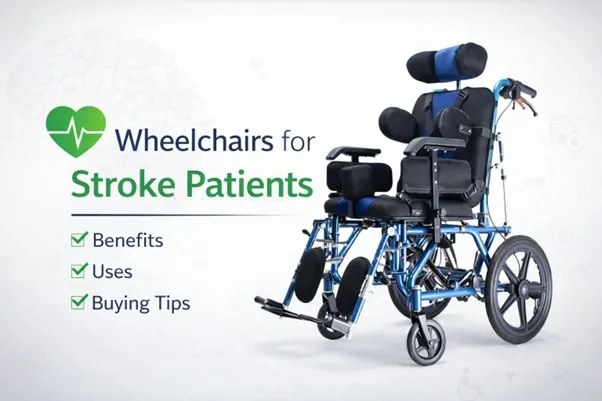
Manual Wheelchair with Support
Features
Best for:
- Moderate stroke recovery
- Indoor mobility
- Caregiver assistance
Features:
- Arm support
- Cushioned seat
- Stable frame
Reclining Wheelchair
Best for:
- Severe weakness
- Long-term care
- Limited sitting tolerance
Wheelchair with Commode
Best for:
- Stroke patients with toileting difficulty
- Reduced walking ability
Reduces:
- Bathroom fall risk
- Caregiver lifting effort
Manual vs Motorized Wheelchair
for Stroke Patients
Manual Wheelchair
- Safer during recovery
- Better caregiver control
- Encourages assisted rehabilitation
Motorized Wheelchair
Only for patients with good
cognitive and hand control
Not recommended in early recovery
Most stroke patients benefit more
from manual or reclining wheelchairs.
Using Wheelchairs as Part of Stroke Rehabilitation
Wheelchairs support rehab by:
- Allowing safe sitting
- Improving circulation
- Encouraging movement outside bed
- Supporting physiotherapy exercises
Sitting out of bed daily helps:
- Prevent depression
- Improve lung function
- Increase alertness
Safety Tips for Stroke Patients
Using Wheelchairs
- Always lock brakes before transfers
- Support weak side during sitting
- Avoid sudden turns
- Do not self-propel without guidance
- Use anti-slip cushions
Caregiver supervision is crucial.
Indian Home Considerations for
Stroke Care
- Narrow spaces → compact wheelchair
- Bathroom access → commode wheelchair
- Flooring → smooth wheels preferred
Wheelchairs must fit real Indian
homes, not just hospital corridors.
Rent vs Buy Wheelchair for
Stroke Patients
Rent If:
- Early recovery phase
- Trial of different models
- Short-term need
Buy If:
- Long-term paralysis
- Elderly stroke survivor
- Daily home care required
Aarogyaa Bharat offers
stroke-friendly wheelchair rental and purchase options with expert guidance.
Psychological Benefits of
Wheelchair Use After Stroke
Stroke survivors often struggle
emotionally.
Wheelchairs help by:
- Reducing fear of falling
- Restoring mobility confidence
- Encouraging social interaction
- Improving mental health
Mobility support plays a major role
in stroke recovery motivation.
Conclusion: Mobility That
Supports Recovery, Not Risk
For stroke survivors, mobility must
be careful, supported, and confidence-building. The right wheelchair:
- Protects weak limbs
- Prevents falls
- Supports rehabilitation
- Reduces caregiver burden
- Restores dignity and independence
A well-chosen wheelchair becomes a
partner in stroke recovery, not just a transport tool.