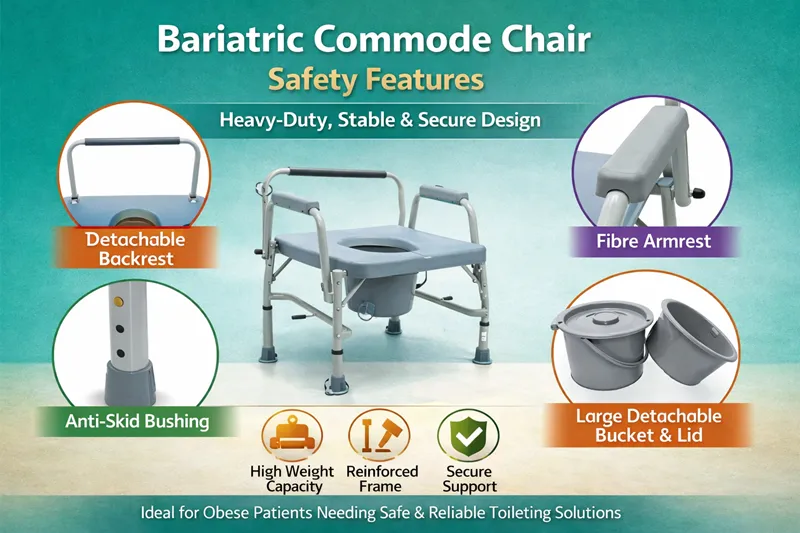
In Indian homes, where bathrooms are often compact, floors are tiled, and support fixtures are minimal, these risks multiply further. A bariatric commode chair is not simply a larger version of a standard commode chair; it is a purpose-engineered medical support system designed to safely manage higher body weight while preserving dignity, comfort, and independence. Understanding the safety features of bariatric commode chairs is critical for families and caregivers to prevent accidents, reduce physical strain, and ensure long-term home-care sustainability. At Aarogyaa Bharat, we frequently encounter situations where standard commode chairs are mistakenly used for bariatric patients, leading to bending frames, unstable seating, loose armrests, and near-miss accidents. These incidents not only endanger the patient but also put caregivers at serious risk of back injuries and emotional stress. Bariatric commode chairs are designed with reinforced structures, advanced stability mechanisms, and ergonomic support systems that specifically address the physical realities of higher body weight, making them an essential investment rather than an optional upgrade.
Why Bariatric Patients Face Higher Toileting Risks
Bariatric patients carry significantly more load on
weight-bearing joints such as knees, hips, ankles, and the lower spine, making
sit-to-stand movements extremely demanding. Reduced flexibility, slower
reaction time, and fatigue further compromise balance, especially during urgent
toileting situations. Many bariatric individuals also have associated
conditions such as diabetes, arthritis, heart disease, or respiratory issues,
which increase dizziness and weakness. In such scenarios, any instability in toileting
equipment can result in catastrophic falls. A bariatric commode chair addresses
these risks through structural strength and controlled support, allowing
movements to occur in a predictable and secure manner.
Reinforced Frame Construction as a Core Safety Feature
The most fundamental safety feature of a bariatric commode
chair is its reinforced frame construction. Unlike standard chairs that use
thin metal tubing, bariatric models are built using heavy-gauge steel or
reinforced alloy frames designed to support significantly higher loads without
flexing or deformation. Cross-bracing between legs adds lateral stability,
preventing wobbling under dynamic movement. This reinforced architecture
ensures that the chair remains solid during sitting, standing, and weight shifting,
which are the moments when accidents are most likely to occur.
High Weight Capacity and Load Distribution
Weight capacity is not just a number; it reflects how safely
the chair distributes load across its structure. Bariatric commode chairs are
designed with higher certified weight limits and evenly distributed support
points, preventing pressure concentration on any single joint or component.
This balanced load distribution protects the chair from structural fatigue and
ensures consistent performance over long-term use. Aarogyaa Bharat strongly
recommends choosing a bariatric commode chair with a weight rating comfortably
above the user’s body weight to maintain a safety margin.
Wide Seat Design for Comfort and Stability
Seat width plays a crucial role in both comfort and safety
for bariatric users. Narrow seats force unnatural posture, increase pressure
points, and compromise balance, often causing fear and discomfort. Bariatric
commode chairs feature wider seats that accommodate body dimensions
comfortably, allowing even weight distribution across the thighs and hips. This
improved seating posture reduces pressure sores, enhances stability, and
encourages confident use without anxiety.
Reinforced Armrests for Safe Transfers
Armrests are one of the most critical safety components for
bariatric users, as they bear significant load during transfers. Bariatric
commode chairs feature reinforced, load-tested armrests that allow users to
push up using upper body strength rather than relying solely on legs. Strong
armrests provide leverage, improve balance, and reduce joint strain, especially
for users with knee or hip pain. Loose or weak armrests are a major cause of
accidents, making reinforcement a non-negotiable safety feature.
Anti-Slip Feet and Floor Stability
Indian homes commonly have tiled floors that can become
slippery due to moisture, cleaning liquids, or polishing residue. Bariatric
commode chairs are equipped with heavy-duty, non-slip rubber feet designed to
grip smooth surfaces under high load. Wider leg spacing further enhances
stability by lowering the centre of gravity. These features prevent sliding or
tipping during transfers, ensuring the chair remains firmly grounded even under
dynamic movement.
Height Adjustability for Joint Protection
Height adjustment is essential for reducing joint strain in
bariatric patients. Sitting too low increases knee and hip stress, while
standing from a low position requires excessive force. Bariatric commode chairs
allow precise height adjustment so the user’s feet remain flat on the floor and
knees stay at a safer angle. This alignment significantly reduces pain and falls
risk while encouraging regular toileting without fear.
Lockable Castors in Bariatric Models
Some bariatric commode chairs include lockable castors for
controlled mobility. These castors allow caregivers to reposition the chair
safely when unlocked and ensure absolute stability during use when locked. For
bariatric patients, uncontrolled movement can be extremely dangerous, making
reliable locking mechanisms a critical safety feature. Properly designed
lockable castors balance mobility and stability without compromising safety.
Hygiene-Focused Safety Design
Hygiene safety is particularly important for bariatric users
due to higher risk of skin breakdown and infection. Bariatric commode chairs
include large, securely fitted buckets that handle higher volume comfortably
and reduce spillage. Smooth, non-porous surfaces simplify cleaning and reduce
bacterial buildup. Controlled hygiene management prevents odour issues and
maintains a safe home environment, especially in small Indian households.
Caregiver Safety and Injury Prevention
One of the biggest advantages of bariatric commode chairs is
reduced caregiver injury risk. Assisting bariatric patients without proper
equipment places enormous strain on caregivers’ backs, shoulders, and knees.
Bariatric commode chairs are designed to minimise lifting by providing
structural support during transfers, allowing caregivers to guide rather than
lift. This dramatically improves caregiver safety and sustainability of
long-term home care.
Comparison Table: Bariatric vs Standard Commode Chair
Safety Features
|
Safety
Aspect |
Bariatric
Commode Chair |
Standard
Commode Chair |
|
Weight
capacity |
Very high,
reinforced |
Limited |
|
Frame
strength |
Heavy-duty,
cross-braced |
Light |
|
Seat width |
Wide and
ergonomic |
Narrow |
|
Armrest
strength |
Reinforced,
load-tested |
Basic |
|
Floor
stability |
High-grip
anti-slip feet |
Moderate |
|
Joint strain |
Reduced |
High |
|
Caregiver
safety |
High |
Low |
Choosing the Right Bariatric Commode Chair
Selecting the right bariatric commode chair requires careful
evaluation of patient weight, mobility level, room layout, and caregiver
support. Families should prioritise certified weight capacity, reinforced frame
construction, wide seating, strong armrests, non-slip feet, and easy hygiene
management. Aarogyaa Bharat helps families navigate these technical
considerations, ensuring that safety is never compromised for convenience or
cost.
Long-Term Value of Bariatric Safety Features
Although bariatric commode chairs may cost more than
standard models, they deliver far greater long-term value by preventing falls,
reducing hospital visits, and protecting caregivers from injury. Over time,
this investment pays for itself through improved safety, comfort, and peace of
mind. For families managing long-term obesity-related care, these safety
features are essential rather than optional.
Why Aarogyaa Bharat Emphasises Bariatric Safety
Engineering
Aarogyaa Bharat understands that bariatric care requires
specialised solutions, not scaled-up generic equipment. Our focus is on
safety-engineered products that work in real Indian home environments,
protecting both patients and caregivers. By educating families on bariatric
commode chair safety features, we help prevent avoidable accidents and promote
dignified, sustainable home care.
Conclusion
Bariatric commode chair safety features are the foundation of secure, dignified, and effective home care for obese patients. Reinforced frames, high weight capacity, wide seating, strong armrests, anti-slip stability, and ergonomic height adjustment work together to reduce fall risk, protect joints, and safeguard caregivers. In Indian homes, where environmental challenges already exist, choosing a properly designed bariatric commode chair is essential for long-term safety and peace of mind. Aarogyaa Bharat remains committed to guiding families toward safety-first solutions that improve quality of life for bariatric patients every single day.