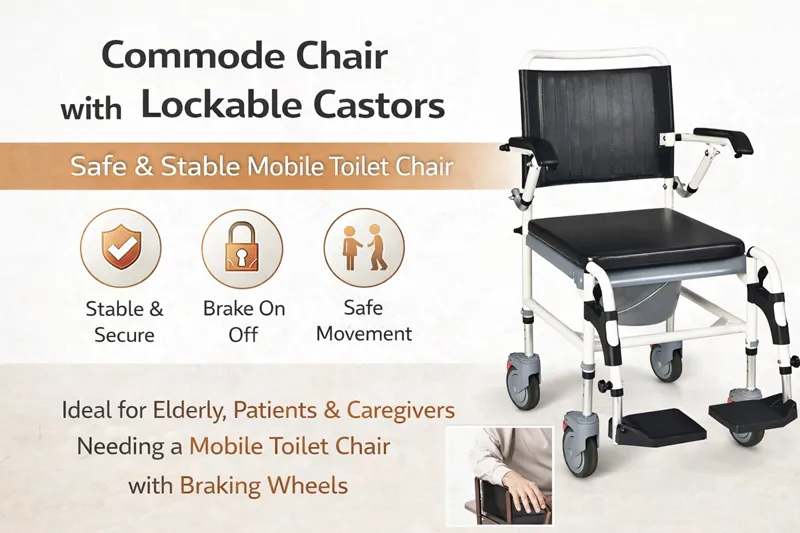
For elderly individuals, post-surgery patients, stroke survivors, paralysis patients, or people with severe weakness, toileting can be one of the most physically demanding and risky daily activities. In Indian homes, where tiled floors, narrow corridors, raised bathroom thresholds, and distant toilets are common, the challenge becomes even more pronounced. A commode chair with lockable castors offers the dual advantage of controlled movement and firm stability, making it an essential solution for safe, dignified, and efficient home care. At Aarogyaa Bharat, we frequently encounter families who struggle with either fully fixed commode chairs that are difficult to reposition or wheeled chairs that feel unsafe due to uncontrolled rolling. Lockable castors solve this problem by allowing the chair to move effortlessly when required and remain completely stationary during sitting, standing, and toileting. This balance dramatically reduces fall risk, caregiver strain, and patient anxiety, transforming daily care routines into safer and more predictable experiences.
Understanding What Lockable Castors Mean in a Commode
Chair
Lockable castors are specially designed wheels fitted with
braking mechanisms that allow caregivers to lock the wheels in place,
preventing any movement during use. Unlike ordinary wheels, lockable castors
provide controlled mobility without compromising stability. When unlocked, the
commode chair can be rolled smoothly across flat surfaces, such as bedroom
floors or corridors, reducing the need for lifting. When locked, the chair
functions like a fixed commode chair, offering a stable base that supports full
body weight safely. This dual functionality is especially important in
home-care environments, where patient needs may change throughout the day.
Why Stability Is Critical During Toileting
The most dangerous moments during toileting are sitting
down, standing up, and transferring weight from one surface to another. Any
unexpected movement during these moments can cause loss of balance, panic, and
serious injury. A commode chair with lockable castors eliminates this risk by
ensuring that once the wheels are locked, the chair does not roll or shift
under load. For elderly parents or patients with weak joints and slow reflexes,
this predictable stability builds confidence and encourages regular use, which
is essential for hygiene and health.
Importance of Controlled Mobility in Home Care
While stability is essential, complete immobility can also
create challenges for caregivers. Moving a fixed commode chair often requires
lifting, dragging, or awkward repositioning, which increases caregiver injury
risk and damages flooring. Lockable castors allow caregivers to reposition the
chair smoothly and quietly, whether moving it closer to the bed, rolling it
into the bathroom for cleaning, or adjusting placement during night-time
emergencies. This controlled mobility significantly reduces physical strain and
makes it possible for a single caregiver to manage toileting safely.
Ideal Patient Profiles for Commode Chairs with Lockable
Castors
Commode chairs with lockable castors are particularly
beneficial for patients who cannot walk independently but can sit with support,
such as stroke survivors, paralysis patients, post-surgery recovery cases,
elderly individuals with severe balance issues, and obese patients who require
stable transfers. They are also useful for patients whose mobility varies
during the day, allowing caregivers to adapt the chair’s position easily as
needs change. In Indian home settings, where space is limited and bathrooms may
be unsafe, these chairs provide unmatched flexibility.
Role of Lockable Castors in Night-Time Safety
Night-time toileting is one of the highest-risk periods in
home care due to darkness, urgency, drowsiness, and stiffness after rest. A
commode chair with lockable castors can be positioned beside the bed before
sleeping and locked securely for use during the night. In case of emergencies,
caregivers can unlock and reposition the chair smoothly without lifting the
patient. This reduces panic, prevents falls, and improves sleep quality for
both patient and caregiver.
Ergonomic and Comfort Features in Modern Lockable-Castor
Designs
Modern commode chairs with lockable castors are designed to
provide ergonomic comfort along with mobility. Adjustable height allows the
seat to align with the bed or wheelchair, reducing joint strain. Strong
armrests provide leverage during transfers, while well-designed seats ensure
comfort during longer use. These features are especially important for elderly
users, arthritis patients, and individuals recovering from surgery, as comfort
directly affects confidence and willingness to use the chair regularly.
Hygiene and Cleaning Advantages
Lockable castor designs make hygiene management
significantly easier. The chair can be rolled to a convenient cleaning area or
bathroom, allowing safe and hygienic disposal of waste without lifting the
bucket across the house. Removable buckets, smooth surfaces, and secure
fittings reduce spillage and odour issues. In small Indian homes, where space
and ventilation may be limited, this ease of cleaning is a major advantage.
Caregiver Safety and Reduced Physical Strain
One of the most overlooked aspects of home care is caregiver
health. Repeated lifting, bending, and twisting during toileting assistance
often leads to back injuries and long-term musculoskeletal problems. A commode
chair with lockable castors dramatically reduces these risks by enabling
caregivers to move the patient while seated rather than lifting body weight.
This improves caregiver efficiency, reduces fatigue, and allows care to be
provided more calmly and safely.
Suitability for Indian Home Environments
Indian homes present unique challenges, including tiled
floors, narrow doorways, and uneven thresholds. High-quality lockable castors
are designed to roll smoothly on tiles while providing strong braking action
when locked. Proper installation and consistent use of wheel locks ensure safe
operation within these environments. Aarogyaa Bharat recommends lockable-castor
commode chairs that are specifically suited for Indian home layouts and daily
usage patterns.
Comparison Table: Commode Chair with Lockable Castors vs
Other Types
|
Feature |
With
Lockable Castors |
With
Non-Locking Wheels |
Without
Wheels |
|
Mobility |
Controlled,
smooth |
Uncontrolled |
None |
|
Stability
during use |
Very high |
Low |
High |
|
Fall risk |
Very low |
High |
Moderate |
|
Caregiver
effort |
Minimal |
High |
High |
|
Night-time
safety |
Excellent |
Poor |
Limited |
|
Cleaning
convenience |
Easy |
Moderate |
Difficult |
|
Suitability
for immobile patients |
Excellent |
Unsafe |
Limited |
Choosing the Right Commode Chair with Lockable Castors
When selecting a commode chair with lockable castors,
families should prioritise wheel quality, braking reliability, frame strength,
height adjustability, armrest support, and ease of cleaning. The locking
mechanism should be simple to operate and secure under full body weight.
Aarogyaa Bharat helps families choose models that meet safety standards and fit
real-world Indian home-care needs rather than generic specifications.
Long-Term Value and Cost Effectiveness
Although commode chairs with lockable castors may be more
expensive than fixed models, they deliver exceptional long-term value by
preventing falls, reducing caregiver injuries, and improving daily efficiency.
Fewer emergencies, hospital visits, and caregiver burnout make them a highly
cost-effective investment for long-term home care, especially for families
managing chronic or progressive conditions.
Why Aarogyaa Bharat Recommends Lockable-Castor Commode
Chairs
Aarogyaa Bharat understands that home care is not static;
patient needs evolve, and care environments change throughout the day. By
recommending commode chairs with lockable castors, we help families achieve the
perfect balance between mobility and safety. Our focus remains on practical,
dignity-preserving solutions that work seamlessly within Indian homes and
caregiving realities.
Conclusion
A commode chair with lockable castors represents one of the most advanced and practical solutions in modern home care, offering controlled mobility without sacrificing stability. By reducing lifting, preventing falls, improving hygiene management, and protecting caregiver health, it transforms toileting from a stressful task into a safe, predictable routine. For Indian families caring for elderly parents or mobility-limited patients, this design provides unmatched flexibility, safety, and peace of mind. Aarogyaa Bharat remains committed to guiding families toward smart, safety-first home-care solutions that improve quality of life every single day.