




Quick Overview (In Simple
Terms)
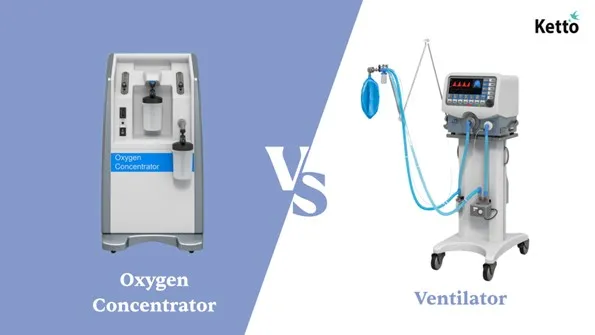
- Ventilator → Breathes for the patient
- Oxygen Concentrator → Supplies oxygen to a
patient who can breathe
Both are respiratory devices, but
their role, complexity, and risk profile are completely different.
What Is a Ventilator?
A ventilator is a life-support
machine that mechanically moves air in and out of the lungs when a patient
cannot breathe adequately on their own.
Common settings:
- ICU
- Operation Theatre
- Emergency department
Ventilator machine, ICU ventilator, mechanical ventilation
How a Ventilator Works
- Air/oxygen is delivered under pressure
- Lungs inflate (inhalation)
- Gas exits lungs (exhalation)
- Cycle repeats based on programmed settings
Ventilators can fully or
partially control breathing.
Ventilator Working


When Is a Ventilator Used?

Ventilators are required when
patients have:
- Respiratory failure
- Severe pneumonia
- ARDS
- Brain injury affecting breathing
- During general anesthesia
- Severe COVID-19 complications
These patients cannot maintain
adequate breathing on their own.
What Is an Oxygen
Concentrator?
An oxygen concentrator is a
medical device that concentrates oxygen from room air and delivers it to a
patient who can breathe independently but needs higher oxygen levels.
Common settings:
- Home care
- Wards
- Clinics
Oxygen concentrator, home oxygen machine, oxygen therapy device
How an Oxygen Concentrator
Works
- Draws room air
- Filters out nitrogen
- Concentrates oxygen (90-95%)
- Delivers oxygen via nasal cannula or mask
It does not assist breathing only
increases oxygen availability.
Oxygen
Concentrator Working


Key Differences Between
Ventilator and Oxygen Concentrator
|
Feature |
Ventilator |
Oxygen
Concentrator |
|
Primary
function |
Assists/controls
breathing |
Supplies
oxygen |
|
Breathing
support |
Yes
(mechanical) |
No |
|
Patient
breathing ability |
Poor or
absent |
Present |
|
Clinical
setting |
ICU / OT |
Home / ward |
|
Complexity |
Very high |
Low |
|
Risk level |
High (life
support) |
Low |
|
Requires
intubation |
Often yes |
No |
|
Cost |
Very high |
Moderate |
Ventilator: Types & Modes
(Brief Overview)
Types
- Invasive ventilator
- Non-invasive ventilator (BiPAP/CPAP)
Modes
- Volume Control
- Pressure Control
- SIMV
- PSV
Ventilator settings must be
managed by trained clinicians.
Oxygen Concentrator: Types
& Flow Rates
Types
- Stationary oxygen concentrator (5-10 LPM)
- Portable oxygen concentrator
Delivery Methods
- Nasal cannula
- Oxygen mask
Used under medical prescription,
often long-term.
Which One Is Needed -
Ventilator or Oxygen Concentrator?
Use a Ventilator If:
- Patient cannot breathe adequately
- Severe respiratory distress
- ICU-level care required
Use an Oxygen Concentrator If:
- Patient breathes on own
- Low oxygen saturation (SpO₂)
- Home or ward-based care
Never substitute one for the
other.
Home
vs ICU Respiratory Care


Cost Comparison (India)
|
Device |
Approx
Price |
|
ICU
Ventilator |
₹6 - 25
lakhs+ |
|
Non-Invasive
Ventilator |
₹1 - 3 lakhs |
|
Oxygen
Concentrator |
₹35,000 -
₹1.2 lakhs |
Costs vary by brand, features,
and service support.
Safety & Training
Requirements
Ventilator:
- Requires ICU setup
- Trained doctors & nurses
- Continuous monitoring
Oxygen Concentrator:
- Minimal training
- Regular filter maintenance
- Electricity backup recommended
Common Myths (Clarified)
“Oxygen concentrator can replace
a ventilator”
False
“Ventilators are used at home”
Rare, only
under strict medical supervision
“Oxygen concentrators are
dangerous”
Safe when
used as prescribed
Advantages & Limitations
- Ventilator - Pros
- Life-saving
- Full respiratory support
- Cons
- Expensive
- High risk if misused
Oxygen Concentrator - Pros
- Easy to use
- Suitable for home care
Cons
- No breathing support
- Not for critical patients
Conclusion
Understanding the difference
between a ventilator and an oxygen concentrator is crucial for safe respiratory
care. While a ventilator is a life-support system used in critical care to
assist or control breathing, an oxygen concentrator is a supportive therapy
device for patients who can breathe but need supplemental oxygen.
Choosing the correct device
depends on clinical condition, care setting, and medical guidance.
At Aarogyaa Bharat, we help
hospitals and families make informed, safe, and cost-effective respiratory
equipment decisions, ensuring the right device is used at the right time for
the right patient.





