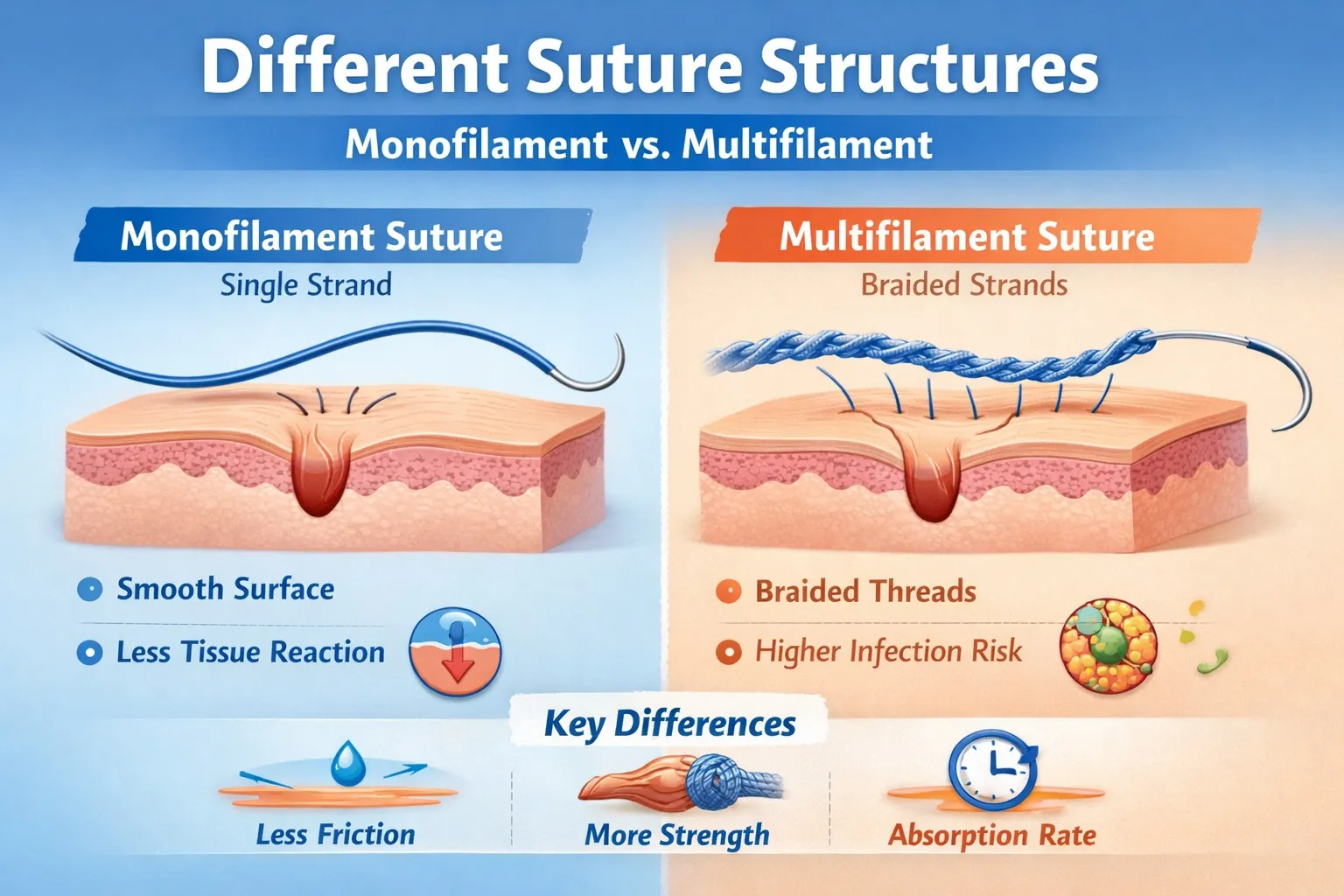
This detailed guide by Aarogyaa Bharat explains:
- What
monofilament and multifilament sutures are
- Structural
differences between the two
- Advantages
and limitations of each type
- Clinical
applications and use cases
- Factors
surgeons consider when selecting suture structure
What Are Suture Structures?
Suture structure refers to how the suture thread is
constructed, not the material itself. Based on structure, sutures are
classified into:
- Monofilament
sutures - made of a single strand
- Multifilament
sutures - made of multiple braided or twisted strands
This structural difference significantly affects performance
during surgery and healing.
What Are Monofilament Sutures?
Monofilament sutures are composed of a single, smooth strand
of material. They pass through tissue with minimal resistance and have a lower
tendency to harbor bacteria.
Common Monofilament Sutures
- Nylon
- Polypropylene
(Prolene)
- PDS
(Polydioxanone)
- Monocryl
Advantages of Monofilament Sutures
Minimal tissue drag
Lower risk of infection
Reduced capillary action
Less tissue reaction
Limitations of Monofilament Sutures
Lower knot security
More difficult handling
Knots may loosen if not secured properly
Common Uses
- Skin
closure
- Cardiovascular
surgery
- Contaminated
or infected wounds
- Subcuticular
suturing
What Are Multifilament Sutures?
Multifilament sutures consist of multiple strands braided or
twisted together, providing greater flexibility and knot security.
Common Multifilament Sutures
- Silk
- Vicryl
(Polyglactin 910)
- Polyester
- Ethibond
Advantages of Multifilament Sutures
Superior knot security
Easier handling
Better tensile strength at knots
Ideal for precise tissue approximation
Limitations of Multifilament Sutures
Higher infection risk
Increased tissue drag
Capillary action may wick bacteria
Common Uses
General soft tissue closure
- Gastrointestinal
surgery
- Vascular
ligation
- Surgical
areas requiring secure knots
Monofilament vs. Multifilament Sutures: Key Differences
|
Feature |
Monofilament |
Multifilament |
|
Structure |
Single strand |
Multiple
braided strands |
|
Surface |
Smooth |
Textured |
|
Tissue drag |
Low |
Higher |
|
Infection
risk |
Lower |
Higher |
|
Knot security |
Lower |
Higher |
|
Handling |
More
difficult |
Easier |
|
Capillarity |
Minimal |
Present |
Infection Risk and Capillarity
Multifilament sutures can exhibit capillary action, allowing fluids and bacteria to travel along the suture strands. This makes them less suitable for contaminated or infected wounds.
Monofilament sutures, with their smooth surface, do not wick fluids, making them safer in high-risk infection scenarios.
Choosing the Right Suture Structure
Surgeons consider the following when selecting suture structure:
- Surgical
site
- Infection
risk
- Tissue
type
- Wound
tension
- Required
knot security
- Healing
duration
There is no universally ideal suture - the choice depends on
clinical needs.
Clinical Examples
- Skin
closure: Monofilament (nylon, polypropylene)
- Bowel
surgery: Multifilament (Vicryl)
- Vascular
surgery: Monofilament
- Ligatures:
Multifilament
How Aarogyaa Bharat Supports Surgical Excellence
At Aarogyaa Bharat, we support surgeons and healthcare
facilities with:
- High-quality
surgical sutures
- Monofilament
and multifilament options
- OT
consumables and surgical instruments
- Trusted
medical education resources
Our goal is to ensure safe surgery, optimal healing, and reliable outcomes.
Conclusion
Understanding suture structure - monofilament vs.
multifilament - is essential for effective wound closure. Monofilament sutures
offer lower infection risk and smoother tissue passage, while multifilament
sutures provide superior handling and knot security.
Selecting the correct suture structure improves:
Healing outcomes
Infection control
Surgical efficiency
In surgery, structure matters as much as material.