What Is an ECG and Why Is It Important?
An ECG (Electrocardiogram) records the electrical
signals generated by the heart as it beats. Every heartbeat is triggered by an
electrical impulse, and the ECG captures how these impulses:
- Start
- Travel
through the heart
- And
reset for the next beat
What an ECG Can Tell You
- Heart
rate (fast, slow, normal)
- Heart
rhythm (regular or irregular)
- Evidence
of heart attack or ischemia
- Electrolyte
imbalance
- Effects
of medications
- Structural
heart problems
An ECG is quick, painless, non-invasive, and often the first
test ordered in cardiac emergencies.
Before You Start: Know the ECG Paper Basics
Understanding ECG paper is essential before interpreting the
waveform.
ECG Grid Basics
- Small
square: 0.04 seconds (time)
- Large
square (5 small): 0.20 seconds
- 5
large squares: 1 second
Vertically:
- Each
small square = 0.1 mV (voltage)
This grid allows you to calculate rate, rhythm, and
intervals accurately.
The Golden Rule of ECG Interpretation
Always follow a fixed sequence.
Never jump straight to conclusions.
A simple beginner-friendly sequence is:
- Check
calibration
- Calculate
heart rate
- Assess
rhythm
- Identify
P waves
- Measure
PR interval
- Examine
QRS complex
- Look
at ST segment
- Check
T waves
Let’s go step by step.
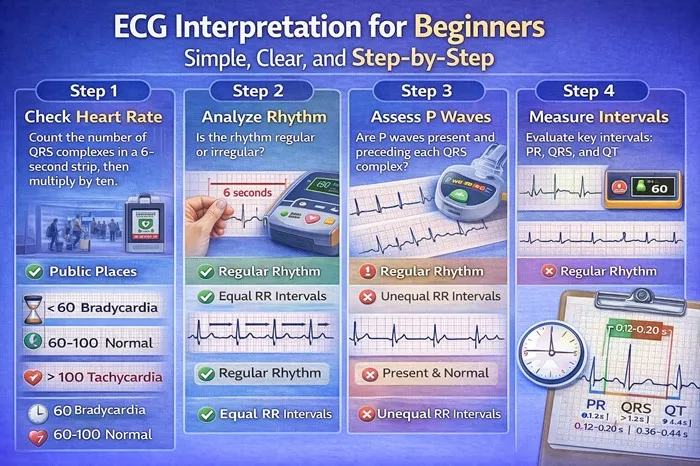
Step 1: Check ECG Calibration
Before interpreting anything, ensure the ECG is recorded
correctly.
- Standard
calibration: 10 mm = 1 mV
- Paper
speed: 25 mm/second
Incorrect calibration can lead to false interpretations.
Step 2: Calculate the Heart Rate
Method 1: Large Box Method (Regular Rhythm)
- Count
large squares between two R waves
- Heart
rate = 300 ÷ number of large squares
Example:
- 4
large squares → 300 ÷ 4 = 75 bpm
Method 2: 6-Second Method (Irregular Rhythm)
- Count
number of QRS complexes in 6 seconds
- Multiply
by 10
This method is commonly used in real-life clinical settings.
Step 3: Assess the Heart Rhythm
Ask yourself:
- Are
R-R intervals equal?
- Is
the rhythm regular or irregular?
A regular rhythm suggests normal conduction, while an
irregular rhythm may indicate arrhythmias like atrial fibrillation.
Step 4: Identify the P Wave
The P wave represents atrial depolarization (atria
contracting).
Normal P Wave
- Present
before every QRS
- Same
shape throughout
- Upright
in most leads
What to Look For
- No
P waves → possible atrial fibrillation
- Too
many P waves → atrial flutter
- Inverted
P waves → abnormal atrial origin
Step 5: Measure the PR Interval
The PR interval reflects conduction from the atria to the
ventricles.
Normal PR Interval
- 0.12-0.20
seconds
- (3-5
small squares)
Clinical Meaning
- Prolonged
PR → first-degree AV block
- Short
PR → pre-excitation (e.g., WPW syndrome)
Step 6: Examine the QRS Complex
The QRS complex represents ventricular depolarization.
Normal QRS Duration
- Less
than 0.12 seconds (3 small squares)
Why It Matters
- Narrow
QRS → normal ventricular conduction
- Wide
QRS → bundle branch block or ventricular rhythm
A wide QRS often signals a more serious condition.
Step 7: Evaluate the ST Segment
The ST segment is one of the most critical parts of ECG
interpretation.
Normal ST Segment
- Flat
and at baseline
Abnormal Findings
- ST
elevation → acute myocardial infarction (heart attack)
- ST
depression → ischemia or strain
Even small ST changes can be life-threatening and should
never be ignored.
Step 8: Analyse the T Wave
The T wave represents ventricular repolarization.
Normal T Wave
- Upright
- Smooth
and rounded
Abnormal T Waves
- Inverted
T waves → ischemia
- Tall
peaked T waves → hyperkalemia
- Flat
T waves → hypokalemia
Electrolyte disturbances often show up first on ECG.
Putting It All Together: A Simple ECG Checklist
For beginners, ask these questions every time:
- Is
the rate normal?
- Is
the rhythm regular?
- Is
there a P wave before every QRS?
- Is
the PR interval normal?
- Is
the QRS narrow or wide?
- Are
ST segments normal?
- Are
T waves normal?
This systematic approach prevents missed diagnoses.
Common ECG Patterns Beginners Should Recognize
Normal Sinus Rhythm
- Rate:
60-100 bpm
- Regular
rhythm
- P
before every QRS
- Normal
intervals
Sinus Bradycardia
- Rate
< 60 bpm
- Regular
rhythm
Sinus Tachycardia
- Rate
> 100 bpm
- Regular
rhythm
Atrial Fibrillation
- No
P waves
- Irregularly
irregular rhythm
Recognizing these early builds strong foundations.
Why ECG Interpretation Matters in Real Life
Accurate ECG interpretation helps:
- Detect
heart attacks early
- Prevent
sudden cardiac death
- Guide
emergency treatment
- Monitor
medication effects
- Save
lives in critical minutes
In emergency medicine, an ECG can change outcomes within
seconds.
Tips for Beginners Learning ECG Interpretation
- Practice
daily with real ECG strips
- Always
follow a fixed sequence
- Focus
on basics before rare conditions
- Compare
with normal ECGs
- Learn
patterns, not memorization
Confidence comes with repetition.
Conclusion
ECG interpretation is not about memorizing waves it’s about
understanding the heart’s electrical story. When you approach ECGs with a calm,
step-by-step method, those complex-looking lines turn into meaningful
information that can guide diagnosis and save lives.
For beginners, mastering the basics of ECG interpretation
builds confidence, sharpens clinical thinking, and opens the door to advanced
cardiac care.
At Aarogyaa Bharat, our mission is to make medical knowledge
simple, practical, and empowering so learners at every level can grow with
confidence.