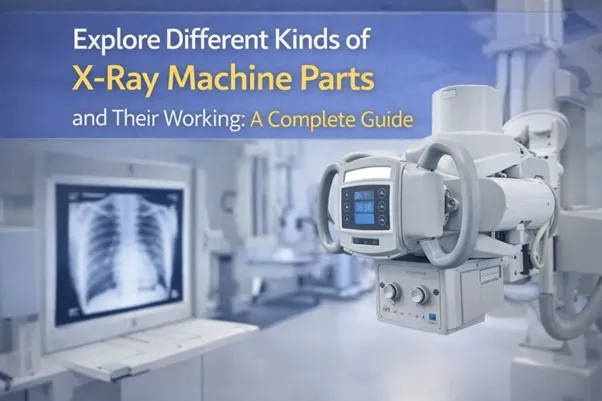
What Is an X-Ray Machine? (Quick Overview)
An X-ray machine is a diagnostic
imaging device that uses controlled ionizing radiation to create images of
internal body structures such as:
- Bones
- Chest & lungs
- Abdomen
- Teeth
- Joints
The clarity, safety, and accuracy
of imaging depend on how well each component performs.
X-ray machine parts, X-ray equipment components, medical X-ray system
How Does an X-Ray Machine
Work? (Basic Principle)
X-ray machines work on the
principle of electromagnetic radiation:
- Electricity heats the filament
- Electrons are released
- High voltage accelerates electrons
- Electrons strike the target (anode)
- X-rays are produced
- X-rays pass through the body
- Detector captures the image
Each part plays a critical role
in this process.
Main Parts of an X-Ray Machine
and Their Working
X-Ray Tube (Heart of the
Machine)
The X-ray tube is where X-rays
are generated.
Components of X-Ray Tube
- Cathode - Tungsten filament that emits
electrons
- Anode - Tungsten target that produces X-rays
Working
- Filament heats → electrons released
- Electrons strike anode → X-rays produced
X-ray tube function
X-Ray Tube Diagram
Cathode Assembly
Function
- Produces and focuses electrons
Components
- Tungsten filament
- Focusing cup
Importance
Ensures a sharp, focused X-ray
beam, improving image quality.
Anode Assembly
Types
- Stationary anode - Dental & portable X-rays
- Rotating anode - Hospital radiology systems
Function
- Converts electron energy into X-rays
- Dissipates heat
Rotating anodes handle higher
workloads safely.
High Voltage Generator
Function
- Supplies high voltage (kVp)
- Controls beam penetration
Why It Matters
- Higher kVp = deeper penetration
- Lower kVp = soft tissue imaging
Ensures image clarity with
controlled radiation dose.
Control Console (Operator
Panel)
The control console is the brain
of the X-ray system.
Controls Include
- kVp (beam energy)
- mA (beam intensity)
- Exposure time
Radiographers adjust these
settings based on body part and patient size.
X-Ray Control Console
Collimator
Function
- Limits size and shape of X-ray beam
- Reduces unnecessary radiation exposure
Benefits
Improved
image contrast
Patient safety
Filters
Function
- Remove low-energy X-rays
- Reduce patient dose
Common Materials
- Aluminium
- Copper
Filters are mandatory for
radiation safety compliance.
Patient Table / X-Ray Table
Function
- Supports patient positioning
- Ensures accurate imaging angles
Tables may be:
- Fixed
- Floating
- Motorized
X-Ray Tube Stand / Gantry
Supports and positions the X-ray
tube precisely.
Types
- Floor-mounted
- Ceiling-suspended
- Mobile stand
Essential for proper alignment
and workflow efficiency.
Image Receptor / Detector
Types
- CR (Computed Radiography)
- DR (Digital Radiography)
Function
- Captures X-ray image
- Converts into digital format
DR systems offer faster imaging
and lower radiation dose.
Digital X-Ray Detector
1X-Ray Grid
Function
- Absorbs scattered radiation
- Improves image contrast
Used mainly in chest and
abdominal imaging.
1Cooling System
Function
- Dissipates heat generated in X-ray tube
Types
- Oil cooling
- Air cooling
Prevents tube damage and extends
lifespan.
1Radiation Shielding
Components
Includes
- Lead-lined tube housing
- Protective barriers
- Lead aprons
Ensures staff and patient safety.
Types of X-Ray Machines Based
on Configuration
- Fixed radiography X-ray
- Mobile X-ray machine
- Digital X-ray system
- Dental X-ray machine
- C-arm X-ray machine
Each uses the same core
components with design variations.
Importance of Understanding
X-Ray Machine Parts
- Better equipment maintenance
- Improved image quality
- Reduced downtime
- Enhanced radiation safety
- Informed purchasing decisions
Maintenance & Quality
Control
- Tube output testing
- Detector calibration
- Collimator alignment
- Radiation leakage checks
Regular maintenance ensures
compliance with AERB guidelines.
Future Advancements in X-Ray
Technology
- AI-based image enhancement
- Wireless detectors
- Dose optimization software
- Portable digital X-ray systems
Conclusion
Understanding the different kinds
of X-ray machine parts and their working is essential for safe operation,
accurate diagnosis, and smart equipment investment. Each component from the
X-ray tube and generator to the detector and shielding plays a vital role in
producing high-quality diagnostic images while minimizing radiation exposure.
For hospitals and diagnostic
centers, this knowledge leads to better maintenance practices, informed
purchases, and improved patient outcomes.
At Aarogyaa Bharat, we guide
healthcare providers in selecting certified, high-performance X-ray machines
and ensure they understand the technology behind every image they capture.