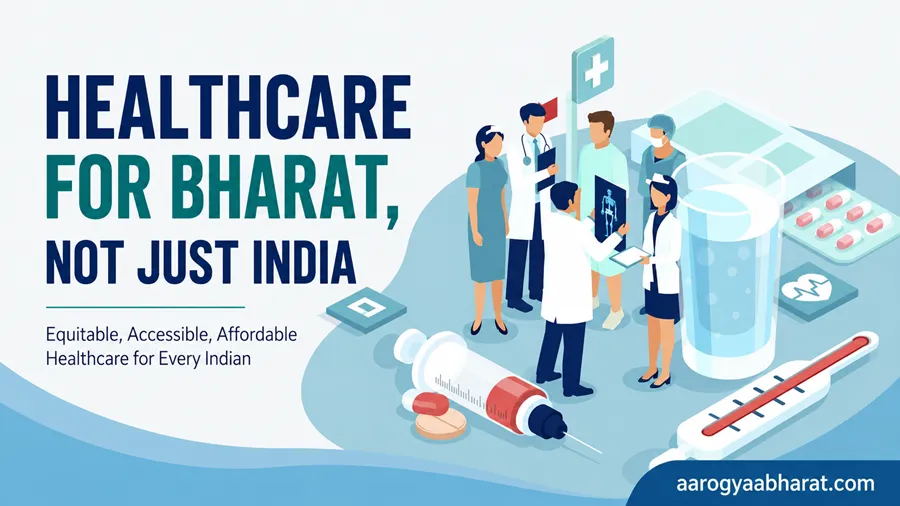
A Nation Is Only Truly Developed When Healthcare Reaches
Every Corner
India’s growth story is often seen through the lens of
cities, technology hubs, and industrial development. But true development is
not limited to urban skylines or metro progress. Real progress begins when
healthcare reaches every single citizen, no matter where they live. “Healthcare
for Bharat, not just India” represents this deeper vision where healthcare is
not a privilege for a few, but a basic right for all. It is a vision where a
farmer in a remote village has the same access to medical support as a citizen
in a metropolitan city. It is about building a system where distance,
geography, and income do not decide the quality of healthcare a person
receives. A developed nation is one where even the most remote village is
connected to life-saving healthcare services.
The Reality of Rural Healthcare Gaps
While India has made remarkable progress in healthcare
infrastructure, a large portion of the population still lives in rural and
semi-rural areas where medical facilities are limited. Many villages do not
have nearby hospitals, specialist doctors, or advanced diagnostic centers. In
emergencies, families are forced to travel long distances, often losing
precious time. Basic healthcare services are sometimes unavailable or
understaffed. This creates a major gap between urban and rural healthcare
access. These challenges highlight a simple truth India’s healthcare system
cannot be considered complete unless it serves Bharat in its entirety. Rural
communities need stronger infrastructure, better staffing, and improved access
to essential medical services to ensure equal healthcare opportunities for all.
Building Healthcare Where People Actually Live
Healthcare for Bharat means shifting focus from centralized
urban hospitals to decentralized, community-based healthcare systems. Instead
of expecting rural patients to travel to cities, healthcare must reach them
where they live. This includes strengthening primary health centers,
introducing mobile healthcare units, and expanding local diagnostic facilities.
It also means ensuring availability of essential medicines, emergency care, and
trained medical staff in rural areas. When healthcare becomes locally
accessible, it reduces delays, saves lives, and improves trust in the system. A
strong rural healthcare network ensures that no patient is left untreated
simply because they live far from a city.
The Power of Digital Healthcare in Rural India
Digital healthcare is becoming a game-changer for rural
inclusion. Through telemedicine, patients in remote areas can consult doctors
without traveling long distances. Mobile health platforms allow families to
access medical advice, book consultations, and receive prescriptions digitally.
Even basic smartphones are now becoming tools for healthcare access in rural
India. Digital diagnostics and remote monitoring systems are helping doctors
track patient conditions from cities while patients stay in their villages.
This bridge between technology and rural healthcare is slowly removing barriers
that once seemed impossible to overcome. It is making healthcare more equal,
faster, and more connected.
Affordable Healthcare as a Right, not a Privilege
For rural India, affordability is one of the biggest
barriers to healthcare access. Many families hesitate to seek treatment because
of cost concerns. Healthcare for Bharat means ensuring that treatment, medical
equipment, and essential services are affordable for every income group. No
family should have to choose between financial stability and medical care.
Affordable healthcare builds trust and encourages early treatment, which
prevents diseases from becoming severe. When healthcare becomes financially accessible,
rural communities become healthier, more productive, and more secure.
Strengthening Primary Healthcare Systems
Primary healthcare centers are the backbone of rural
healthcare in India. However, many of these centers still lack proper
infrastructure, equipment, and skilled professionals. Strengthening these
centers is essential for building healthcare for Bharat. When primary care is
strong, most health issues can be treated locally without the need for hospital
travel. This reduces pressure on urban hospitals and ensures faster treatment
for rural populations. Better-equipped health centers also improve maternal care,
child health, and preventive healthcare services in villages.
Mobile Healthcare Units Bringing Care to Doorsteps
In many remote regions, physical hospitals cannot reach
every village easily. This is where mobile healthcare units play a vital role.
These units bring doctors, diagnostic tools, and medicines directly to rural
communities. They act as moving healthcare centers that can serve multiple
villages. Mobile healthcare bridges the gap between accessibility and need,
ensuring that even the most isolated communities receive timely medical
attention. This model is especially effective for preventive care, vaccinations,
and basic diagnostics.
Preventive Healthcare for Rural Communities
Preventive healthcare is extremely important for rural
India, where awareness about early disease detection may be limited. Educating
communities about hygiene, nutrition, vaccinations, and regular health checkups
can significantly reduce disease burden. Many health conditions become severe
simply due to delayed diagnosis. Preventive healthcare helps stop diseases
before they become life-threatening. When rural populations are educated and
empowered about health, entire communities become stronger and healthier over
time.
The Role of Technology in Rural Transformation
Technology is not just for cities it is becoming a powerful
tool for rural transformation. Affordable smartphones, internet connectivity,
and digital healthcare platforms are helping rural India connect with modern
medical systems. Artificial intelligence, remote diagnostics, and mobile health
apps are gradually entering rural healthcare ecosystems. These tools help
doctors extend their reach beyond hospitals and provide care to underserved
populations. Technology is turning distance into connection and isolation into
access.
Human Connection Still Matters Most
Even with advanced technology, healthcare remains deeply
human. Rural patients often rely on trust, relationships, and personal care
when choosing healthcare services. Doctors, nurses, and healthcare workers play
a crucial role in building this trust in rural communities. Compassion,
empathy, and consistent care are just as important as technology and
infrastructure. Healthcare for Bharat must combine modern innovation with human
connection to create a system that people believe in and depend on.
A Future Where No One Is Left Behind
The vision of healthcare for Bharat is a future where every
citizen, regardless of location, income, or background, has equal access to
quality healthcare. It is a future where villages are not behind cities in
healthcare access. It is a system where technology, affordability, and
infrastructure work together to eliminate healthcare inequality. When rural
India becomes strong, the entire nation becomes stronger. A truly developed
India is one where healthcare reaches every home, every village, and every person
without exception.
Conclusion
Healthcare for Bharat is not just a policy idea it is a moral responsibility and a national vision. It focuses on bridging the gap between urban and rural healthcare systems through accessibility, affordability, and technology. By strengthening rural infrastructure, expanding digital healthcare, and ensuring compassionate care, India can build a truly inclusive healthcare system. A healthy Bharat means a strong India, and a strong India begins when healthcare reaches every corner of the nation.