What Is Sudden Cardiac Arrest?
Sudden cardiac arrest (SCA) occurs when the heart
suddenly stops beating effectively. As a result:
- Blood
flow to the brain and body stops
- The
person becomes unconscious within seconds
- Normal
breathing stops or becomes gasping
Without immediate action, irreversible brain damage can
begin within 4-6 minutes, and death can follow soon after.
Sudden cardiac arrest is not the same as a heart attack. A
heart attack is a circulation problem, while cardiac arrest is an electrical
failure of the heart.
What Is CPR (Cardio Pulmonary Resuscitation)?
CPR is an emergency procedure that combines:
- Chest
compressions to manually pump blood
- Rescue
breaths (in some cases) to provide oxygen
CPR does not restart the heart on its own, but it keeps
vital organs alive until defibrillation or advanced medical care is available.
Why CPR Is So Important
When CPR is started immediately:
- Chances
of survival double or triple
- Brain
damage is delayed
- Time
is gained until emergency services arrive
In sudden cardiac arrest, doing something is always better
than doing nothing.
When Should You Perform CPR?
Start CPR if the person:
- Has
collapsed suddenly
- Is
unresponsive (does not respond to shouting or shaking)
- Is
not breathing normally (no breathing or only gasping)
If you are unsure, assume cardiac arrest and start CPR.
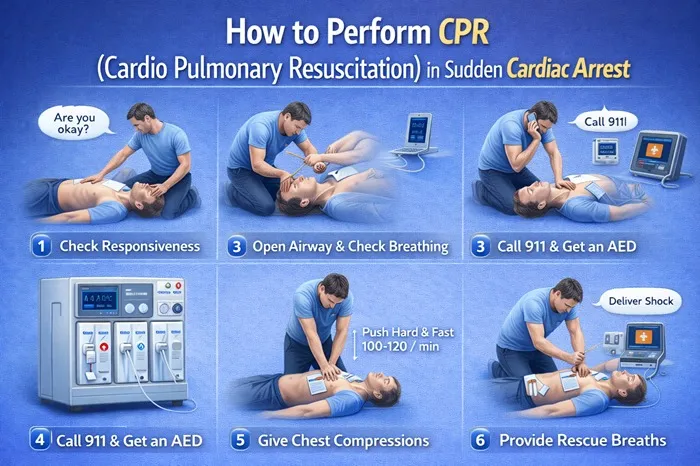
Step-by-Step: How to Perform CPR in Sudden Cardiac Arrest
Step 1: Ensure Scene Safety
Before helping, quickly check that the area is safe for you
and the victim (traffic, electricity, fire, etc.).
Step 2: Check Responsiveness
- Tap
the person’s shoulders
- Shout
loudly: “Are you okay?”
If there is no response, act immediately.
Step 3: Call for Help
- Shout
for nearby help
- Call
emergency medical services (EMS) or ask someone else to call
- If
available, ask someone to bring an AED (Automated External Defibrillator)
Step 4: Check Breathing
- Look
for chest movement
- Listen
for breathing
- Feel
for breath
If the person is not breathing or only gasping, start CPR.
Hands-Only CPR (Recommended for Untrained Bystanders)
If you are not trained in rescue breathing, hands-only CPR
is highly effective.
- Place
the heel of one hand on the center of the chest
- Place
your other hand on top
- Keep
arms straight, shoulders over hands
- Push
hard and fast
Compression Details
- Rate:
100-120 compressions per minute
- Depth:
About 5-6 cm (2 inches) in adults
- Allow
full chest recoil after each compression
Continue until:
- Emergency
help arrives
- An
AED is ready
- The
person shows signs of life
- You
are physically exhausted
CPR With Rescue Breaths (If You Are Trained)
Compression-to-Breath Ratio
- 30
chest compressions
- 2
rescue breaths
How to Give Rescue Breaths
- Open
the airway by tilting the head back and lifting the chin
- Pinch
the nose
- Give
one breath over 1 second
- Watch
the chest rise
- Give
the second breath
Then return immediately to chest compressions.
CPR for Children and Infants (Basic Difference)
- Use
gentler compressions
- For
infants, use two fingers instead of hands
- Compression
depth: about one-third of chest depth
If unsure, follow emergency dispatcher instructions.
Using an AED During CPR
An AED (Automated External Defibrillator) can analyse heart
rhythm and deliver a shock if needed.
How AED Fits Into CPR
- Turn
on the AED and follow voice prompts
- Attach
pads as instructed
- Stop
compressions only when told
- Resume
CPR immediately after shock or “no shock advised” message
AEDs are designed for public use and are safe even for
non-medical users.
Common Myths About CPR
- “I
might break ribs.”
Broken ribs are less dangerous than death. CPR saves lives. - “I’m
afraid of doing it wrong.”
Any attempt is better than no attempt. - “CPR
always revives the person.”
CPR buys time it doesn’t guarantee revival, but it greatly improves survival chances.
What to Do After CPR
- Continue
care until professionals take over
- Provide
details of what happened
- Take
care of yourself performing CPR can be emotionally intense
Cardiac arrest can happen:
- At
home
- At
work
- In
public places
- To
people of all ages
Learning CPR means you could one day save a loved one or a
stranger.
Conclusion
Knowing how to perform CPR in sudden cardiac arrest is not just medical knowledge it is a life skill. In moments of crisis, quick action, steady hands, and the courage to help can keep someone alive long enough for professional treatment. You don’t need to be perfect. You just need to act.
At Aarogyaa Bharat, we believe awareness and preparedness
save lives. Learning CPR today could mean giving someone a second chance at
life tomorrow.