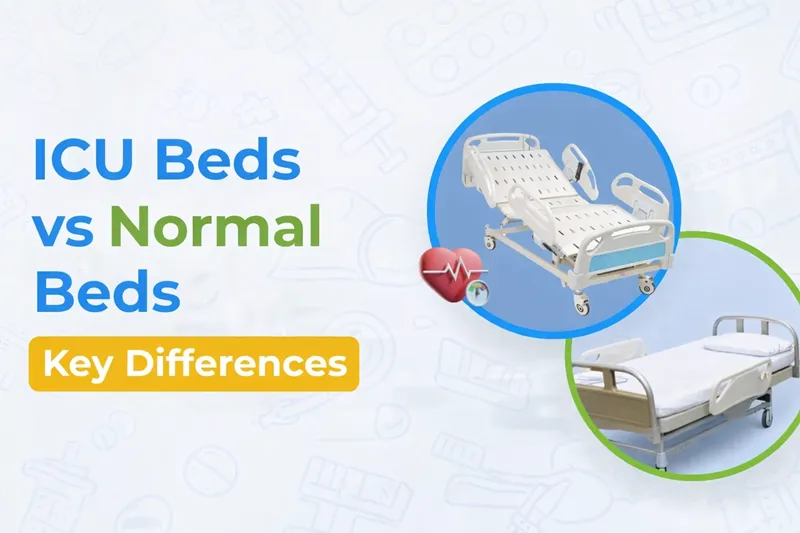
ICU beds and normal beds serve completely different
purposes. Understanding the difference is essential to ensure patient safety,
comfort, recovery, and cost efficiency especially in India, where home care,
long-term illness management, and elderly care are increasingly common.
This in-depth guide explains ICU beds vs normal beds,
covering functionality, medical needs, safety, caregiver impact, cost, and
practical use cases so families can make the right, medically sound decision
rather than an emotional or costly one.
Understanding the Two Bed Types
What Is an ICU Bed?
An ICU (Intensive Care Unit) bed is a highly specialised
medical bed designed for critically ill patients who require continuous
monitoring, life-support equipment, and frequent medical intervention.
ICU beds are usually found in:
- Hospital
intensive care units
- Trauma
centres
- Critical
care wards
They are not designed primarily for comfort they are
designed for medical access, emergency response, and survival support.
What Is a Normal Bed?
A normal bed refers to a standard household bed, typically
used for everyday sleeping at home.
Normal beds are:
- Fixed
in height
- Flat
or minimally adjustable
- Designed
for comfort, not medical care
While suitable for healthy individuals, normal beds often
fail to support medical or recovery needs during illness.
ICU Beds vs Normal Beds: Core Purpose Difference
|
Aspect |
ICU Bed |
Normal Bed |
|
Primary Use |
Critical care |
Everyday
sleeping |
|
Patient
Condition |
Life-threatening |
Healthy or
mild illness |
|
Monitoring |
Continuous |
None |
|
Medical
Equipment |
Integrated |
Not supported |
|
Comfort Focus |
Secondary |
Primary |
|
Caregiver
Support |
Medical staff |
Family only |
Design and Functionality Differences
ICU Bed Design
ICU beds are engineered to:
- Support
ventilators and monitors
- Allow
rapid access from all sides
- Enable
emergency procedures
- Adjust
into complex medical positions
Common features include:
- Fully
electric controls
- CPR
emergency release
- Trendelenburg
and reverse Trendelenburg positions
- Integrated
weighing systems
- X-ray
compatible surfaces
Normal Bed Design
Normal beds are designed for:
- Rest
and sleep
- Minimal
posture variation
- Domestic
use
They lack:
- Height
adjustment
- Medical
positioning
- Safety
rails
- Emergency
features
Patient Safety: ICU Beds vs Normal Beds
ICU Bed Safety
ICU beds prioritise:
- Emergency
readiness
- Fall
prevention in unconscious patients
- Rapid
repositioning during crises
However:
- They
require trained handling
- Improper
use can cause discomfort
- They
are not intuitive for family caregivers
Normal Bed Safety
Normal beds:
- Offer
basic sleeping safety
- Lack
fall protection
- Increase
risk for weak or dizzy patients
For ill or elderly patients, normal beds often increase fall
and injury risk.
Comfort and Recovery Experience
Comfort on ICU Beds
ICU beds are:
- Firm
and clinical
- Designed
for stability, not relaxation
- Often
uncomfortable for long-term conscious patients
Patients may experience:
- Poor
sleep
- Anxiety
- Feeling
“medicalised”
Comfort on Normal Beds
Normal beds provide:
- Familiar
sleeping comfort
- Psychological
reassurance
However, during illness they may:
- Cause
posture pain
- Increase
pressure points
- Worsen
breathing or reflux
ICU Beds vs Normal Beds in Home Care
Can ICU Beds Be Used at Home?
Technically yes but rarely advisable.
ICU beds at home make sense only when:
- Patient
is ventilator-dependent
- Continuous
medical supervision is available
- Emergency
response systems are in place
For most homes, ICU beds are:
- Overly
complex
- Extremely
expensive
- Difficult
to maintain
Normal Beds for Home Care: Are They Enough?
Normal beds may work for:
- Very
mild illness
- Short-term
rest
They are not suitable for:
- Elderly
care
- Post-surgery
recovery
- Long-term
illness
- Stroke
or paralysis care
Cost Comparison in India (High-Search Topic)
ICU Bed Cost in India
- Basic
ICU bed: ₹2.5 – ₹4 lakh
- Advanced
ICU bed: ₹4 – ₹8+ lakh
- Additional
equipment: Extra cost
Maintenance, electricity, and service costs are high.
Normal Bed Cost in India
- Wooden
or metal bed: ₹10,000 – ₹40,000
- Mattress
extra
Low cost but no medical value.
Caregiver Impact: ICU Bed vs Normal Bed
ICU Beds and Caregivers
- Require
training
- Complex
controls
- High
dependency on professionals
Family caregivers may feel overwhelmed.
Normal Beds and Caregivers
- Require
manual lifting
- High
risk of caregiver injury
- Increased
physical strain
Neither is ideal for long-term caregiving at home.
ICU Beds vs Normal Beds vs Hospital Beds (Important
Clarification)
Most families confuse ICU beds with hospital beds.
- ICU
beds → Critical, life-support care
- Normal
beds → Everyday sleeping
- Hospital
beds (non-ICU) → Recovery, elderly care, home nursing
For home care, hospital beds (manual, semi-electric, fully
electric) are usually the best option.
Which Bed Is Right for Which Situation?
ICU Bed Is Right If:
- Patient
is critically ill
- Ventilator
or life-support is required
- Continuous
monitoring is mandatory
Normal Bed Is Right If:
- Person
is healthy
- No
medical support is required
Neither Is Right If:
- Patient
is elderly
- Recovery
is ongoing
- Long-term
care is needed
In such cases, a hospital bed is the correct choice.
Common Myths About ICU Beds
Myth: ICU beds are better for all patients
Reality: They are only better for critically ill patients
Myth: ICU beds speed up recovery
Reality: Recovery depends on comfort, sleep, and mobility not ICU
features
Myth: ICU beds are ideal for home care
Reality: They are usually impractical at home
Risks of Choosing the Wrong Bed
Choosing an ICU bed unnecessarily can lead to:
- Emotional
distress
- High
financial burden
- Poor
sleep quality
Choosing a normal bed for a sick patient can cause:
- Falls
- Bedsores
- Delayed
recovery
- Caregiver injuries
Conclusion: The Right Bed Saves More Than Money
Choosing between an ICU bed and a normal bed is not about
choosing the most advanced or the cheapest option it is about choosing the
right tool for the patient’s condition.
- ICU
beds save lives in critical situations
- Normal
beds serve healthy individuals
- Neither
is ideal for recovery, elderly care, or long-term home care
For families, understanding this distinction prevents:
- Unnecessary
expense
- Increased
risk
- Emotional
stress
The best care decision is an informed one. When the bed
matches the patient’s real medical needs, recovery improves, caregivers remain
safe, and care becomes more humane and effective.
A bed does not treat illness but the right bed supports
healing, dignity, and safety every single day.
At Aarogyaa Bharat, we help you understand the real difference between ICU beds and normal beds - so you can make safe, practical, and informed care decisions for your loved ones.