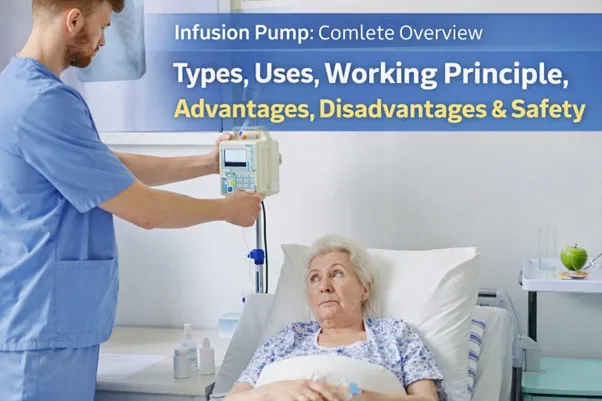
What Is an Infusion Pump?


An infusion pump is a medical
device used to deliver fluids, medications, or nutrients into a patient’s body
in a controlled and precise manner. Unlike manual IV drips, infusion pumps
regulate:
- Flow rate
- Volume
- Duration
with high accuracy, reducing the
risk of human error.
Infusion pump, IV infusion pump, medical infusion device
Why Are Infusion Pumps
Important in Healthcare?
Manual drug administration can
lead to:
- Overdose or underdose
- Inconsistent delivery
- Increased nursing workload
Infusion pumps ensure:
- Accurate dosing
- Continuous drug delivery
- Reduced medication errors
- Better patient outcomes
They are essential in critical
care and long-duration therapies.
How Does an Infusion Pump
Work? (Working Principle)
Infusion pumps work by
mechanically pushing fluid from a reservoir into the patient’s bloodstream at a
programmed rate.
Step-by-Step Working:
- Medication/fluid is loaded into syringe or IV bag
- Pump is programmed with flow rate and volume
- Pump mechanism (piston/roller) pushes fluid
- Sensors monitor flow, pressure, and occlusion
- Alarms alert staff in case of error
This ensures continuous and safe
infusion.
Infusion Pump Working
Mechanism


Types of Infusion Pumps
Infusion pumps are classified
based on design and application.
Volumetric Infusion Pump
- Uses IV bags
- Delivers large volumes of fluid
- Common in wards and ICUs
Uses: Fluids, antibiotics,
electrolytes
Syringe Infusion Pump
- Uses syringe mechanism
- Highly precise delivery
- Ideal for low-volume drugs
Uses: Vasopressors,
insulin, anaesthetic drugs
Patient Controlled Analgesia
(PCA) Pump
- Allows patient-controlled pain relief
- Built-in safety lockouts
Uses: Post-operative pain
management
Enteral Feeding Pump
- Delivers nutrition via feeding tube
- Used in long-term care
Insulin Infusion Pump
- Delivers insulin continuously
- Used in diabetes management
Elastomeric Infusion Pump
- Disposable
- No electricity required
- Used in home care
types of infusion pumps
Different
Types of Infusion Pumps


Clinical Uses of Infusion
Pumps
Infusion pumps are used across
almost every medical specialty.
Intensive Care Units (ICU)
- Vasopressors
- Sedatives
- Antibiotics
Operation Theatres
- Anesthetic agents
- Muscle relaxants
Oncology
- Chemotherapy drugs
Neonatal & Pediatric Care
- Precise low-dose medication
- Pain management
- Nutritional support
infusion pump uses, IV pump applications
Advantages of Using Infusion
Pumps
- High Accuracy & Precision
- Continuous Drug Delivery
- Reduced Human Error
- Improved Patient Safety
- Programmable Dosing
- Alarm-Based Safety
Advantages Over Gravity IV
Drips
|
Feature |
Infusion
Pump |
Gravity
Drip |
|
Accuracy |
Very high |
Low |
|
Flow control |
Automatic |
Manual |
|
Safety alarms |
Yes |
No |
|
Suitable for
ICU |
Yes |
Limited |
Disadvantages &
Limitations of Infusion Pumps
Despite their importance,
infusion pumps have limitations:
- High initial cost
- Requires staff training
- Risk of programming errors
- Dependence on power/battery
- Regular maintenance required
infusion pump disadvantages
Safety Features in Modern
Infusion Pumps
Modern pumps include:
- Occlusion alarms
- Air-in-line detection
- Dose error reduction systems (DERS)
- Battery backup
- Drug libraries
These features significantly
reduce medication errors.
Common Problems &
Troubleshooting
|
Issue |
Cause |
|
Occlusion
alarm |
Blocked
tubing |
|
Air alarm |
Air bubble in
line |
|
Flow error |
Wrong
programming |
|
Battery
failure |
Low charge |
Regular checks prevent
complications.
Maintenance & Calibration
- Daily functional check
- Cleaning after use
- Battery health monitoring
- Annual calibration
Proper maintenance ensures
accurate delivery.
Infusion Pump Price Range in
India
|
Type |
Approx
Price |
|
Syringe pump |
₹18,000 -
₹45,000 |
|
Volumetric
pump |
₹35,000 -
₹1.2 lakhs |
|
PCA pump |
₹60,000 -
₹2.5 lakhs |
|
Feeding pump |
₹25,000 -
₹80,000 |
Prices vary by brand and
features.
Infusion Pumps in Home Care
Portable and elastomeric pumps
allow:
- Reduced hospital stays
- Patient comfort
- Continuous therapy at home
They are widely used in
palliative care and chronic conditions.
Future of Infusion Pump
Technology
- Smart drug libraries
- Wireless monitoring
- AI-based dosing alerts
- Integration with hospital EMR
The focus is on zero medication error.
Conclusion
The infusion pump is a
cornerstone of modern medical care, ensuring accurate, controlled, and
continuous delivery of medications and fluids across ICUs, OTs, oncology units,
and home-care settings. Its ability to reduce medication errors while improving
patient safety makes it an indispensable medical device.
For hospitals and healthcare
providers, choosing the right infusion pump means better outcomes, improved
workflow, and enhanced patient trust.
At Aarogyaa Bharat, we help you
select reliable, clinically proven infusion pumps that match your care
requirements, patient load, and budget ensuring precision in every drop.