However, one of the most common and potentially dangerous
confusions we see at Aarogyaa Bharat is patients and caregivers assuming that
oxygen concentrators and BiPAP machines serve the same purpose. In reality,
these two devices perform entirely different medical functions. An oxygen
concentrator delivers more oxygen, while a BiPAP machine delivers air pressure
support to help the lungs expand and contract properly. Using the wrong device
can lead to delayed treatment, worsening symptoms, and even life-threatening
complications.
Many patients with breathlessness, low oxygen levels,
snoring, or sleep apnea are unsure whether they need oxygen therapy,
non-invasive ventilation support, or a combination of both. Doctors often
prescribe one or the other or sometimes both together depending on the
underlying condition. Unfortunately, families often purchase equipment without
fully understanding these differences, leading to improper therapy at home.
This comprehensive guide explains in maximum depth the key
differences between oxygen concentrators and BiPAP machines, how each device
works, who needs which one, when they are used together, their advantages and
limitations, safety considerations, buying guidance, and how to build the right
respiratory care setup for long-term health and peace of mind.
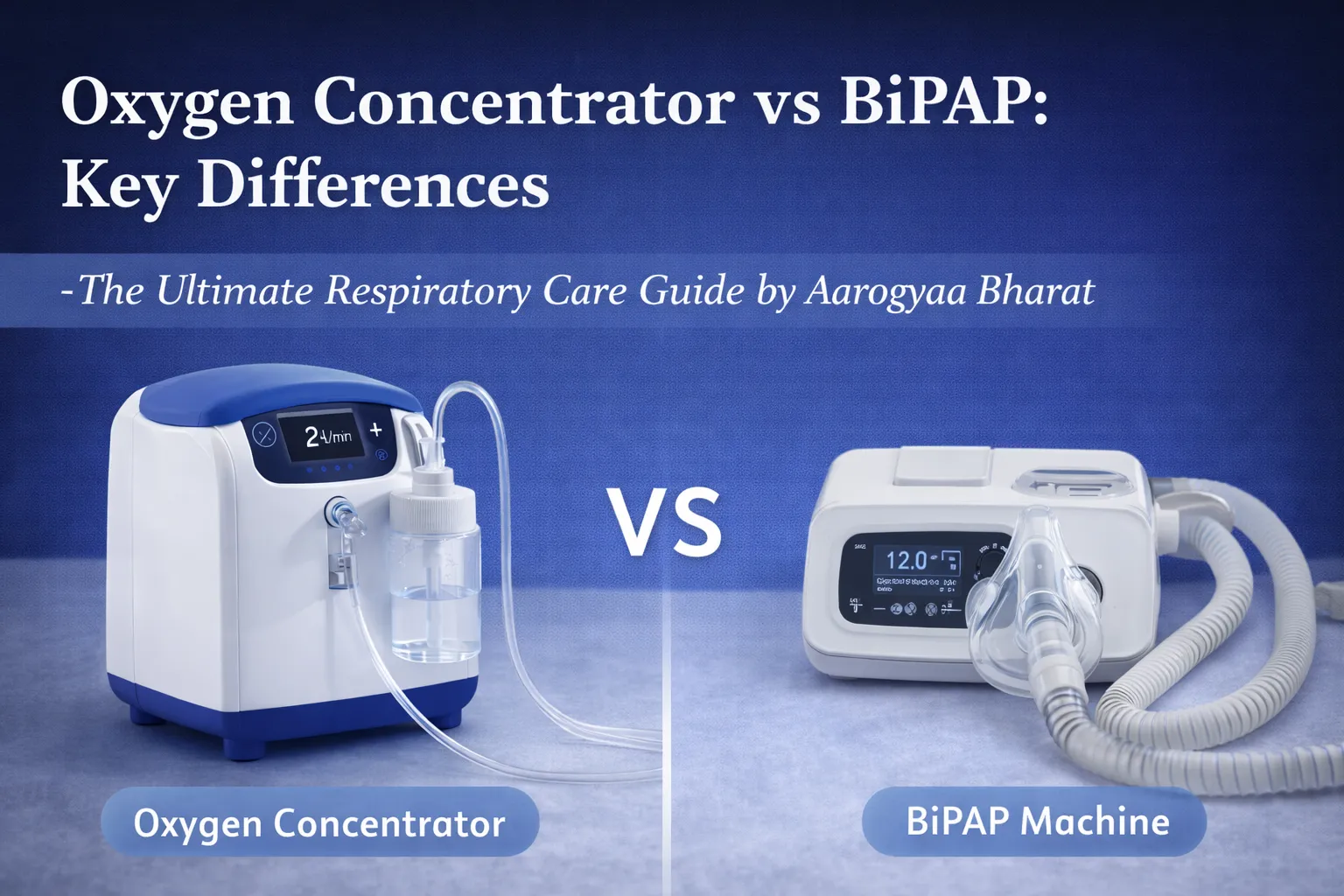
What Is an Oxygen Concentrator and How It Works
An oxygen concentrator is a medical device designed to
provide supplemental oxygen to patients who cannot maintain healthy blood
oxygen levels on their own. It works by pulling in room air, filtering out
nitrogen and other gases, and delivering oxygen-enriched air typically 90% to
96% purity through a nasal cannula or face mask. This purified oxygen helps
increase the amount of oxygen in the bloodstream, supporting vital organs such
as the brain, heart, and kidneys.
Unlike oxygen cylinders, which store compressed oxygen in a
finite tank, concentrators generate oxygen continuously as long as electricity
is available. This makes them safer, more economical, and far more convenient
for long-term home use. Patients do not need to worry about refills,
deliveries, or handling heavy cylinders, which is especially beneficial for
elderly individuals and people living alone.
Oxygen concentrators are typically prescribed when a
patient’s blood oxygen saturation (SpO₂) falls below normal levels usually
below 88-90% either at rest or during physical activity. Common conditions that
require oxygen therapy include COPD, pulmonary fibrosis, pneumonia recovery,
post-COVID lung damage, severe asthma, bronchiectasis, heart failure, and
advanced age-related respiratory decline.
Modern oxygen concentrators come with user-friendly digital
displays, adjustable flow settings, oxygen purity sensors, and alarm systems
that alert users to power failure, low purity, or tubing disconnection. These
safety features make concentrators one of the most reliable and widely used
respiratory care devices for long-term home therapy.
What Is a BiPAP Machine and How It Works
A BiPAP (Bilevel Positive Airway Pressure) machine is a form
of non-invasive ventilation that helps patients breathe more effectively by
delivering pressurized air into the lungs. Unlike oxygen concentrators, BiPAP
machines do not generate oxygen. Instead, they provide two levels of air
pressure a higher pressure when the patient inhales (IPAP) and a lower pressure
when the patient exhales (EPAP). This pressure difference reduces the effort
required to breathe and keeps airways open.
BiPAP therapy is especially useful for patients whose
breathing muscles are weak or whose lungs cannot expand properly on their own.
By assisting both inhalation and exhalation, a BiPAP machine improves
ventilation, reduces carbon dioxide (CO₂) build up in the blood, and decreases
respiratory fatigue. This makes it a life-saving device for patients with
advanced respiratory failure and certain neuromuscular disorders.
BiPAP machines are commonly prescribed for conditions such
as severe COPD, obesity hypoventilation syndrome, neuromuscular diseases (like
ALS and muscular dystrophy), central sleep apnea, obstructive sleep apnea with
CO₂ retention, and acute respiratory distress in hospital or home ICU settings.
In many cases, BiPAP therapy is used overnight to support breathing during
sleep, when respiratory drive naturally decreases.
Modern BiPAP machines are equipped with sophisticated
sensors, auto-adjusting pressure algorithms, humidifiers, data recording, and
alarm systems. They require a properly fitted mask either nasal, oronasal, or
full-face to ensure effective pressure delivery and patient comfort.
The Fundamental Difference: Oxygen vs Pressure Support
The most important difference between an oxygen concentrator
and a BiPAP machine lies in what problem they are designed to solve. An oxygen
concentrator increases the oxygen concentration in the air a patient breathes,
helping improve blood oxygen levels. A BiPAP machine increases air pressure,
helping the lungs expand and improving ventilation mechanics.
In simple terms, an oxygen concentrator treats low oxygen
levels, while a BiPAP machine treats weak or inefficient breathing mechanics. A
patient may have normal oxygen levels but still require a BiPAP machine if
their lungs cannot move air in and out properly. Conversely, a patient may have
strong breathing muscles but still need an oxygen concentrator if their lungs
cannot absorb enough oxygen due to disease or damage.
This distinction is critical because using one device
instead of the other can worsen the patient’s condition. For example, giving
oxygen alone to a patient with CO₂ retention may suppress their respiratory
drive and cause dangerous carbon dioxide build up. Similarly, using a BiPAP
machine without supplemental oxygen in a severely hypoxic patient may not
correct low oxygen levels adequately.
Understanding this difference helps families make informed
decisions and follow medical prescriptions accurately rather than relying on
assumptions or incomplete information.
Medical Conditions That Require an Oxygen Concentrator
Oxygen concentrators are primarily prescribed for conditions
that cause hypoxemia, which is abnormally low oxygen levels in the blood. COPD
is the most common condition requiring long-term oxygen therapy, especially in
advanced stages where lung damage prevents efficient oxygen absorption.
Post-COVID lung damage has emerged as a major reason for
oxygen concentrator use in elderly patients. Many individuals experience lung
fibrosis, reduced lung capacity, and persistent breathlessness months after
recovering from COVID-19, making oxygen therapy essential for daily
functioning.
Pulmonary fibrosis, bronchiectasis, interstitial lung
disease, and severe pneumonia recovery are other conditions where oxygen
concentrators play a critical role in stabilizing breathing and preventing
organ damage.
Heart failure patients may also require oxygen therapy when
reduced cardiac output leads to inadequate oxygen delivery to tissues. In such
cases, supplemental oxygen reduces strain on the heart and improves overall
circulation efficiency.
Medical Conditions That Require a BiPAP Machine
BiPAP machines are prescribed for conditions that impair
ventilation mechanics or cause CO₂ retention. Severe COPD patients who cannot
exhale carbon dioxide effectively often require BiPAP therapy to prevent
hypercapnia and respiratory acidosis.
Neuromuscular disorders such as ALS, muscular dystrophy,
spinal cord injuries, and multiple sclerosis weaken the muscles responsible for
breathing. In these patients, BiPAP machines act as mechanical support systems
that reduce respiratory effort and prevent respiratory failure.
Sleep-related breathing disorders such as central sleep
apnea and complex sleep apnea also benefit from BiPAP therapy. Unlike CPAP
machines, which provide continuous pressure, BiPAP machines offer variable
pressure support that adapts better to certain breathing patterns.
Obesity hypoventilation syndrome, chest wall deformities,
and acute respiratory distress in hospital or home ICU settings are other
scenarios where BiPAP therapy is medically necessary.
When Oxygen Concentrator and BiPAP Are Used Together
In many real-world medical scenarios, patients require both
oxygen therapy and pressure support simultaneously. This is particularly common
in advanced COPD, severe COVID-19 pneumonia, and home ICU setups. In such
cases, oxygen is fed into the BiPAP machine through a dedicated port, allowing
the patient to receive oxygen-enriched air under pressure.
This combined therapy improves both oxygenation and
ventilation, making it one of the most effective respiratory support strategies
for critically ill patients. It ensures that oxygen reaches deep into the lungs
while also assisting breathing muscles and reducing CO₂ retention.
However, this setup must be configured carefully by medical
professionals to avoid incorrect oxygen flow rates or pressure settings.
Improper configuration can lead to lung injury, CO₂ buildup, or oxygen
toxicity.
At Aarogyaa Bharat, we design customized oxygen-plus-BiPAP
setups for home ICU patients, ensuring that both devices work together safely
and effectively.
Ease of Use and Patient Comfort Comparison
Oxygen concentrators are generally easier to use than BiPAP
machines. Most concentrators require minimal setup, with simple flow adjustment
and nasal cannula placement. Patients can move around freely, eat, talk, and
sleep while using an oxygen concentrator, making it more suitable for long-term
daily therapy.
BiPAP machines, on the other hand, require careful mask
fitting, pressure calibration, and humidification settings. Many patients
initially find BiPAP masks uncomfortable or claustrophobic, especially during
sleep. Adaptation can take days or weeks, and patient compliance is often a
challenge.
Noise level is another factor. While modern concentrators
are relatively quiet, BiPAP machines may produce noticeable airflow sounds,
which can disturb light sleepers.
Despite these challenges, BiPAP therapy provides unmatched
respiratory support for patients who genuinely need ventilation assistance,
making comfort trade-offs medically worthwhile.
Safety Considerations and Risks
- Oxygen concentrators carry fire risks because oxygen-enriched environments intensify combustion. Patients must avoid smoking, candles, incense, and open flames near oxygen setups. Proper ventilation and electrical safety are also essential.
- BiPAP machines carry risks related to pressure injury, mask leaks, nasal dryness, and gastric distension. Incorrect pressure settings can cause lung barotrauma or reduce cardiac output.
- Both devices require regular cleaning, maintenance, and professional servicing to prevent infections and mechanical failures.
- Patients should never self-prescribe or modify therapy settings without medical advice, as improper usage can lead to serious health consequences.
Buying Guidance: Which One Do You Need?
- Choosing between an oxygen concentrator and a BiPAP machine depends entirely on medical diagnosis, not personal preference. Patients with low SpO₂ levels but normal breathing mechanics usually need an oxygen concentrator.
- Patients with breathing muscle weakness, CO₂ retention, or sleep-related breathing disorders usually need a BiPAP machine.
- Patients with advanced respiratory failure often need both devices working together.
- Never purchase either device without a doctor’s prescription and a proper respiratory assessment.
Comparison Table: Oxygen Concentrator vs BiPAP
|
Feature |
Oxygen
Concentrator |
BiPAP
Machine |
|
Primary
Function |
Increases
oxygen levels |
Provides
pressure support |
|
Oxygen
Generation |
Yes |
No |
|
Air Pressure
Support |
No |
Yes |
|
Typical Use
Duration |
8-24
hours/day |
Night or ICU
use |
|
Medical
Conditions |
COPD,
Post-COVID, Fibrosis |
Sleep Apnea,
COPD, ALS |
|
Portability |
Medium-High |
Low-Medium |
|
Power
Dependency |
High |
High |
|
Ease of Use |
Very Easy |
Moderate-Complex |
|
Comfort Level |
High |
Medium |
|
Cost Range |
Moderate |
High |
Conclusion
Oxygen concentrators and BiPAP machines are both life-saving
respiratory devices, but they serve completely different medical purposes. An
oxygen concentrator treats low oxygen levels, while a BiPAP machine treats weak
or inefficient breathing mechanics. Confusing these two can lead to dangerous
treatment errors and delayed recovery.
Choosing the right device requires a proper medical
diagnosis, respiratory assessment, and professional guidance. In many serious
cases, a combination of both devices offers the most effective respiratory
support.
At Aarogyaa Bharat, we specialize in providing oxygen
concentrators, BiPAP machines, home ICU setups, and expert consultation
tailored to each patient’s medical condition and lifestyle needs. Our mission
is to ensure that every patient receives the right respiratory support at the
right time.
If you are unsure whether you need an oxygen concentrator, a
BiPAP machine, or both, Aarogyaa Bharat is always here to guide you toward
safer breathing and better health outcomes.