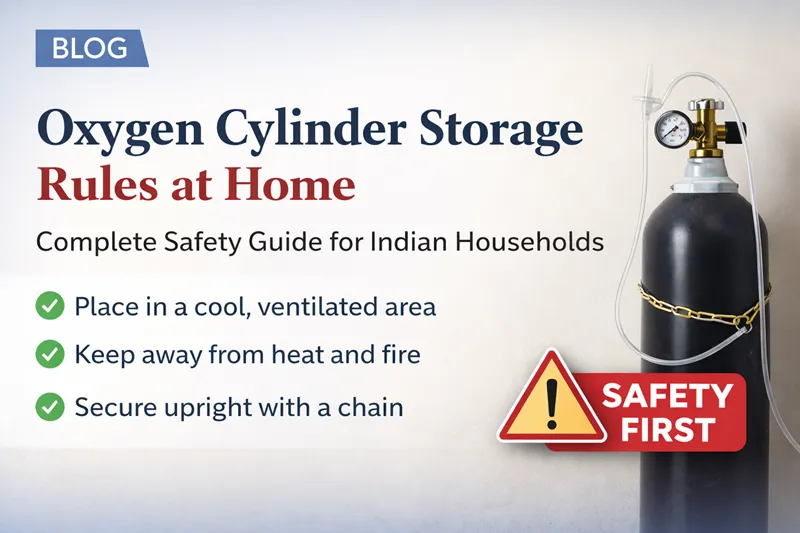
However, despite their medical importance, oxygen cylinders are also classified as high-pressure hazardous equipment because they store oxygen gas at extremely high pressure. If handled or stored incorrectly, oxygen cylinders can pose serious risks, including fire hazards, gas leaks, explosions, and physical injuries.
In India, where many households are not equipped with specialized medical storage areas, oxygen cylinders are often kept in living rooms, bedrooms, balconies, or storerooms without proper safety measures. This increases the risk of accidents, especially in homes with children, elderly family members, pets, or frequent electrical appliance usage. At Aarogyaa Bharat, we regularly educate families on proper oxygen cylinder storage rules to ensure both medical effectiveness and household safety. This comprehensive guide explains where and how to store oxygen cylinders at home, what safety precautions to follow, and how to reduce fire and explosion risks.
What Is an Oxygen Cylinder and Why It Needs Special Storage
An oxygen cylinder is a pressurized container that stores medical-grade oxygen gas at pressures ranging from 150 to 200 bar. This high-pressure storage allows a large volume of oxygen to be compressed into a relatively small metal tank, making it portable and usable in emergency or home care settings. However, the same pressure that makes oxygen cylinders efficient also makes them potentially dangerous if mishandled.
Unlike oxygen concentrators, which generate oxygen from ambient air, cylinders contain a finite supply of compressed oxygen that can escape rapidly if the valve is damaged, the cylinder falls, or the regulator malfunctions. Oxygen itself is not flammable, but it strongly supports combustion, meaning that even a small spark can cause surrounding materials to ignite violently in an oxygen-rich environment. This is why strict storage rules and handling precautions are essential for every household using oxygen cylinders.
Legal and Medical Guidelines for Oxygen Cylinder Storage in India
While India does not have a single unified household regulation document for medical oxygen cylinder storage, guidelines are derived from standards set by the Gas Cylinders Rules, 2016, the Petroleum and Explosives Safety Organisation (PESO), and general medical safety recommendations. These guidelines emphasize secure storage, proper ventilation, fire safety, and controlled access to oxygen cylinders.
Hospitals and medical facilities follow strict compliance protocols for oxygen storage, but similar principles should be applied at home, scaled appropriately for residential environments. At Aarogyaa Bharat, we recommend following hospital-grade safety practices as closely as possible to minimize risk. These include storing cylinders upright, securing them against tipping, maintaining safe distances from heat sources, and ensuring proper labeling and valve protection.
Ideal Location for Storing an Oxygen Cylinder at Home
Choosing the right location is the first and most important step in safe oxygen cylinder storage. Cylinders should always be kept in a cool, dry, and well-ventilated area where they are protected from direct sunlight, moisture, and heat. Avoid placing cylinders near stoves, heaters, fireplaces, electric geysers, or direct sunlight exposure through windows, as high temperatures can increase internal pressure and raise the risk of leakage or rupture.
The storage area should be free from flammable materials such as curtains, paper, plastic, cleaning chemicals, cooking oil, and alcohol-based products. It is also advisable to store cylinders away from high-traffic zones to prevent accidental knocks or falls. At Aarogyaa Bharat, we recommend designating a dedicated oxygen corner in the home that is clearly marked and restricted from unnecessary handling.
Proper Positioning: Upright vs Horizontal Storage
Oxygen cylinders should always be stored in an upright vertical position, secured with a stand, chain, or wall bracket to prevent tipping. Storing cylinders upright ensures that the valve remains properly aligned and reduces the risk of mechanical damage. Horizontal storage is not recommended because it increases the chances of rolling, impact damage, and valve stress.
For small portable cylinders, a cylinder trolley or stand should be used to keep them stable and mobile without risking accidental falls. Large cylinders must be chained or strapped to a wall or a stable structure to prevent them from toppling over. At Aarogyaa Bharat, we provide cylinder stands and safety accessories to help families implement proper storage setups at home.
Distance Rules: How Far Should an Oxygen Cylinder Be from Heat and Fire Sources
Maintaining a safe distance between oxygen cylinders and potential ignition sources is critical to fire prevention. Cylinders should be kept at least 5 to 10 feet away from open flames, cooking stoves, heaters, candles, incense sticks, and smoking areas. Electrical appliances such as hair dryers, irons, and space heaters should also be kept at a safe distance to avoid sparks or overheating near oxygen storage areas.
Smoking should be strictly prohibited in any room where oxygen cylinders are stored or used. Even a small cigarette ember can cause a serious fire in an oxygen-enriched environment. At Aarogyaa Bharat, we advise families to place visible “No Smoking” signs near oxygen storage areas to reinforce safety awareness.
Valve Protection and Regulator Safety
The valve is the most critical and vulnerable part of an oxygen cylinder. If the valve is damaged due to impact or mishandling, it can turn the cylinder into a dangerous projectile. This is why valve protection caps must always be kept in place when the cylinder is not in active use.
Regulators should be securely attached and regularly inspected for leaks, cracks, or loose fittings. Never use oil, grease, or petroleum-based products on cylinder valves or regulators, as these substances can ignite spontaneously in the presence of high-pressure oxygen. At Aarogyaa Bharat, we conduct regulator safety checks as part of our cylinder delivery and maintenance services.
Ventilation Requirements for Oxygen Cylinder Storage
Proper ventilation is essential to prevent oxygen buildup in case of minor leaks. Cylinders should be stored in rooms with adequate airflow, such as rooms with windows or ventilation fans. Avoid storing cylinders in enclosed spaces like cupboards, wardrobes, bathrooms, or small storerooms without ventilation, as trapped oxygen can increase fire risk.
If a leak occurs in a poorly ventilated space, oxygen concentration in the air can rise rapidly, making even normally non-flammable materials highly combustible. At Aarogyaa Bharat, we strongly advise keeping cylinders in open or semi-open spaces where fresh air circulation is consistent.
Fire Safety Precautions for Oxygen Cylinder Storage
Fire safety is a critical component of oxygen cylinder storage rules. Every household using oxygen cylinders should have a Class ABC fire extinguisher easily accessible near the storage area. Family members should be trained on how to use the extinguisher and what steps to take in case of a fire or gas leak.
Avoid using aerosol sprays, oil-based products, or flammable cleaning chemicals near oxygen cylinders. Electrical wiring near the storage area should be in good condition, with no exposed wires or loose sockets. At Aarogyaa Bharat, we also recommend installing smoke detectors in rooms where oxygen cylinders are stored or frequently used.
Handling Rules: How to Move and Transport Oxygen Cylinders Safely
Oxygen cylinders should never be dragged, rolled, or dropped. When moving a cylinder, always use a proper trolley or carry it with both hands while keeping it upright. Avoid lifting heavy cylinders alone, as dropping them can cause serious injuries and equipment damage.
Cylinders should not be transported in the boot of a closed car without proper ventilation. If transport is necessary, ensure that the cylinder is secured upright and that the vehicle has adequate airflow. At Aarogyaa Bharat, we offer professional cylinder delivery and relocation services to minimize handling risks.
Do’s and Don’ts of Oxygen Cylinder Storage at Home
| Do’s | Don’ts |
|---|---|
| Store cylinders upright | Do not store horizontally |
| Keep in a cool, ventilated area | Do not place near heat sources |
| Use valve protection caps | Do not use oil or grease on valves |
| Secure with stand or wall chain | Do not leave cylinders unsecured |
| Keep fire extinguisher nearby | Do not smoke near oxygen |
| Inspect regulators regularly | Do not use damaged equipment |
| Label full and empty cylinders | Do not mix full and empty cylinders |
Common Mistakes to Avoid in Home Oxygen Cylinder Storage
One of the most common mistakes is storing cylinders near kitchens or cooking areas due to space constraints. This dramatically increases fire risk. Another frequent error is placing cylinders in bathrooms or damp areas, which can cause rusting and regulator damage.
Some families also forget to secure cylinders properly, leading to tipping hazards, especially in homes with children or pets. Using unauthorized or damaged regulators is another major safety violation. At Aarogyaa Bharat, we strongly recommend periodic safety audits to identify and correct these common storage mistakes.
Oxygen Cylinder vs Oxygen Concentrator: Which Is Safer for Home Use?
| Feature | Oxygen Cylinder | Oxygen Concentrator |
|---|---|---|
| Oxygen Supply | Limited stored gas | Continuous generation |
| Refill Requirement | Yes | No |
| Fire Hazard Risk | Higher | Lower |
| Pressure Risk | High-pressure storage | No pressure storage |
| Maintenance | Regulator and refill checks | Filter and power checks |
| Long-Term Cost | Higher | Lower |
Oxygen concentrators are generally safer and more practical for long-term home use because they do not store compressed oxygen and eliminate refill logistics. At Aarogyaa Bharat, we recommend concentrators as the preferred option for households requiring daily oxygen therapy.
Emergency Steps If an Oxygen Cylinder Leak Is Detected
If you detect a hissing sound, unusual odor, or rapid oxygen depletion, treat it as a potential leak. Immediately turn off the cylinder valve if it is safe to do so and open all windows and doors to ventilate the room. Evacuate all people from the area and avoid switching electrical appliances on or off, as sparks can ignite oxygen-enriched air.
Call your oxygen supplier or emergency services immediately and do not attempt to repair the leak yourself. At Aarogyaa Bharat, we provide 24/7 emergency support for cylinder-related issues to ensure rapid and safe resolution.
Why Choose Aarogyaa Bharat for Safe Oxygen Solutions?
At Aarogyaa Bharat, we prioritize patient safety as much as medical effectiveness. Our oxygen cylinders and accessories meet strict medical-grade standards and undergo thorough quality checks before delivery.
We offer:
-
Medical-grade oxygen cylinders
-
Certified regulators and stands
-
Professional installation and safety training
-
Emergency replacement support
-
Oxygen concentrator alternatives
-
24/7 customer assistance
Our mission is to make home oxygen therapy safe, reliable, and stress-free for every household in India.
Conclusion
Oxygen cylinders can be life-saving, but they must be handled and stored with extreme care to prevent accidents. By following proper oxygen cylinder storage rules choosing the right location, maintaining safe distances, securing cylinders, and practicing fire safety you can protect your loved ones while ensuring uninterrupted oxygen therapy.
For safe oxygen solutions, expert guidance, and transparent service, trust Aarogyaa Bharat India’s dependable partner in home oxygen care.