What Is a Medical Stretcher?
A medical stretcher is a patient transport device designed
to carry patients safely in lying or semi-reclining positions during:
- Emergency
response
- Hospital
transfers
- Diagnostic
procedures
- Surgical
and post-operative movement
Stretchers are engineered to provide:
- Patient comfort
- Stability
- Easy mobility
- Clinical safety
Medical stretcher, hospital stretcher, patient transport stretcher
Why Are Stretchers Important in Healthcare?
Stretchers help:
- Prevent
patient falls and injuries
- Maintain
spinal alignment
- Reduce
strain on healthcare staff
- Enable
faster emergency response
- Improve
infection control
In emergency and trauma care, the right stretcher can save
lives.
Classification of Stretchers
Stretchers can be classified based on:
- Mode
of transport
- Clinical
application
- Patient
condition
- Location
of use
Let’s explore each type in detail.
Emergency Stretchers
Emergency stretchers are designed for rapid response and
immediate patient transport.
Key Features
- Lightweight
but strong frame
- Foldable
design
- Safety
belts
- Easy
manoeuvrability
Common Uses
- Ambulances
- Accident
sites
- Disaster
zones
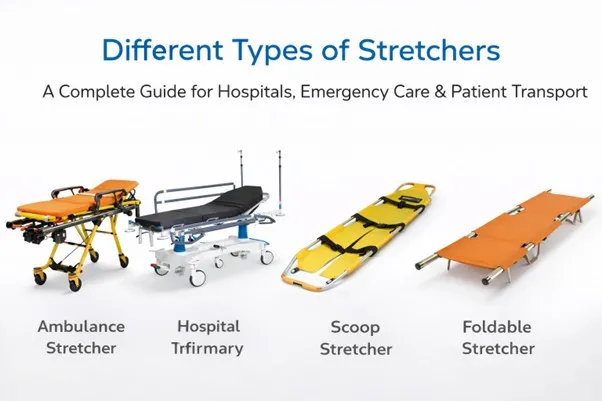
Emergency Stretcher
Ambulance Stretchers
Ambulance stretchers are advanced mobile stretchers mounted
inside ambulances.
Key Features
- Height-adjustable
- Wheeled
base
- Shock-absorbing
design
- Locking
mechanism
Advantages
- Smooth
loading/unloading
- Reduced
paramedic strain
- Improved
patient safety
Ambulance
stretcher
Transfer Stretchers (Hospital Stretchers)
Used for intra-hospital patient movement.
Applications
- Ward
to OT
- ICU
to imaging
- Recovery
room transfers
Features
- Adjustable
backrest
- Side
rails
- IV
pole attachments
Hospital Transfer Stretcher
Scoop Stretchers
Scoop stretchers are split-type stretchers designed for
spinal injury patients.
Key Advantage
- Patient
does not need to be rolled or lifted
Used In
- Road
accidents
- Suspected
spinal trauma
- Rescue operations
Basket Stretchers (Stokes Stretchers)
Designed for rescue and evacuation operations.
Applications
- Mountain
rescue
- Water
rescue
- Disaster
response
Features
- Rigid
structure
- Secure
strapping
- Can
be lifted vertically
Basket Stretcher
Folding Stretchers
These are portable, collapsible stretchers.
Best For
- First-aid
rooms
- Clinics
- Field
medical camps
Benefits
- Easy
storage
- Lightweight
- Cost-effective
Bariatric Stretchers
Specially designed for obese or high-weight patients.
Features
- High
weight capacity
- Wider
platform
- Reinforced
frame
Importance
Ensures dignity, safety, and comfort for bariatric patients.
MRI-Compatible Stretchers
Used in radiology and imaging departments.
Key Features
- Non-magnetic
materials
- Safe
inside MRI rooms
- Smooth mobility
MRI Compatible Stretcher
Pediatric Stretchers
Designed specifically for children and infants.
Features
- Smaller
size
- Child
safety restraints
- Soft
padding
Mortuary Stretchers
Used for transporting deceased patients.
Applications
- Hospitals
- Mortuaries
- Forensic
departments
Materials Used in Stretchers
- Stainless
steel
- Aluminium
alloy
- Carbon
fiber (advanced)
- Medical-grade
plastic
Material selection affects durability, weight, and hygiene.
Key Features to Look for When Buying a Stretcher
- Weight
capacity
- Wheel
locking system
- Side
rails
- Mattress
quality
- IV
stand compatibility
- Easy
cleaning surface
How to Choose the Right Stretcher
Consider:
- Hospital
type (clinic, trauma centre, ICU)
- Patient
category (adult, paediatric, bariatric)
- Frequency
of use
- Budget
and maintenance
At Aarogyaa Bharat, we recommend application-based stretcher
selection, not one-size-fits-all.
Approximate Stretcher Price Range in India
|
Type |
Price
Range |
|
Folding
stretcher |
₹3,000 -
₹8,000 |
|
Emergency
stretcher |
₹10,000 -
₹25,000 |
|
Ambulance
stretcher |
₹40,000 -
₹1,00,000 |
|
₹80,000 -
₹2,00,000 |
|
|
Bariatric
stretcher |
₹1,00,000+ |
Maintenance & Safety Tips
- Regular
wheel inspection
- Mattress
disinfection
- Locking
mechanism checks
- Annual
servicing
Proper maintenance ensures long life and patient safety.
Conclusion
Stretchers are an essential yet often underestimated
component of healthcare infrastructure. Choosing the right type of stretcher
ensures patient safety, staff efficiency, and better emergency response.
From ambulances and trauma centres to ICUs and diagnostic
departments, each medical setting requires a specific stretcher design tailored
to patient needs.
At Aarogyaa Bharat, we help healthcare providers select
reliable, durable, and application-specific stretchers that meet both clinical
and operational requirements.