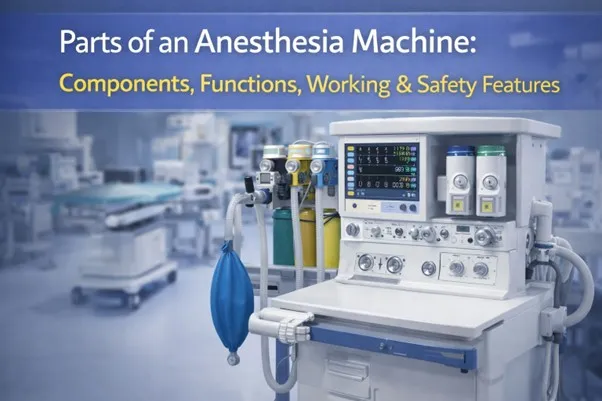
What Is an Anesthesia Machine?
An anesthesia machine is a
medical device used to:
- Deliver medical gases (oxygen, nitrous oxide, air)
- Administer volatile anesthetic agents
- Support or control patient breathing
- Monitor ventilation safety
It is commonly called an
anesthesia workstation in modern OTs.
anesthesia machine parts, anesthesia workstation, OT anesthesia equipment
Why Understanding Anesthesia
Machine Parts Is Important
- Ensures patient safety
- Prevents anesthesia-related accidents
- Helps in troubleshooting
- Supports regulatory compliance
- Enables informed equipment purchase
Basic Working Principle of an
Anesthesia Machine
- Gas supply enters machine
- Pressure is regulated
- Flow is controlled
- Anesthetic vapor is added
- Mixture reaches patient
- Exhaled gases are safely removed
Each stage involves dedicated
components.
Main Parts of an Anesthesia
Machine (With Functions)
Gas Supply System
Function
Provides medical gases to the
machine.
Sources
- Central pipeline supply
- Backup gas cylinders
Common Gases
- Oxygen (O₂)
- Nitrous Oxide (N₂O)
- Medical Air
anesthesia gas supply system
Pressure Regulators
Function
- Reduce high cylinder pressure
- Maintain constant working pressure
Why Important
Prevents damage to internal
components and ensures steady gas flow.
Flow Meters (Flowmeters)
Function
- Measure and control gas flow rate
Types
- Rotameter (glass tube type)
- Digital flow sensors (modern machines)
Flow meters allow
anesthesiologists to set precise gas ratios.
Flow Meter in Anesthesia Machine
Vaporizers
Function
Convert liquid anesthetic into
vapor and mix it with fresh gas.
Common Agents
- Isoflurane
- Sevoflurane
- Desflurane
Safety Feature
- Agent-specific filling system
- Temperature compensation
anesthesia vaporizer
Oxygen Flush Valve
Function
Delivers 100% oxygen at high flow
rate directly to the circuit.
Use
- Emergency oxygen delivery
- Circuit flushing
Must be used carefully to avoid
lung barotrauma.
Breathing Circuit System
Function
Delivers anesthetic gas to
patient and removes exhaled gases.
Types
- Open circuit
- Semi-closed circuit
- Closed circuit
Includes:
- Inspiratory limb
- Expiratory limb
- Y-piece
Anesthesia Breathing Circuit
CO₂ Absorber (Soda Lime
Canister)
Function
Removes carbon dioxide from
exhaled gases.
Material Used
- Soda lime
- Baralyme
Allows rebreathing without CO₂
buildup.
Reservoir Bag (Breathing Bag)
Function
- Stores gas mixture
- Allows manual ventilation
- Indicates patient breathing
Different sizes used for:
- Adults
- Paediatrics
- Neonates
Ventilator (Anesthesia
Ventilator)
Function
Provides mechanical ventilation
during surgery.
Modes
- Volume controlled
- Pressure controlled
Integrated ventilators improve
ventilation accuracy and safety.
Anesthesia Ventilator
Scavenging System
Function
Safely removes waste anesthetic
gases from OT.
Why Important
- Protects OT staff
- Prevents occupational exposure
Mandatory for modern anesthesia
setups.
1 Monitoring & Safety
Systems
Includes
- Oxygen failure protection device
- Hypoxic guard system
- Pressure alarms
- Oxygen analyzer
These systems prevent hypoxia and
overdose.
2 Control Panel / Display
Screen
Function
Displays:
- Gas flow
- Oxygen concentration
- Airway pressure
- Ventilation parameters
Modern machines feature
touchscreen interfaces.
Types of Anesthesia Machines
- Basic anesthesia machine
- Anesthesia workstation
- Portable anesthesia machine
- ICU-compatible anesthesia system
Anesthesia Machine Safety
Features
- Fail-safe valves
- Pin index safety system
- Color-coded gas hoses
- Alarm systems
- Pressure relief valves
Safety is the top priority in
anesthesia delivery.
Maintenance & Pre-Use
Checklist
- Leak test
- Flow meter check
- Vaporizer filling
- CO₂ absorber inspection
- Alarm verification
Daily checks prevent critical OT
incidents.
Price Range of Anesthesia
Machines in India
|
Type |
Approx
Price |
|
Basic
anesthesia machine |
₹2.5 - 5
lakhs |
|
Advanced
workstation |
₹8 - 25 lakhs |
|
Portable
anesthesia unit |
₹3 - 7 lakhs |
Conclusion
Understanding the parts of an anesthesia machine is essential for safe anesthesia delivery, effective ventilation, and patient survival during surgery. Every component from gas supply and vaporizers to ventilators and safety alarms works together to create a controlled, life-saving system.
For hospitals and surgical
centers, choosing the right anesthesia machine means better surgical outcomes,
improved OT efficiency, and regulatory compliance.
At Aarogyaa Bharat, we help
healthcare providers select certified, high-performance anesthesia machines and
ensure complete understanding of their components, working, and safety
features.