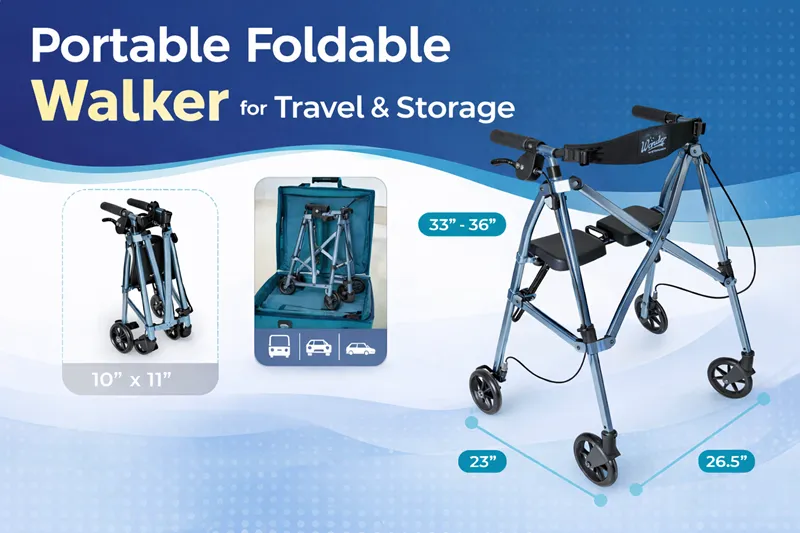
Unlike traditional walkers that are bulky and difficult to
carry, foldable walkers collapse quickly into a compact structure, making them
ideal for travel, hospital visits, rehabilitation sessions, and everyday home
care support. Families caring for elderly members often search hospital pages
and home care resources to understand which mobility aids can provide the right
balance between safety and convenience. Aarogyaa Bharat’s rehabilitation
section highlights foldable walkers as one of the most practical mobility
devices because they support safe walking while remaining easy to transport
between rooms, clinics, and healthcare facilities across cities pages. As
healthcare calculators increasingly emphasize fall prevention and mobility
monitoring for seniors, foldable walkers have become an important part of
modern elderly support and physiotherapy recovery programs.
What Is a Foldable Walker and How It Works
A foldable walker is a mobility support device designed with
a collapsible frame that allows the walker to fold flat when it is not being
used. This design feature allows the walker to be stored easily in small spaces
or transported inside vehicles during hospital visits and physiotherapy
sessions. Most foldable walkers available in the Aarogyaa Bharat rehabilitation
section are made from lightweight aluminium frames that provide strength
without adding unnecessary weight, ensuring elderly users can lift or
reposition the walker without difficulty. The folding mechanism usually
operates through push buttons or trigger handles that allow caregivers or users
to collapse the walker within seconds. Patients visiting hospital pages for orthopaedic
treatment or neurological rehabilitation are frequently advised by
physiotherapists to use walkers that provide stable walking support while
remaining easy to transport. In urban environments where apartments often have
limited storage space, foldable walkers also help families maintain organized
home care environments while ensuring mobility assistance is always available
whenever required.
Why Foldable Walkers Are Ideal for Travel and
Transportation
Mobility support equipment must not only provide stability
but also adapt to the lifestyle and movement patterns of the user. Elderly
individuals frequently visit hospitals, physiotherapy centers, diagnostic
clinics, and rehabilitation facilities located in different cities pages.
Carrying bulky equipment during these visits can become inconvenient and
physically demanding for both patients and caregivers. Foldable walkers solve
this problem by offering a compact design that can easily fit into cars, taxis,
or public transport vehicles. The ability to fold the walker allows caregivers
to store it in vehicle trunks without occupying large amounts of space.
Aarogyaa Bharat’s home care equipment guides often recommend foldable walkers
for patients who require mobility support during travel or frequent hospital
appointments. Healthcare calculators used for mobility risk assessment also
identify portable walking aids as beneficial for patients recovering from
surgery or managing long-term conditions such as arthritis, Parkinson’s
disease, or muscle weakness. The convenience of transportation makes foldable
walkers an essential part of rehabilitation programs and elderly mobility
support systems.
Important Design Features That Improve Walker Usability
Modern foldable walkers incorporate several structural
features that improve safety, comfort, and ease of use. These walkers are
typically designed with adjustable height settings so that the handles align
with the user’s wrist level, promoting proper posture and reducing strain on
the shoulders and back. Ergonomic grips improve comfort for users who rely on
walkers for extended periods during rehabilitation exercises or daily mobility
routines. Anti-slip rubber tips provide additional traction on floors, ensuring
that the walker remains stable on tiles, wooden flooring, or hospital
corridors. Some walkers also include front wheels that make forward movement
smoother during physiotherapy sessions recommended through hospital pages.
Aarogyaa Bharat’s rehabilitation equipment listings emphasize walkers that
combine durability with portability, ensuring the walker can support elderly
users safely while remaining easy to fold and transport. When families consult
healthcare calculators to assess fall risk and mobility limitations, walkers
with these design features are often recommended as reliable mobility
solutions.
Situations Where Foldable Walkers Are Commonly
Recommended
Foldable walkers are used in various healthcare and home
care situations where individuals require walking assistance but also need
flexibility in transport and storage. Hospitals frequently recommend walkers to
patients who have undergone knee replacement surgery, hip replacement surgery,
or spinal procedures. Physiotherapists listed on hospital pages also suggest
walkers for patients recovering from neurological conditions or muscle weakness
that affects balance. Elderly individuals living independently often use
walkers to move safely between rooms within their homes while reducing fall
risk. Families managing elderly care support through Aarogyaa Bharat’s home
care section often rely on walkers as a preventive mobility aid. In
rehabilitation programs that require patients to attend physiotherapy sessions
across different cities pages, foldable walkers allow easy movement between
locations. Healthcare calculators designed to measure mobility recovery
progress also include walker usage as part of recommended recovery plans.
Typical Features of a Foldable Walker
|
Feature |
Details |
|
Frame
Material |
Lightweight aluminium
or reinforced steel |
|
Folding
System |
Push-button
or trigger fold mechanism |
|
Height
Adjustment |
Multiple
adjustable height levels |
|
Weight
Capacity |
Usually
supports 100–150 kg users |
|
Grip Type |
Ergonomic
handles for comfort |
|
Base Support |
Anti-slip
rubber tips for stability |
How Foldable Walkers Improve Daily Home Care Mobility
Home care environments require mobility aids that provide
both reliability and flexibility. Elderly individuals who live at home need
walking support that allows them to move between rooms, bathrooms, and living
areas without assistance. Foldable walkers provide this support while remaining
easy to store beside beds or inside closets when not needed. Aarogyaa Bharat’s
home care equipment recommendations highlight walkers because they reduce fall
risk and encourage independent movement. Families searching hospital pages for
elderly mobility advice often learn that maintaining safe walking habits can
significantly improve long-term health outcomes. Healthcare calculators
designed for fall prevention also emphasize mobility aids as a key component of
elderly safety planning. Because foldable walkers are lightweight and compact,
they integrate easily into home care routines without creating clutter or
storage challenges.
Key Advantages of Using a Foldable Walker
- Compact
structure makes transportation extremely convenient
- Lightweight
frame reduces strain on elderly users
- Adjustable
height allows customized posture support
- Easy
folding mechanism enables quick storage
- Anti-slip
rubber tips improve walking stability
- Ideal
for hospital visits and physiotherapy sessions
- Supports
independent mobility for seniors
- Compatible
with home care and rehabilitation environments
Foldable Walker vs Traditional Walker Comparison
Mobility devices vary depending on the user’s physical
condition and mobility requirements. Fixed walkers provide rigid structural
support but are often heavier and difficult to transport. Foldable walkers
offer a balance between stability and portability, making them more suitable
for individuals who travel frequently or attend rehabilitation sessions in
different healthcare facilities. Patients consulting hospital pages often
choose foldable walkers because they can be carried easily during physiotherapy
appointments or follow-up consultations. Aarogyaa Bharat’s rehabilitation
section recommends foldable walkers for patients who need reliable walking
support but also require flexible storage and travel convenience. Healthcare
calculators used in mobility assessments frequently highlight foldable walkers
as an effective solution for moderate mobility challenges.
Foldable Walker vs Fixed Walker
|
Feature |
Foldable
Walker |
Fixed
Walker |
|
Portability |
Easily folds
for travel |
Difficult to
transport |
|
Storage |
Compact and
space saving |
Requires
large storage area |
|
Weight |
Lightweight
and easy to carry |
Usually,
heavier |
|
Convenience |
Ideal for
hospital visits |
Mostly
suitable for indoor use |
|
Best For |
Travel and
home mobility |
Maximum
indoor stability |
Choosing the Right Foldable Walker for Elderly Mobility
Selecting the correct walker requires understanding the
user’s mobility condition, body height, and lifestyle needs. Elderly
individuals recovering from surgery may require walkers with wheels to support
smoother movement during rehabilitation exercises. Patients undergoing
physiotherapy programs listed on hospital pages often need walkers that allow
gradual mobility improvement while maintaining stability. Aarogyaa Bharat
recommends reviewing walker specifications carefully before purchase to ensure
the device meets safety requirements. Individuals living in different cities
pages may also consider environmental factors such as uneven floors or outdoor
pathways when choosing walker models. Healthcare calculators designed to
estimate mobility needs can help families determine whether a standard foldable
walker or wheeled walker is more suitable. Making an informed choice ensures
that the walker provides long-term comfort and reliable mobility support.
How Foldable Walkers Support Rehabilitation Programs
Rehabilitation programs focus on restoring strength,
balance, and walking ability after injury or surgery. During the early stages
of recovery, patients often experience limited muscle strength and reduced
balance control. Foldable walkers provide stable support during these early
recovery stages, allowing patients to practice walking safely under
physiotherapist supervision. Hospitals and rehabilitation centers listed on
hospital pages frequently recommend walkers during orthopaedic recovery and
neurological rehabilitation. Aarogyaa Bharat’s rehabilitation equipment section
highlights walkers as essential mobility aids that assist patients in gradually
regaining independence. Healthcare calculators used to track recovery progress
often include mobility aid usage as part of treatment plans. Because foldable
walkers are portable and lightweight, patients can continue using them during
therapy sessions, hospital visits, and daily home movement.
Conclusion
Foldable walkers represent one of the most practical and reliable mobility support solutions for elderly individuals, rehabilitation patients, and people recovering from surgery. Their ability to combine stability with portability makes them ideal for both home care environments and healthcare settings. Unlike traditional walkers that can be difficult to transport, foldable walkers collapse easily, allowing users to carry them during hospital visits, physiotherapy sessions, and travel across different cities pages. Aarogyaa Bharat’s home care and rehabilitation sections emphasize the importance of mobility aids in improving safety, independence, and quality of life for seniors. When combined with guidance from hospital pages and insights from healthcare calculators, foldable walkers become a valuable part of a structured mobility and fall prevention plan. By choosing the right walker model and integrating it into daily routines, families can ensure safer movement, greater confidence, and improved independence for elderly individuals and rehabilitation patients.