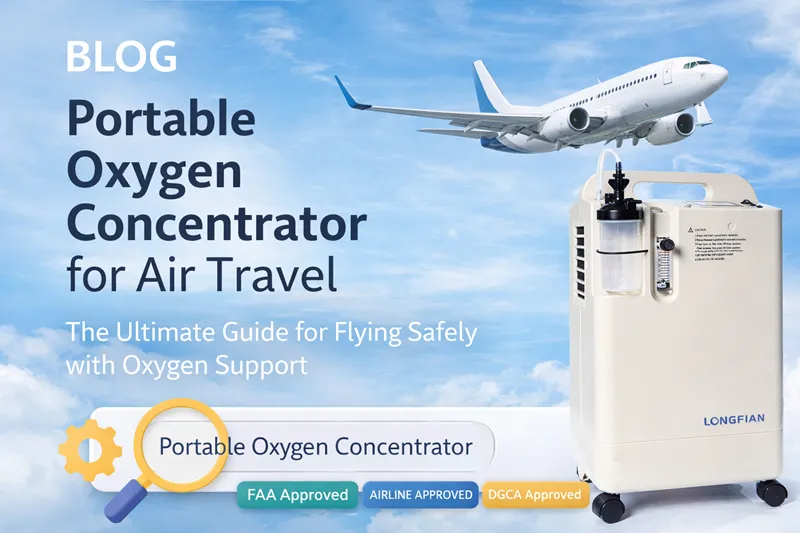
The reduced cabin pressure and lower oxygen availability at cruising altitude can worsen breathlessness, fatigue, and oxygen desaturation, especially for people with chronic lung diseases, post-COVID lung damage, pulmonary fibrosis, asthma, and heart-related hypoxia. Without proper oxygen support, even short flights can become physically exhausting and medically risky.
This is why a portable oxygen concentrator (POC) has become an essential travel companion for patients who require supplemental oxygen while flying. Modern POCs are compact, lightweight, and designed specifically to meet aviation safety standards, allowing patients to continue their oxygen therapy seamlessly during domestic and international flights. At Aarogyaa Bharat, we regularly help travelers navigate airline approvals, medical certificates, battery planning, and equipment selection so they can fly confidently without compromising their health.
What Is a Portable Oxygen Concentrator (POC)?
A portable oxygen concentrator is a battery-powered medical device that produces high-purity oxygen by filtering nitrogen from ambient air and delivering concentrated oxygen to the patient. Unlike traditional oxygen cylinders, which store compressed oxygen in a tank, POCs generate oxygen continuously as long as they have power, making them safer and more practical for long-term use and travel. These devices are engineered to be compact, lightweight, and easy to carry, with most models weighing between 2 and 7 kilograms.
Portable concentrators typically operate in pulse-dose mode, releasing oxygen only when the patient inhales, which conserves battery life while maintaining effective oxygen delivery. Some advanced models also offer continuous flow settings for patients who require steady oxygen output, although these units are heavier and have shorter battery runtimes. At Aarogyaa Bharat, we provide medically certified portable oxygen concentrators that are optimized for both daily mobility and air travel, ensuring reliable oxygen therapy wherever you go.
Why Oxygen Cylinders Are Banned on Flights
Oxygen cylinders are classified as hazardous materials due to the risks associated with compressed gas under changing cabin pressure conditions. During a flight, the cabin is pressurized to simulate an altitude of around 6,000–8,000 feet, which can cause pressure fluctuations inside sealed containers. Even a small leak or structural defect in an oxygen cylinder can lead to rapid gas expansion, posing a serious explosion or fire hazard.
For this reason, all commercial airlines strictly prohibit personal oxygen cylinders in both carry-on and checked baggage, regardless of medical necessity. Even airline-supplied oxygen services are becoming less common as more airlines shift responsibility to passengers using approved portable oxygen concentrators. In contrast, POCs are considered safe because they do not store oxygen; they simply extract it from the surrounding air, making them the only legally permitted personal oxygen devices for air travel.
Are Portable Oxygen Concentrators Allowed on Airplanes?
Yes, portable oxygen concentrators are allowed on most commercial airlines, provided they meet regulatory approval and comply with airline-specific requirements. Many international airlines follow FAA (Federal Aviation Administration) guidelines, while European airlines follow EASA standards and Indian airlines operate under DGCA regulations. These aviation authorities maintain official lists of approved POC models that have been tested for electromagnetic interference, fire safety, and performance reliability in aircraft environments.
However, airline policies vary significantly in terms of documentation, advance notice, seating restrictions, and battery requirements. Some airlines require passengers to inform them 48–72 hours before departure, submit a medical clearance form, and carry proof of device certification. At Aarogyaa Bharat, we help patients verify airline policies in advance and prepare the necessary paperwork to avoid last-minute complications at the airport.
Key Airline Rules for Flying with a Portable Oxygen Concentrator
Airlines impose several mandatory rules to ensure passenger safety and operational efficiency. One of the most critical requirements is that travelers must carry enough battery power to last at least 150% of the total flight duration, including layovers and potential delays. This means that if your journey takes 8 hours, you must carry batteries capable of powering your concentrator for at least 12 hours. This buffer ensures uninterrupted oxygen therapy even in case of unexpected delays.
Passengers must also carry their POC in carry-on luggage, not in checked baggage, and ensure that it fits under the seat or in the overhead compartment. Some airlines restrict the use of POCs during taxi, takeoff, and landing, while others allow continuous usage throughout the flight. It is always advisable to confirm these rules directly with your airline before travel to avoid confusion or denied boarding.
How to Choose the Right Portable Oxygen Concentrator for Air Travel
Choosing the right POC requires careful evaluation of your medical needs, travel duration, and airline compatibility. The most important factor is your doctor-prescribed oxygen flow rate, which determines whether a portable concentrator can meet your therapy requirements. Most POCs support pulse-dose delivery equivalent to 1–5 LPM, making them suitable for mild to moderate hypoxia but not for severe oxygen needs that require continuous high-flow support.
Other critical factors include device weight, battery life, noise level, oxygen purity consistency, and ease of operation. A good travel concentrator should be lightweight enough to carry comfortably, quiet enough for cabin use, and capable of maintaining oxygen purity above 90% at all flow settings. At Aarogyaa Bharat, we recommend only airline-approved models that have proven reliability, strong service support, and compatibility with international aviation regulations.
Continuous Flow vs Pulse-Dose: Which Is Better for Flights?
Most portable oxygen concentrators deliver oxygen in pulse-dose mode, which releases oxygen only when the patient inhales. This method significantly conserves battery power and extends runtime, making it ideal for air travel. Pulse-dose delivery works well for patients with stable breathing patterns who primarily breathe through their noses and do not require constant oxygen flow.
However, pulse-dose mode may not be suitable for patients with irregular breathing patterns, mouth breathing, or sleep-related hypoxia. In such cases, a portable concentrator with continuous flow capability may be necessary, although these models are heavier and have shorter battery life. Patients should always consult their doctor before switching from continuous-flow home oxygen therapy to pulse-dose portable oxygen for travel.
Battery Requirements for Flying with a Portable Oxygen Concentrator
Battery planning is one of the most critical aspects of flying with a portable oxygen concentrator. Airlines require passengers to carry enough batteries to power their device for at least 150% of the expected flight duration, including transit time and delays. This rule ensures that patients never run out of oxygen support mid-flight, which could lead to medical emergencies.
Most POC batteries are lithium-ion and must comply with airline safety limits, typically under 160 Wh (watt-hours) per battery. Passengers should carry spare batteries in their carry-on luggage, not in checked bags, and ensure that all batteries are fully charged before boarding. At Aarogyaa Bharat, we help patients calculate their exact battery needs based on their travel itinerary and provide compatible spare batteries for long-haul journeys.
Medical Documentation Needed for Flying with Oxygen
Most airlines require passengers to submit a medical information form (MEDIF) or fit-to-fly certificate issued by a registered doctor. This document confirms the patient’s medical condition, oxygen flow requirements, and fitness to travel by air. Some airlines also request a copy of the POC’s technical specifications and airline approval certificate to verify compliance with safety regulations.
Passengers should carry both printed and digital copies of their medical documents, prescription, and concentrator user manual while traveling. This ensures smooth check-in, faster security clearance, and minimal questioning at airport checkpoints. Aarogyaa Bharat provides complete documentation support to help patients prepare all required paperwork before travel.
Step-by-Step Checklist Before Your Flight
Before traveling with a portable oxygen concentrator, it is essential to follow a structured checklist to avoid last-minute stress and medical risks. Start by informing your airline about your oxygen requirements and confirming whether your POC model is approved for in-flight use. Next, arrange a doctor’s certificate and ensure that your oxygen prescription is up to date.
Charge all batteries fully, pack spare batteries in your carry-on bag, and carry a pulse oximeter to monitor your oxygen saturation during the journey. It is also advisable to test your concentrator at home for several hours before departure to ensure it functions reliably. At Aarogyaa Bharat, we provide a personalized pre-travel checklist to every patient to ensure smooth and safe air travel.
Tips for a Comfortable Flight with a Portable Oxygen Concentrator
To ensure a stress-free journey, passengers should arrive at the airport early to allow sufficient time for security screening and medical clearance verification. Wearing loose-fitting clothing, staying hydrated, and practicing deep breathing exercises can help reduce travel fatigue and improve oxygen absorption during the flight.
It is also advisable to inform cabin crew about your oxygen concentrator so they can assist if needed. Keep your POC easily accessible during the flight, avoid blocking air vents, and monitor your oxygen saturation levels using a pulse oximeter. These small precautions can significantly enhance comfort and safety while flying.
Common Mistakes to Avoid When Flying with a POC
One of the most common mistakes is failing to inform the airline in advance about oxygen requirements, which can result in denied boarding. Another frequent error is carrying insufficient battery backup, leading to anxiety and potential medical risk mid-flight. Some passengers also choose non-approved POC models, which are rejected during check-in.
Additional mistakes include not carrying medical documentation, using damaged batteries, and assuming that airport charging facilities will always be available. At Aarogyaa Bharat, we educate every traveler about these pitfalls and provide personalized pre-travel guidance to ensure smooth journeys.
Why Choose Aarogyaa Bharat for Travel Oxygen Solutions?
At Aarogyaa Bharat, we specialize in providing airline-approved portable oxygen concentrators that meet international safety standards and patient comfort requirements. Our product range includes lightweight, battery-efficient models suitable for domestic and international flights, along with compatible spare batteries and travel accessories.
We offer doorstep delivery, rental options for short-term travel, professional training on device usage, and complete documentation support for airline approvals. Our expert team works closely with patients, doctors, and airlines to ensure that every journey is safe, smooth, and medically supported.
Conclusion
Traveling with a respiratory condition no longer means sacrificing mobility or independence. With the right portable oxygen concentrator and proper preparation, patients can fly safely, comfortably, and confidently to any destination. From short domestic flights to long international journeys, modern POCs make it possible to maintain consistent oxygen therapy without disruption.
For expert guidance, airline-approved concentrators, and end-to-end travel support, trust Aarogyaa Bharat India’s reliable partner for portable oxygen solutions.