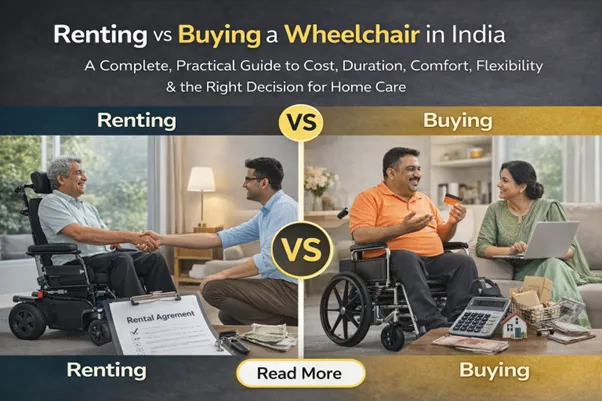
At Aarogyaa Bharat, this question
comes up every day:
“Should we rent for now or buy
directly?”
This final, in-depth guide of the
series breaks down renting vs buying a wheelchair in India using real-world
scenarios, cost comparisons, medical needs, and lifestyle factors so you can
make a clear, confident, and financially sensible decision.
Why This Decision Matters More
Than It Seems
Choosing incorrectly can lead to:
- Unnecessary expenses
- Discomfort during recovery
- Storage problems
- Frequent replacements
- Caregiver frustration
The right choice:
- Saves money
- Improves comfort
- Fits your home & routine
- Adapts to changing needs
Understanding the Two Options
Clearly
Renting a Wheelchair
- Pay a monthly or short-term fee
- Use for a defined period
- Return when no longer needed
- One-time upfront cost
- Long-term ownership
- Ongoing maintenance responsibility
Neither is “better” universally
the right choice depends on context.
When Renting a Wheelchair Makes Sense
Ideal Situations for Renting
- Post-surgery recovery (knee replacement, fractures)
- Short-term illness or weakness
- Uncertain recovery duration
- Trial before buying
- Limited storage space
Key Advantages of Renting
- Lower upfront cost
- No long-term commitment
- Easy upgrade or change
- Ideal for temporary needs
Renting Costs in India
(Typical Range)
|
Wheelchair
Type |
Monthly
Rent (₹) |
|
Basic manual |
1,500 - 2,500 |
|
Foldable aluminium |
2,500 - 4,000 |
|
Comfort /
rehab |
4,000 - 7,000 |
|
Bariatric |
5,000 - 9,000 |
Long rentals (6+ months) can
exceed buying cost.
Limitations of Renting (Be
Aware)
- Limited model choices
- Wear & tear from previous users
- Hygiene concerns if not well maintained
- Monthly cost accumulation
Renting is best when time-bound.
When Buying a Wheelchair Is the Better Choice
Ideal Situations for Buying
- Elderly long-term care
- Neurological conditions (stroke, Parkinson’s)
- Daily use beyond 4-6 months
- Need for customized comfort
- Future reuse expected
Key Advantages of Buying
- Long-term cost efficiency
- Better comfort & fit
- Hygiene control
- Full customization (cushions, accessories)
- Peace of mind
Buying Costs in India
(One-Time)
|
Wheelchair
Category |
Price (₹) |
|
Basic
foldable |
6,000 - 9,000 |
|
Aluminium comfort |
9,000 -
15,000 |
|
Long-term /
rehab |
15,000 -
30,000 |
|
Bariatric |
25,000 -
45,000 |
Most bought wheelchairs last 5-8
years with proper care.
Cost Comparison: Rent vs Buy
(Real Scenario)
Example: Knee Replacement
Recovery
- Rent for 3 months @ ₹3,000/month = ₹9,000
- Buy Aluminium wheelchair = ₹12,000
Renting makes sense here.
Example: Elderly Daily Home
Use
- Rent for 12 months @ ₹3,000/month = ₹36,000
- Buy comfort wheelchair = ₹18,000
Buying saves money and improves
comfort.
Comfort & Health Perspective (Often Ignored)
- Rented chairs may not fit perfectly
- Cushions may be basic or worn
- Long sitting needs customization
If the user:
- Sits >4-5 hours/day
- Has pressure sore risk
- Has posture issues
Buying is strongly recommended
Storage & Transport
Considerations
Renting Works Well If:
- Wheelchair is used occasionally
- Returned after recovery
- Space is limited temporarily
Buying Works Well If:
- Foldable storage available
- Frequent transport needed
- Reuse expected in future
Hybrid Strategy (Best of Both
Worlds)
Many Indian families choose this:
- Rent first (1-2 months)
- Observe comfort, size, usage
- Buy the right model with confidence
This avoids rushed purchases and
regret.
Common Mistakes Families Make
- Renting too long “just in case”
- Buying too early without clarity
- Ignoring comfort for cost
- Not factoring storage
- Assuming one size fits all
Quick Decision Checklist
Choose RENT if:
- Need is temporary
- Recovery timeline is short
- Storage is tight
- Budget is limited short-term
Choose BUY if:
- Daily or long-term use
- Elderly or neurological care
- Comfort is critical
- Reuse expected
Conclusion
Renting and buying are both valid
but timing is everything.
- Rent for uncertainty
- Buy for stability
- Choose comfort over urgency
- Plan for dignity, not just movement
The right decision supports not just mobility but quality of life.