So, are side rails really necessary?
The answer is not a simple yes or no. Side rails, when used
correctly, are powerful safety and mobility-support tools. When used
incorrectly, they can create discomfort or misuse. This guide explains what
side rails actually do, when they are necessary, when they are optional, and
how to use them responsibly to protect both patients and caregivers.
What Are Side Rails?
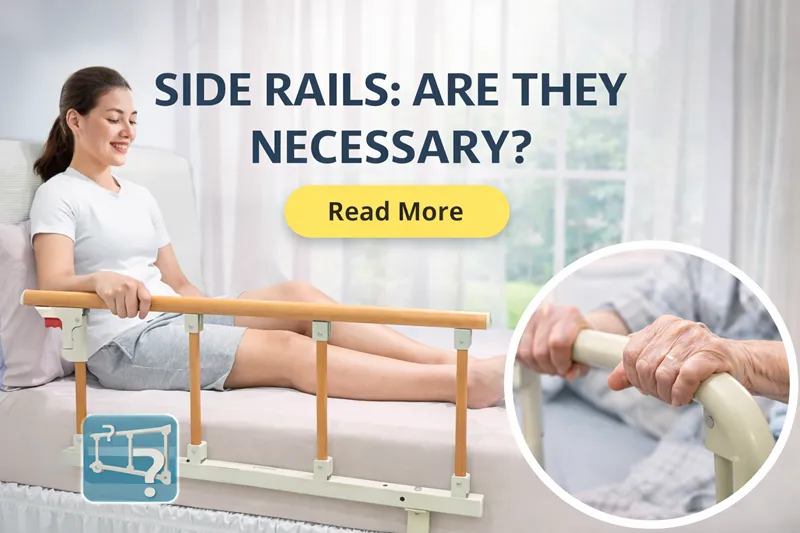
Side rails are protective barriers attached to the sides of
hospital beds. They may be:
- Full-length
or half-length
- Fixed
or foldable
- Manual
or assisted-lock types
Their primary purpose is to enhance safety and support
movement, not to restrain patients.
Why the Question “Are Side Rails Necessary?” Comes Up So
Often
Concerns usually arise because:
- Families
fear restricting patient freedom
- Caregivers
worry about patient entrapment
- Patients
feel “confined” initially
- Lack
of understanding of correct usage
Search queries such as “hospital bed side rails necessary,”
“side rails for elderly safety,” “do side rails prevent falls,” show widespread
confusion.
The Real Purpose of Side Rails
Side rails are designed to:
- Prevent
accidental falls
- Provide
support during turning or sitting
- Assist
safe repositioning
- Increase
patient confidence during movement
- Support
caregivers during transfers
They are supportive devices, not restraints.
Side Rails and Fall Prevention
How Side Rails Reduce Fall Risk
Falls often occur when patients:
- Roll
unintentionally during sleep
- Attempt
to sit or stand without support
- Lose
balance due to weakness or dizziness
Side rails:
- Create
a physical boundary
- Provide
a handhold for stability
- Reduce
sudden rolling or slipping
For elderly patients and post-surgery cases, side rails can
dramatically lower fall risk.
Side Rails as Mobility Aids
Side rails actively support patient movement.
They help patients:
- Turn
in bed independently
- Pull
themselves into a sitting position
- Adjust
posture safely
This is especially helpful for patients with partial
mobility, where rails encourage independence rather than dependence.
Side Rails and Elderly Care
Elderly patients often face:
- Poor
balance
- Muscle
weakness
- Fear
of falling
Side rails:
- Provide
reassurance
- Reduce
nighttime fall anxiety
- Support
safer movement
In elderly home care, side rails are often strongly
recommended.
Side Rails in Post-Surgery Recovery
After surgery, patients may:
- Experience
dizziness
- Have
reduced strength
- Be
under medication effects
Side rails help:
- Prevent
falls during recovery
- Support
safe repositioning
- Reduce
caregiver intervention
They allow patients to recover with less risk and more
confidence.
Side Rails for Long-Term and Bedridden Patients
For long-term care, side rails:
- Prevent
accidental rolling
- Reduce
caregiver strain during turning
- Improve
overall safety
However, they must be used thoughtfully to avoid unnecessary
restriction.
When Side Rails May Not Be Necessary
Side rails may be optional when:
- The
patient is fully mobile
- Bed
height is low
- Continuous
supervision is available
- The
patient strongly prefers no rails
In such cases, alternatives like low beds or floor mats may
be used.
Common Myths About Side Rails
Myth 1: Side rails restrain patients
Reality: When used correctly, they support movement
rather than restrict it.
Myth 2: Side rails increase injury risk
Reality: Modern rails are designed to minimise
entrapment and injury.
Myth 3: Side rails are only for hospitals
Reality: They are widely used in home care,
especially for elderly and long-term patients.
Correct Use of Side Rails
Proper use is key to safety.
Best practices include:
- Using
rails appropriate to patient size
- Keeping
gaps minimal
- Teaching
patients how to use rails
- Lowering
rails during supervised transfers
Correct usage ensures rails remain a safety feature, not a
barrier.
Side Rails and Patient Dignity
Some patients initially resist side rails.
To maintain dignity:
- Explain
their purpose clearly
- Use
partial rails if suitable
- Involve
patients in the decision
When patients understand that rails are protective, not
restrictive, acceptance improves.
Choosing the Right-Side Rails
When selecting side rails, consider:
- Patient
mobility level
- Cognitive
status
- Bed
type compatibility
- Ease
of folding or removal
The right rail design ensures both safety and comfort.
Side Rails and Caregiver Safety
Side rails help caregivers by:
- Providing
leverage during repositioning
- Reducing
lifting strain
- Preventing
sudden patient movement
This supports safer, more sustainable caregiving.
Legal and Ethical Considerations
Side rails should never be used:
- As
punishment
- Without
patient or family consent
- Without
regular reassessment
Ethical use focuses on safety and patient wellbeing.
Conclusion: Side Rails Are Tools Not Restrictions
Side rails are not about limiting freedom; they are about
protecting safety while enabling movement.
When chosen appropriately and used responsibly, side rails:
- Prevent
falls
- Support
mobility
- Reduce
caregiver strain
- Improve
patient confidence
- Enhance
overall care safety
For families caring for loved ones at home, understanding
the role of side rails helps eliminate fear and misuse. The key is individual
assessment, clear communication, and regular review.
In most cases, side rails are not just necessary they are
one of the simplest and most effective safety measures available.
When used with care and compassion, side rails become a
quiet partner in healing protecting without restricting, and supporting without
confining.
A hospital bed does not cure cancer but it can profoundly
improve how a patient lives with it, every single day.
Aarogyaa Bharat explains whether side rails are necessary on hospital beds, highlighting their role in patient safety, fall prevention, and mobility support.