As surgical techniques evolve and healthcare standards rise,
the responsibility placed on surgical device manufacturers has increased
significantly, making reliability and compliance non-negotiable.
From routine surgical procedures to highly complex and
lifesaving interventions, surgical devices directly influence procedural
success, clinical efficiency, and long-term patient health. Surgeons require
instruments that provide predictable performance under pressure, ergonomic
comfort during long operations, and durability across repeated sterilization
cycles. Surgical device manufacturers must therefore balance precision
engineering, material science, innovation, and strict regulatory adherence to
meet the demanding expectations of modern healthcare systems while ensuring
patient safety at every stage.
As healthcare infrastructure expands globally and access to
surgical care improves, the demand for high quality surgical devices continues
to grow steadily. Surgical device manufacturers are no longer limited to
production alone, but actively contribute to improving surgical standards,
reducing complications, supporting minimally invasive techniques, and enabling
faster patient recovery. In this evolving healthcare landscape, trusted
surgical device manufacturers remain essential partners in delivering safe,
effective, and scalable surgical care.
Role of Surgical Device Manufacturers in Modern
Healthcare
Surgical device manufacturers enable healthcare providers to
deliver consistent and high-quality surgical care by supplying instruments that
support accuracy, stability, and efficiency throughout surgical procedures.
These manufacturers work closely with surgeons and clinicians to understand
real world operating room challenges and convert those insights into device
designs that improve usability and performance. High quality surgical devices
help reduce intraoperative risks, minimize human error, and support smoother
post operative recovery, which ultimately improves patient outcomes and
hospital efficiency.
Range of Surgical Devices Manufactured
Surgical device manufacturers produce a comprehensive range
of instruments and equipment that cater to both general and specialized
surgical needs, ensuring end to end support for healthcare facilities. This
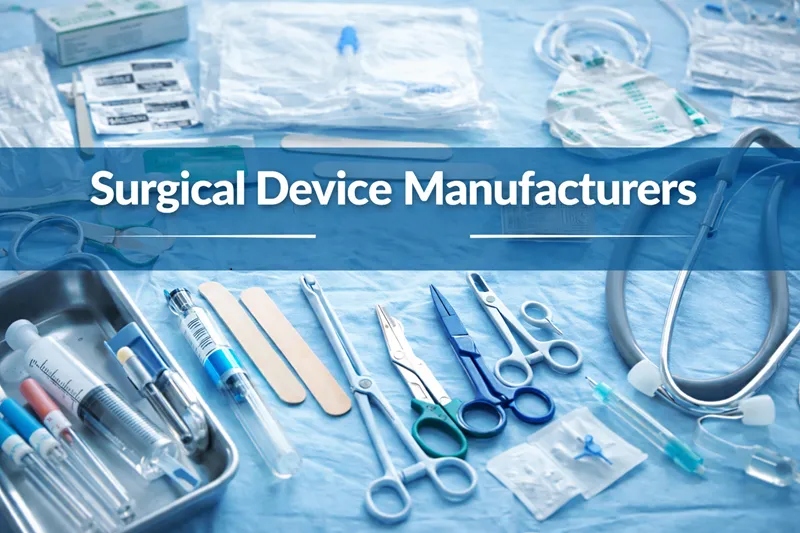
includes commonly used surgical tools such as forceps, scissors, clamps,
retractors, and needle holders, along with advanced devices designed for
minimally invasive, laparoscopic, and robotic assisted surgeries. Manufacturers
also develop specialized surgical devices for orthopaedics, cardiovascular surgery,
neurology, urology, gynaecology, ophthalmology, and cosmetic procedures,
allowing hospitals to source complete surgical solutions from reliable
partners.
Precision Engineering and Manufacturing Excellence
Precision engineering lies at the heart of surgical device
manufacturing, as these devices must meet extremely tight tolerances and exact
specifications to perform reliably during critical procedures. Manufacturers
invest heavily in advanced machining technologies, CNC systems, surface
finishing techniques, and controlled production environments to ensure
uniformity and consistency across every device produced. Even minor dimensional
inaccuracies can compromise surgical precision and patient safety, which is why
manufacturing excellence is treated as a fundamental requirement rather than a
competitive advantage.
Materials Used in Surgical Device Manufacturing
The selection of materials used in surgical device
manufacturing directly impacts device performance, durability, and patient
safety, as surgical instruments must withstand repeated use and sterilization
without losing structural integrity. Manufacturers commonly use surgical grade
stainless steel, titanium alloys, and advanced medical grade polymers because
these materials offer high strength, corrosion resistance, biocompatibility,
and long-term reliability. Proper material selection also ensures smooth surface
finishes, sharp cutting edges, and resistance to wear, all of which are
essential for safe and precise surgical procedures.
Quality Standards, Compliance, and Sterilization
Surgical device manufacturers operate under strict national
and international regulatory frameworks designed to protect patient safety and
ensure device effectiveness. Compliance with standards such as ISO, CE, GMP,
and country specific medical device regulations is mandatory throughout the
design, manufacturing, inspection, and documentation processes. In addition,
manufacturers follow validated sterilization methods such as steam, ethylene
oxide, or gamma radiation depending on the device type and material and ensure
sterile packaging that maintains safety until the point of use. These rigorous
quality and sterilization protocols are critical in preventing surgical site
infections and maintaining clinical trust.
Surgical Device Manufacturers in India
India has emerged as a strong and reliable hub for surgical
device manufacturing, offering a combination of skilled engineering talent,
cost efficiency, and adherence to international quality standards. Indian
surgical device manufacturers supply hospitals and surgical centers across the
country while exporting to global markets in Asia, Africa, Europe, and the
Middle East. Continuous investment in technology, compliance, and quality
systems has strengthened India’s reputation as a dependable contributor to the
global surgical healthcare supply chain.
Role of Aarogyaa Bharat in Surgical Device Supply
Aarogyaa Bharat plays a crucial role in connecting
healthcare providers with trusted surgical device manufacturers by offering
access to verified, compliant, and quality assured surgical products. We work
closely with manufacturers who meet strict regulatory and performance
benchmarks, ensuring hospitals and clinics receive reliable surgical devices.
Our platform provides transparent pricing, authentic sourcing, and dependable
nationwide delivery, simplifying procurement and helping healthcare providers
focus on patient care rather than supply challenges.
Future of Surgical Device Manufacturing
The future of surgical device manufacturing is closely tied
to advancements in medical technology, minimally invasive surgery, and
precision driven healthcare. Increasing adoption of robotic assisted
procedures, digital surgical planning, and patient specific solutions will
drive demand for more advanced and reliable surgical devices. Manufacturers
that prioritize innovation, regulatory compliance, and continuous quality
improvement will be best positioned to lead the industry and support the next
generation of surgical care.
Conclusion
Surgical device manufacturers are indispensable partners in modern healthcare, as their products directly influence surgical accuracy, patient safety, and clinical outcomes. Their commitment to precision engineering, high quality materials, strict compliance, and continuous innovation ensures that surgeons can perform procedures with confidence and consistency. With India’s growing manufacturing capabilities and platforms like Aarogyaa Bharat enabling reliable access, surgical device manufacturers will continue to play a vital role in advancing safe, effective, and efficient surgical care.