At Aarogyaa Bharat, we often help families and caregivers
choose the right sleep and support solutions for home care. In this detailed
guide, we compare water beds vs air beds, explain how they work, their
benefits, limitations, and help you decide which one is right for your needs.
Why Specialized Beds Matter in Medical Care
Traditional mattresses are designed for comfort, not medical
recovery. Patients who spend long hours in bed are at risk of:
- Pressure
sores (bedsores)
- Back
and joint pain
- Poor
blood circulation
- Muscle
stiffness
- Disturbed
sleep
Water beds and air beds are designed to redistribute
pressure, reduce friction, and improve comfort making them especially useful
for elderly patients, post-surgery recovery, paralysis, spinal injuries, and
long-term bedridden care.
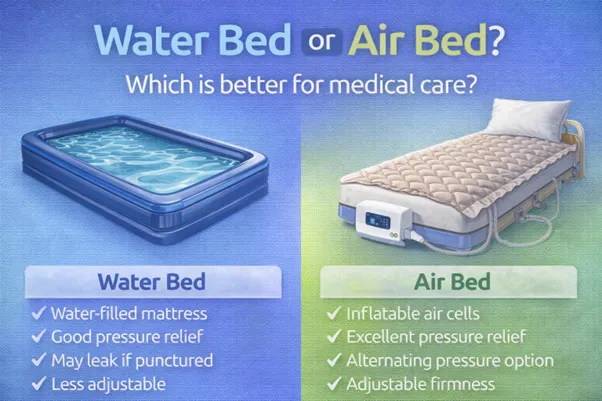
What Is a Water Bed?
A water bed is a mattress filled with water, enclosed within
a sturdy vinyl casing. Modern medical water beds are very different from the
old luxury versions and are designed specifically for pressure relief and
therapeutic support.
How a Water Bed Works
- The
water shifts with body movement
- Pressure
is evenly distributed across the body
- No
single pressure point-bears excessive weight
Key Benefits of Water Beds
- Excellent
pressure redistribution
- Reduces
risk of pressure ulcers
- Supports
natural spinal alignment
- Soothes
joint and muscle pain
- Provides
a gentle massaging effect
Limitations of Water Beds
- Heavy
and difficult to move
- Risk
of leakage if not maintained properly
- Requires
stable room temperature
- Not
ideal for patients who need frequent repositioning
- Takes
time to adjust firmness
What Is an Air Bed?
An air bed (medical air mattress) uses adjustable air
chambers to support the body. Advanced air beds include alternating pressure
systems, which inflate and deflate air cells at regular intervals.
How an Air Bed Works
- Air
pressure adjusts to body weight
- Alternating
cells reduce prolonged pressure
- Promotes
blood circulation
Key Benefits of Air Beds
- Highly
effective for bedsore prevention
- Adjustable
firmness
- Lightweight
and portable
- Easy
to install on existing beds
- Ideal
for long-term and critical care patients
Limitations of Air Beds
- Requires
electricity
- Pump
noise may disturb light sleepers
- Needs
regular monitoring of air pressure
- Less
“natural” feel compared to water beds
Water Bed vs Air Bed: A Detailed Comparison
|
Feature |
Water Bed |
Air Bed |
|
Pressure
relief |
Very good |
Excellent |
|
Bedsore
prevention |
Good |
Superior |
|
Adjustability |
Limited |
Highly
adjustable |
|
Ease of
movement |
Difficult |
Easy |
|
Maintenance |
Moderate |
Low |
|
Power
requirement |
No |
Yes |
|
Suitability
for ICU/home care |
Moderate |
High |
Which One Should You Choose?
Choose a Water Bed if:
- The
patient has joint pain or arthritis
- Short-term
recovery is expected
- Comfort
and spinal support are the main goals
- Bed
mobility is not frequently required
Choose an Air Bed if:
- The
patient is bedridden for long periods
- There
is high risk of pressure sores
- Frequent
repositioning is needed
- Home
nursing or ICU-like care is involved
For medical and long-term home care, air beds are generally
preferred due to their clinical effectiveness.
Who Benefits Most from These Beds?
- Elderly
individuals
- Paralysis
patients
- Post-surgery
recovery patients
- Stroke
survivors
- Spinal
injury patients
- Terminally
ill patients
- Patients
with limited mobility
Importance of Sleep in Healing
Medical research shows that deep, uninterrupted sleep:
- Boosts
immune function
- Accelerates
wound healing
- Reduces
inflammation
- Improves
pain tolerance
- Enhances
mental health
Choosing the right bed is not a luxury it is an essential
part of recovery and dignity in care.
How Aarogyaa Bharat Helps
At Aarogyaa Bharat, we provide:
- Medical-grade
air beds and mattresses
- Home-care
hospital bed solutions
- Expert
guidance for patient care setup
- Trusted
healthcare equipment for home and hospitals
We focus on comfort, safety, and recovery, because healing
begins with rest.
Frequently Asked Questions (FAQs)
Q1. Is an air bed better than a water bed for bedsores?
Yes. Air beds, especially alternating pressure mattresses,
are more effective in preventing and managing pressure ulcers.
Q2. Can water beds be used for elderly patients?
They can be used, but air beds are generally safer and more
practical for elderly patients who need frequent assistance.
Q3. Do air beds consume a lot of electricity?
No. Medical air bed pumps consume minimal power and are designed for continuous use.
Conclusion
When it comes to recovery and long-term care, sleep is not
optional it is therapeutic. Whether you choose a water bed or an air bed
depends on the patient’s condition, mobility, and care requirements.
For most medical and home care situations, air beds offer
superior support, safety, and convenience, while water beds provide
comfort-focused relief in select cases.