Understanding the Basic Difference Between Commode Chairs with and Without Wheels
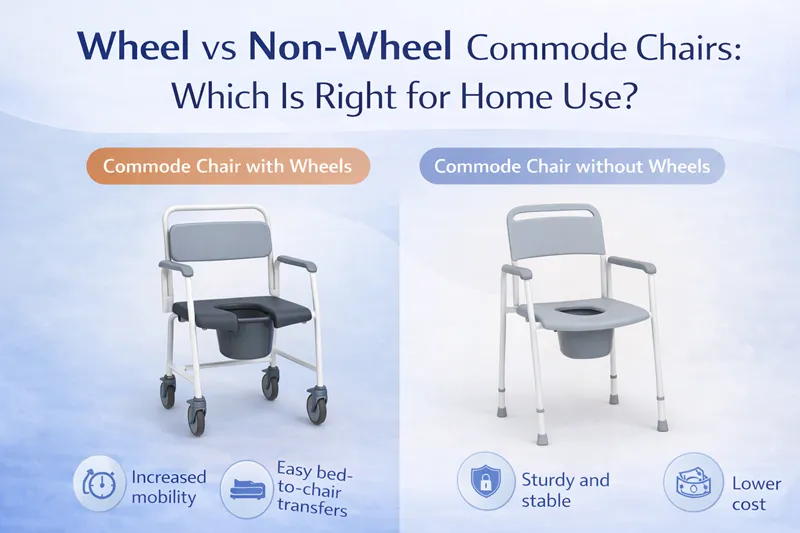
A commode chair without wheels is a stationary toileting
chair designed to be placed at a fixed location, usually beside the bed or near
the bathroom. It relies on rubber-tipped legs or a wide base for stability and
is meant to stay in one place during use. A commode chair with wheels, on the
other hand, is designed for mobility. It includes casters that allow caregivers
to move the user from bed to bathroom or within rooms, along with locking
brakes to keep the chair stable during toileting. While both serve the same
basic purpose, their functionality and suitability differ significantly.
Why the Choice Between Wheels and No Wheels Matters
The presence or absence of wheels directly affects safety,
independence, caregiver effort, and daily routine. For some users, wheels
provide essential mobility and reduce lifting. For others, wheels can actually
increase fall risk if not used correctly. Choosing the wrong type can lead to
instability, caregiver injury, or unnecessary dependency. Understanding when
mobility is needed and when stability is more important is the key to choosing
correctly.
Commode Chair Without Wheels: Features and Purpose
A commode chair without wheels is designed for maximum
stability. It usually has four strong legs fitted with anti-slip rubber tips
that grip the floor firmly. Because it does not move, it provides a strong
sense of security for users who are anxious about balance or fear slipping.
These chairs are commonly used as bedside commode chairs and are ideal when the
user can walk a few steps with support or when caregivers assist the user to
the chair.
Stationary commode chairs are simple, reliable, and easy to
use. They do not require brake management and have fewer moving parts, which
reduces maintenance and long-term wear.
Who Should Use a Commode Chair Without Wheels
Commode chairs without wheels are best suited for elderly
individuals who can walk short distances but struggle with squatting or
standing from a low toilet. They are ideal for post-surgery patients who are
allowed limited walking but need a safe seated toileting option. They are also
suitable for users who feel insecure on moving equipment and prefer a fixed,
stable chair. In small homes where the chair will always remain beside the bed,
a non-wheeled commode chair is often the safest and simplest option.
Safety Benefits of a Commode Chair Without Wheels
The biggest advantage of a commode chair without wheels is
stability. Because the chair does not move, there is minimal risk of rolling,
shifting, or brake failure. This makes it especially suitable for night-time
use, when users may be sleepy, disoriented, or moving without full attention.
For elderly individuals with balance issues or fear of falling, a stationary
commode chair provides confidence and reassurance.
Limitations of a Commode Chair Without Wheels
While stability is a major advantage, lack of mobility can
also be a limitation. Caregivers may need to help the user walk to the chair or
physically assist during transfers. For users who are bedridden or cannot stand
safely, lifting or pivoting becomes necessary, increasing caregiver strain and
injury risk. In such cases, a stationary chair may not be practical for
long-term care.
Commode Chair with Wheels: Features and Purpose
A commode chair with wheels is designed to combine toileting
support with mobility. It includes smooth-rolling casters that allow caregivers
to move the user safely from bed to bathroom or within the home. High-quality
models include lockable brakes on the wheels to prevent movement during
toileting. Some wheeled commode chairs are designed to be rolled directly over
a western toilet, adding further flexibility.
This type of chair reduces the need for lifting and makes
caregiving easier in homes where the bathroom is far from the bedroom or where
the user cannot walk safely at all.
Who Should Use a Commode Chair with Wheels
Commode chairs with wheels are ideal for bedridden or
semi-bedridden patients, stroke survivors, people with paralysis or severe
weakness, and post-surgery patients who are not allowed to bear weight. They
are also useful in homes where caregivers need to move the user frequently or
where space layout requires mobility. For long-term dependent care, wheeled
commode chairs significantly reduce caregiver effort and physical strain.
Safety Considerations for Commode Chairs with Wheels
Safety with wheeled commode chairs depends heavily on proper
brake usage. The brakes must always be locked during toileting to prevent
rolling. Poor-quality wheels or weak brakes can compromise safety, which is why
selecting a medically reliable model is critical. When used correctly on flat
surfaces with brakes engaged, wheeled commode chairs are very safe and stable.
However, they require more caregiver awareness and training than stationary
chairs.
Caregiver Effort and Physical Strain Comparison
From a caregiver’s perspective, the difference between
wheeled and non-wheeled commode chairs is significant. A non-wheeled chair
often requires guiding, supporting, or lifting the user, which can be
physically exhausting over time. A wheeled commode chair allows caregivers to
move the user without lifting, reducing back strain and fatigue. For long-term
care situations, this reduction in physical effort can prevent caregiver
injuries and burnout.
Comfort and User Confidence
User comfort and confidence vary depending on the chair
type. Some users feel more secure on a stationary chair because it does not
move at all. Others feel more comfortable knowing they do not have to stand or
walk, which makes wheeled chairs preferable. Proper seat height, armrest
support, and backrest design play a crucial role in comfort for both types.
Confidence often increases when the chair matches the user’s mobility level
rather than forcing unnecessary movement.
Home Layout and Space Considerations
Home layout strongly influences the choice. In small homes
or bedrooms where the commode chair will remain beside the bed, a non-wheeled
chair is often sufficient. In larger homes, or where the bathroom is far from
the bedroom, wheeled commode chairs offer practical mobility. Narrow doorways,
uneven floors, or small bathrooms may limit the usefulness of wheeled chairs
and should be considered before choosing.
Comparison Table: Commode Chair with Wheels vs Without
Wheels
|
Feature |
Commode
Chair Without Wheels |
Commode
Chair with Wheels |
|
Mobility |
Fixed |
Movable |
|
Stability
during use |
Very high |
High (with
brakes) |
|
Fall risk |
Very low |
Low (if
brakes locked) |
|
Caregiver
effort |
Medium to
high |
Low |
|
Suitable for
bedridden users |
Limited |
Excellent |
|
Night-time
safety |
Excellent |
Good (with
care) |
|
Maintenance |
Low |
Moderate |
|
Best for |
Semi-mobile
users |
Dependent
users |
Which Option Is Better for Elderly Care
For elderly individuals who can stand with support and walk
a few steps, a commode chair without wheels is often safer and simpler. For
elderly individuals with severe weakness, balance issues, or frequent
night-time toileting needs, a commode chair with wheels may be better if
caregivers are available and trained to use brakes properly. In many homes,
families use a stationary commode chair for night-time and a wheeled chair for
daytime assisted movement.
Which Option Is Better After Surgery
After surgery, the choice depends on weight-bearing
restrictions. If the patient is allowed limited walking, a stationary commode
chair works well. If the patient is not allowed to stand or walk, a wheeled
commode chair is safer and more comfortable. As recovery progresses, families
may switch from wheeled to non-wheeled chairs.
Cost Differences and Long-Term Value
Commode chairs with wheels are generally more expensive due
to additional components like casters, brakes, and reinforced frames. However,
for long-term dependent care, they often provide better value by reducing
caregiver injury and improving safety. Non-wheeled commode chairs are more
affordable and suitable for short-term or semi-independent use.
Common Mistakes Families Make
A common mistake is choosing a wheeled commode chair for an independent user, which can increase fall risk if brakes are forgotten. Another mistake is choosing a stationary chair for a fully dependent patient, leading to unsafe lifting. Ignoring home layout and caregiver strength also leads to poor outcomes. Assessing the user’s mobility honestly is the most important step.
Conclusion
The choice between a commode chair with wheels and without wheels should never be based on convenience alone. It must be guided by the user’s mobility level, safety needs, caregiver strength, and home layout. Stationary commode chairs offer unmatched stability and simplicity, while wheeled commode chairs provide essential mobility and reduce caregiver strain for dependent users. Making the right choice improves safety, comfort, dignity, and quality of care at home. Aarogyaa Bharat remains committed to helping families select the most suitable home healthcare solutions for every stage of care.