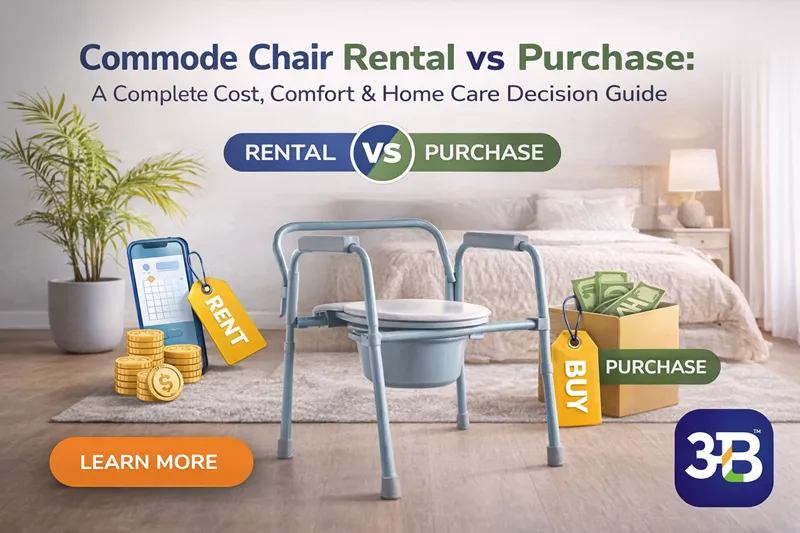
This decision is far more complex than it appears on the
surface, especially in Indian home-care settings where care is managed by
family members and not institutions. A commode chair is not used once or twice;
it becomes part of a person’s daily routine, sometimes multiple times a day and
night. The choice between renting and buying directly impacts comfort, hygiene,
cost over time, caregiver stress, storage, and long-term peace of mind. Many
families make hurried decisions during stressful medical situations and later
regret them when costs add up or the equipment does not meet ongoing needs.
Understanding the real differences between renting and buying a commode chair
helps families make a thoughtful, financially sensible, and emotionally
comfortable decision that truly supports patient well-being.
Why the Rental vs Buying Decision Matters So Much in Home
Care
In Indian homes, healthcare equipment often shares space
with daily family life, making every decision more personal and long-lasting. A
commode chair is an intimate care product, used for toileting, hygiene, and
sometimes assisted transfers. Choosing incorrectly can result in repeated
expenses, discomfort for the patient, or additional workload for caregivers.
Renting may seem economical at first, while buying may appear expensive
initially, but the true cost and value of each option only become clear when
viewed over time. This decision matters because it directly affects patient
safety, hygiene control, emotional comfort, and the sustainability of home
care, especially when care extends beyond a few weeks.
Understanding What Commode Chair Rental Really Means
Renting a commode chair usually involves paying a monthly
rental fee to use the chair for a fixed period. Rental providers typically
offer standard models that are easy to deploy quickly after hospital discharge
or surgery. Rental is often chosen when the duration of use is uncertain or
expected to be short, such as after orthopaedic surgery, temporary injury, or
brief illness. While rental reduces upfront cost, families should understand
that rental chairs are shared-use equipment, cleaned between users, and usually
limited in features. There may also be security deposits, transport charges,
minimum rental periods, and conditions related to damage or wear. Over time,
these factors can increase total cost and inconvenience.
What Buying a Commode Chair Involves in Practical Terms
Buying a commode chair means making a one-time investment in
a product that becomes a permanent part of the home-care setup. Purchased
chairs can be selected based on the patient’s exact needs, including seat
height, cushion comfort, wheels, anti-slip safety, bariatric capacity, or
foldable storage. Buying offers complete control over hygiene, usage, and
maintenance. For families caring for elderly individuals or patients with
chronic or progressive conditions, ownership brings stability and eliminates repeated
coordination with rental providers. Although the upfront cost is higher, the
long-term value is often greater, especially when the chair is used daily.
When Renting a Commode Chair Is the Right Choice
Renting a commode chair makes sense when the care
requirement is clearly temporary and time-bound. Examples include post-surgery
recovery after knee or hip replacement, fracture healing, short-term weakness
after hospitalization, or recovery from infection. In these cases, the
patient’s mobility is expected to improve steadily, and the chair may not be
needed beyond a few weeks. Renting avoids spending on equipment that may soon
become unnecessary. It also helps families who are unsure about future needs or
do not want to manage storage after recovery. For short-term care, rental can
be a practical and economical solution.
Situations Where Buying a Commode Chair Is Clearly Better
Buying a commode chair is usually the better option when
care needs are long-term, ongoing, or progressive. Elderly individuals with
declining mobility, patients with neurological disorders, spinal injuries,
paralysis, Parkinson’s disease, or chronic weakness often require consistent
toileting support. In these cases, renting becomes expensive over time and
limits access to comfort-enhancing features. Buying ensures the chair is always
available, familiar, hygienically controlled, and tailored to the patient’s
body and condition. For families providing daily care over months or years,
ownership reduces uncertainty and improves caregiving consistency.
Cost Comparison Over Time: Rental vs Buying
|
Aspect |
Renting a
Commode Chair |
Buying a
Commode Chair |
|
Initial
expense |
Low |
Moderate to
high |
|
Monthly
payment |
Required |
None |
|
Long-term
cost |
Increases
continuously |
Fixed |
|
Feature
options |
Limited |
Wide choice |
|
Hygiene
control |
Partial |
Full |
|
Best suited
for |
Short-term
use |
Long-term
care |
When rental continues beyond two to three months, the
cumulative cost often exceeds the price of buying a good-quality commode chair.
Hygiene and Emotional Comfort Considerations
Hygiene is a major concern because a commode chair is used
for intimate bodily functions. While rental providers clean equipment before
delivery, many families feel uncomfortable using equipment previously used by
others, especially for elderly, immunocompromised, or chronically ill patients.
Buying a commode chair ensures complete hygiene control, from cleaning methods
to frequency and replacement of buckets or cushions. Emotional comfort also
matters; patients often feel more secure and respected using their own
equipment rather than rented items, which can feel impersonal or temporary.
Comfort, Customization, and Feature Availability
Rental chairs are usually basic, one-size-fits-all models.
Advanced features such as cushioned seats, height adjustment, wheels with
locks, anti-slip legs, or bariatric support may not be available or may cost
extra. Buying allows families to choose features that directly improve comfort,
safety, and ease of use. Over time, comfort becomes critical, especially when
the chair is used multiple times daily. A poorly chosen chair can cause
discomfort, resistance, or even medical complications, making buying the right
chair an investment in quality of life.
Storage and Space Considerations in Indian Homes
Many families worry that buying a commode chair will
permanently occupy space. However, modern foldable commode chairs can be stored
compactly when not in use. Renting avoids storage concerns but only
temporarily. If care becomes long-term, storage becomes unavoidable anyway.
Choosing a foldable purchased chair offers the best of both worlds: ownership
without clutter.
Impact on Caregivers and Daily Routines
Caregivers manage toileting multiple times a day, often
under physical and emotional strain. Rental chairs may need replacement,
servicing, or return coordination, adding logistical stress. Buying ensures the
chair is always available, properly adjusted, and familiar. This consistency
reduces caregiver fatigue, improves safety, and makes daily routines smoother
and more predictable.
Environmental and Practical Sustainability
From a practical standpoint, repeated rentals involve
transport, cleaning, and redistribution of equipment. Buying a durable chair
for long-term use reduces repeated logistics and provides continuity of care.
For families committed to home care, ownership often proves more sustainable
and emotionally reassuring.
Rental vs Buying Based on Patient Category
|
Patient
Type |
Better
Option |
Reason |
|
Post-surgery
recovery |
Rent |
Short
duration |
|
Temporary
injury |
Rent |
Limited use |
|
Elderly
long-term care |
Buy |
Daily ongoing
use |
|
Chronic
illness |
Buy |
Comfort and
hygiene |
|
Disability or
paralysis |
Buy |
Permanent
support |
|
Home ICU
setup |
Buy |
Reliability
and safety |
Common Mistakes Families Make
A common mistake is choosing rental only because it seems
cheaper initially, without calculating long-term cost. Another mistake is
buying immediately without understanding whether the need is temporary.
Families also underestimate hygiene and comfort requirements. The best approach
is to realistically assess expected duration and reassess after a few weeks if
needed.
Why Aarogyaa Bharat Helps Families Decide Correctly
Aarogyaa Bharat understands that home-care decisions are
emotional and practical at the same time. By offering guidance based on patient
condition, duration, comfort needs, and budget, Aarogyaa Bharat helps families
avoid costly mistakes. The goal is not just equipment supply, but enabling
safe, dignified, and sustainable home care.
Conclusion
The choice between renting and buying a commode chair should never be rushed or based on cost alone. Renting is ideal for short-term recovery and temporary care, while buying is almost always the better option for elderly care, chronic illness, disability, or long-term home care. A well-chosen commode chair improves safety, comfort, hygiene, and emotional well-being, making it one of the most important decisions in home healthcare. Aarogyaa Bharat remains committed to helping families make informed, compassionate choices that truly support long-term quality of life.