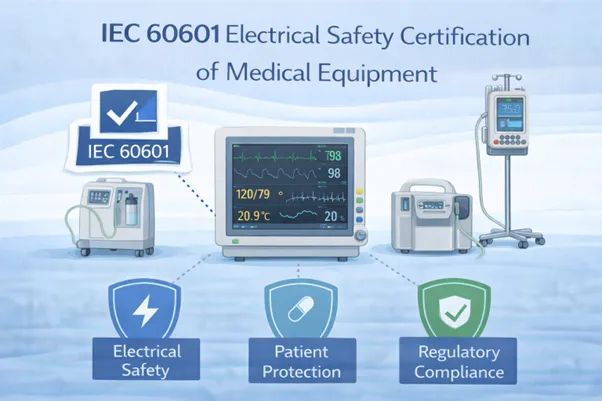
This is why IEC 60601 electrical safety certification is
considered the global gold standard for medical electrical equipment.
At Aarogyaa Bharat, we often guide hospitals, diagnostic
centers, and medical equipment buyers on choosing devices that are not just
technologically advanced but also electrically safe and compliant. This
comprehensive guide explains IEC 60601 certification in detail, including what
it is, why it matters, scope, test requirements, device categories, compliance
process, hospital relevance, and FAQs in clear, practical language.
What Is IEC 60601 Certification?
IEC 60601 is an international standard developed by the
International Electrotechnical Commission (IEC) that defines electrical safety
and essential performance requirements for medical electrical equipment.
IEC 60601 certification ensures that a medical device:
- Does
not expose patients or operators to electrical shock
- Prevents
fire and overheating hazards
- Functions
safely under normal and fault conditions
- Maintains
electromagnetic compatibility (EMC)
- Performs
reliably in clinical environments
In simple terms, IEC 60601 ensures that electrically powered
medical equipment is safe to use on human beings.
IEC 60601 medical equipment certification
Why IEC 60601 Is Critical in Healthcare
Hospitals are electrically complex environments. Patients
are often:
- Physically
weak or unconscious
- Connected
to multiple electrical devices
- Exposed
through invasive procedures
Even a small leakage current can cause serious injury or
death, especially in critical care settings.
Key Reasons IEC 60601 Matters
- Protects
patients from electrical shock
- Prevents
device-related fires
- Ensures
safe operation in ICUs and OTs
- Reduces
electromagnetic interference
- Supports
regulatory approvals worldwide
For hospitals and diagnostic centers, using IEC
60601-certified medical equipment is essential for patient safety and legal
compliance.
electrical safety medical equipment
Electrical Safety in Hospital Equipment
Who Issues IEC 60601 Certification?
IEC standards are developed by the International
Electrotechnical Commission, but testing and certification are performed by
accredited laboratories and certification bodies, such as:
- TÜV
- UL
- Intertek
- SGS
These bodies conduct rigorous laboratory testing to verify
compliance.
Scope of IEC 60601 Standard
IEC 60601 applies to:
- Medical
electrical equipment
- Medical
electrical systems
- Devices
intended for diagnosis, treatment, monitoring, or life support
Examples of Equipment Covered
- ECG
machines
- Patient
monitors
- Ventilators
- Defibrillators
- Infusion
pumps
- Ultrasound
machines
- X-ray
and imaging systems
IEC 60601 certified medical devices
Structure of IEC 60601 Standard
IEC 60601 is a family of standards, not a single document.
Main Components
- IEC
60601-1 - General requirements for basic safety and essential performance
- IEC
60601-1-2 - Electromagnetic compatibility (EMC)
- IEC
60601-1-6 - Usability engineering
- IEC
60601-1-8 - Alarm systems
- Collateral
and Particular Standards - Device specific requirements
Each part addresses a specific risk area.
IEC 60601 Standards Framework
Key Safety Requirements Under IEC 60601
1. Protection Against Electrical Shock
- Limits
leakage current
- Defines
insulation requirements
- Specifies
grounding and isolation
2. Mechanical & Structural Safety
- Stability
of equipment
- Protection
from moving parts
- Resistance
to mechanical stress
3. Fire & Thermal Safety
- Control
of surface temperature
- Prevention
of overheating
- Fire-resistant
materials
4. Electromagnetic Compatibility (EMC)
- Device
must not interfere with other equipment
- Must
operate correctly in presence of EMI
IEC 60601 EMC compliance
Essential Performance Concept
IEC 60601 introduces the idea of essential performance,
meaning:
Performance necessary to achieve freedom from unacceptable
risk.
If a failure compromises essential performance, the device
is considered unsafe even if no electrical shock occurs.
IEC 60601 Compliance Testing
Testing includes:
- Leakage
current measurement
- Dielectric
strength testing
- Ground
continuity testing
- EMC
immunity & emission tests
- Fault
condition simulation
Testing is conducted under normal and single-fault
conditions.
IEC 60601 Electrical Safety Testing
IEC 60601 vs ISO vs Regulatory Approval
|
Aspect |
IEC 60601 |
ISO 13485 |
Regulatory
Approval |
|
Focus |
Electrical
safety & performance |
Quality
management |
Legal market
access |
|
Scope |
Product-specific |
Organization-wide |
Product-specific |
|
Issued by |
IEC-accredited
labs |
Certification
bodies |
Government
regulators |
|
Mandatory |
Indirectly
yes |
Indirectly
yes |
Legally
mandatory |
IEC 60601 supports CE, FDA, and CDSCO approvals but does
not replace them.
Why IEC 60601 Matters for Medical Device Manufacturers
For manufacturers, IEC 60601:
- Reduces
product failure risk
- Prevents
costly recalls
- Simplifies
CE & FDA submissions
- Builds
buyer confidence
- Enables
global market access
IEC 60601 compliance for manufacturers
Why IEC 60601 Matters for Hospitals & Diagnostic
Centers
Hospitals benefit because IEC 60601-certified equipment:
- Minimizes
electrical hazards
- Ensures
safe multi-device environments
- Reduces
legal and insurance risks
- Meets
accreditation requirements
Hospital biomedical teams often reject non-IEC-compliant
equipment.
IEC compliant hospital equipment
Common Mistakes to Avoid
Assuming CE or ISO alone ensures electrical safety
Ignoring EMC requirements
Using uncertified refurbished equipment
Poor maintenance after installation
Future Trends in Electrical Safety Standards
- Stronger
EMC requirements
- Integration
with cybersecurity standards
- Increased
focus on home-care equipment safety
- Global harmonization of electrical standards
Conclusion
IEC 60601 certification is not just a technical requirement it
is a critical patient-safety safeguard. In an environment where patients are
vulnerable and devices are interconnected; electrical safety can never be
compromised.
At Aarogyaa Bharat, we strongly recommend selecting IEC
60601-certified medical equipment to ensure safe, reliable, and compliant
healthcare delivery whether in hospitals, diagnostic centers, or home-care
settings.