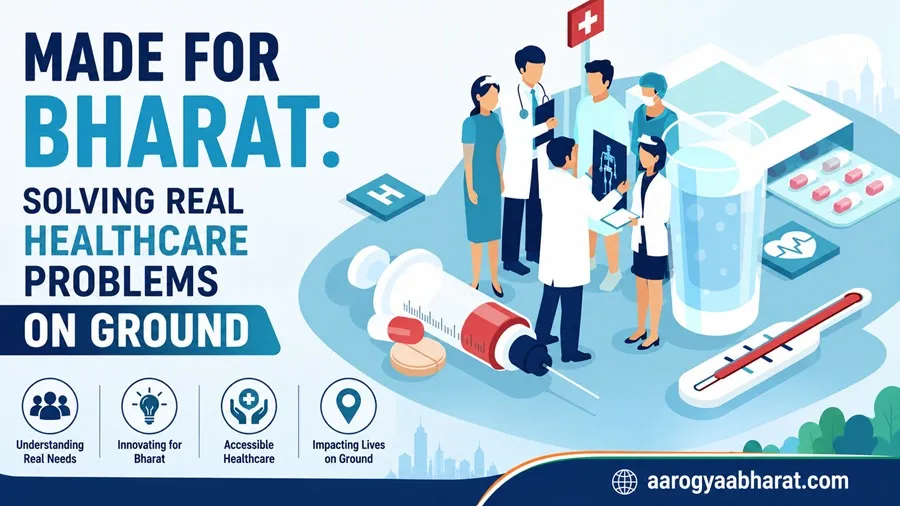
India’s Healthcare Challenges Need Bharat-Focused
Solutions
India’s healthcare system is evolving rapidly, but the
reality on the ground remains very different from what is often seen in urban
hospitals and large medical centers. Across villages, small towns, semi-urban
areas, and even growing cities,
healthcare providers continue facing operational struggles related to
accessibility, affordability, infrastructure, staffing, and medical equipment
availability. The vision of Viksit Bharat cannot be achieved through imported
ideas alone because India’s healthcare needs are unique and deeply connected to
the realities of Bharat. Real healthcare transformation happens when solutions
are designed specifically for Indian conditions, patient behavior,
affordability levels, and operational challenges faced every day on the ground.
Healthcare Accessibility Remains a Major Challenge
One of the biggest operational problems in India is
healthcare accessibility because millions of people still struggle to reach
hospitals, diagnostic centers, and emergency care services on time. In rural
regions, patients often travel long distances for even basic medical treatment,
while urban hospitals frequently
experience overcrowding and long waiting times. Delayed access to healthcare
can increase complications, treatment costs, and patient risk. Practical
healthcare solutions such as telemedicine, mobile healthcare services, digital
consultations, and decentralized healthcare systems are helping reduce this gap
by bringing medical support closer to communities. Building healthcare systems
that work efficiently for both cities and
villages is essential for creating a stronger healthcare ecosystem.
Medical Equipment Availability Is a Real Ground-Level
Problem
Many hospitals, clinics, and healthcare centers across India
continue facing shortages of essential medical equipment such as oxygen
concentrators, wheelchairs, patient
monitors, ICU beds, ventilators, BiPAP
systems, and rehabilitation devices.
Smaller hospitals and
rural healthcare facilities often struggle with budget limitations that make
advanced equipment difficult to purchase and maintain. In many cases, patients
and families face stress during emergencies because critical equipment is
unavailable when needed. Healthcare equipment rental services, portable medical
technologies, and affordable healthcare infrastructure solutions are becoming
important ways to solve these operational challenges. Access to reliable medical
equipment can directly improve patient outcomes and emergency
preparedness.
Rural Healthcare Needs More Than Just Hospitals
Building
hospitals alone is not enough to solve rural healthcare problems
because many villages also face shortages of doctors, diagnostic services,
emergency transportation, and specialist consultations. Rural healthcare
systems require practical support through mobile clinics, telemedicine
platforms, digital diagnostics, AI-assisted healthcare tools, and portable
medical devices that can reach remote areas more efficiently. Ground-level
healthcare workers also need better training, support systems, and healthcare
technologies that simplify patient care. Healthcare solutions made for Bharat
must focus on flexibility, affordability, and accessibility rather than
depending only on large centralized systems.
Emergency Healthcare Delays Cost Lives
Emergency healthcare remains one of the biggest operational
struggles across India because delays in ambulances, oxygen support, ICU
access, and emergency treatment continue affecting patient survival rates.
During accidents, respiratory emergencies, heart attacks, and critical
illnesses, even small delays can become life-threatening. Many healthcare
facilities still lack proper emergency preparedness systems, especially in
smaller towns and rural regions. Improving ambulance coordination, emergency
medical equipment access, oxygen infrastructure, and real-time
healthcare support systems can significantly strengthen emergency healthcare
delivery across India. Faster healthcare response systems are essential for
saving lives on the ground.
Healthcare Affordability Is a Daily Concern for Families
Healthcare affordability remains a major challenge for
millions of Indian families because rising treatment costs, hospitalization
expenses, diagnostics, and medical equipment charges often create financial
pressure during emergencies. Many patients delay treatment because they are
worried about healthcare costs, which can worsen health conditions over time.
Affordable healthcare models such as digital consultations, preventive
healthcare, medical
equipment rentals, home healthcare services, and low-cost diagnostics are
helping reduce financial burden for ordinary citizens. Solutions built for
Bharat must prioritize affordability without compromising healthcare quality
because accessible healthcare is essential for inclusive national development.
Home Healthcare Is Solving Practical Patient Problems
Home healthcare services are becoming increasingly important
in India because many patients prefer receiving medical support at home instead
of remaining hospitalized for long periods. Elderly individuals, chronic
disease patients, post-surgery patients, and rehabilitation cases often require
continuous support that can be managed more comfortably at home. Medical
equipment such as oxygen
concentrators, hospital
beds, wheelchairs, patient
monitors, and rehabilitation
devices are now supporting home-based healthcare across India. Home
healthcare reduces hospital overcrowding, lowers treatment costs, and improves
patient comfort while solving practical operational challenges faced by
hospitals and families alike.
Technology Is Helping Solve Ground-Level Healthcare
Issues
Digital healthcare technology is playing a major role in
solving real healthcare problems across Bharat. Telemedicine platforms, AI
healthcare chatbots, remote patient
monitoring systems, digital health records, and healthcare guidance
applications are helping patients receive faster and more organized medical
support. Technology is especially valuable in areas where healthcare
infrastructure and specialist availability remain limited. Digital healthcare
systems reduce travel time, improve communication, support faster diagnosis,
and help healthcare providers manage patient data more efficiently.
Technology-driven healthcare solutions designed for Indian conditions are
helping bridge operational gaps at multiple levels.
Healthcare Workers Face Operational Challenges Every Day
Doctors, nurses, technicians, ambulance staff, and
healthcare workers across India work under intense pressure due to high patient
volumes, staffing shortages, emergency situations, and infrastructure
limitations. In many healthcare facilities, limited resources increase workload
and affect operational efficiency. Supporting healthcare workers with better
medical technologies, digital systems, automation tools, and healthcare
infrastructure can improve both patient care and workplace efficiency. Healthcare
transformation is not only about machines and hospitals but also about
creating systems that help healthcare professionals work more effectively and
sustainably.
Rehabilitation and Recovery Care Need More Attention
One of the most overlooked healthcare challenges in India is
rehabilitation and long-term recovery support for patients recovering from
surgeries, accidents, strokes, or chronic illnesses. Many patients require physiotherapy
equipment, mobility aids, patient lifts, wheelchairs, walkers,
and rehabilitation services after treatment, but access to these services
remains limited in many areas. Recovery-focused healthcare is essential for
improving patient quality of life and reducing long-term disability. Solutions
designed for Bharat must focus not only on emergency treatment but also on
long-term recovery, rehabilitation,
and patient independence.
Smart Healthcare Systems Can Improve Efficiency
India’s healthcare future depends heavily on smarter
healthcare systems that improve coordination, reduce delays, and support
efficient patient management. Digital appointment systems, AI-assisted
diagnostics, real-time healthcare tracking, GPS-enabled ambulances, and
integrated patient data systems can improve operational efficiency
significantly. Smart healthcare infrastructure helps hospitals manage patient
flow better, improves emergency response, and supports faster clinical
decision-making. Technology-driven healthcare systems made specifically for
Indian healthcare environments can solve many operational struggles that affect
patients and providers daily.
Healthcare Startups Are Building Bharat-Centric Solutions
Indian healthcare startups are increasingly focusing on
solving practical healthcare challenges faced by ordinary citizens instead of
only targeting premium urban markets. Many startups are building affordable
healthcare devices, telemedicine platforms, diagnostic tools, emergency
healthcare systems, and home healthcare services designed specifically for
Indian needs. These startups understand local healthcare realities and are
creating scalable solutions that work in both urban and rural environments. Innovation
focused on real-world healthcare problems can create long-term impact and
improve healthcare accessibility across the country.
Solving Healthcare Problems Requires Collaboration
No single organization can solve India’s healthcare
challenges alone because healthcare transformation requires collaboration
between government bodies, private
hospitals, healthcare startups, technology companies, medical equipment
providers, and healthcare professionals. Public-private partnerships,
healthcare awareness programs, digital healthcare initiatives, and
infrastructure investment all play important roles in strengthening the
healthcare ecosystem. Ground-level healthcare problems require practical and
coordinated solutions that focus on accessibility, affordability, efficiency,
and patient-centred care.
The Future of Bharat-Focused Healthcare Solutions
The future of Indian healthcare depends on building systems
that understand the real needs of Bharat. Solutions that are affordable,
scalable, technology-driven, and operationally practical will create the
biggest impact across healthcare sectors. Digital healthcare, AI-powered
systems, portable
medical equipment, home healthcare, preventive care, and smart
infrastructure will continue transforming healthcare delivery in India. The
focus must remain on solving real healthcare problems faced by ordinary people
every day rather than only building high-end healthcare systems for limited
populations. Bharat-focused healthcare innovation will play a major role in
shaping a healthier and stronger India in the coming years.
Conclusion
India’s healthcare transformation can only succeed when healthcare solutions are built for the realities of Bharat. Ground-level operational struggles such as healthcare accessibility, emergency delays, medical equipment shortages, affordability challenges, and rural healthcare gaps require practical and scalable solutions designed specifically for Indian conditions. Through digital healthcare, affordable medical technologies, home healthcare services, smart healthcare systems, and innovation-driven startups, India is gradually solving many real healthcare problems faced across the country. As the nation moves toward the vision of Viksit Bharat, healthcare systems made for Bharat will remain essential for building a healthier, stronger, and more inclusive future.