Why Outdoor Mobility Requires Specialized Support
Outdoor walking exposes elderly individuals to unpredictable terrain conditions such as cracked pavements, gravel pathways, sloped sidewalks, wet surfaces, and crowded public spaces, all of which demand enhanced balance control and structural stability beyond what basic indoor walkers provide. Age-related reductions in reflex speed, muscle strength, and depth perception further amplify fall risk when navigating outdoor environments. Even minor surface irregularities may cause sudden wheel resistance or frame instability if the walker is not designed for outdoor durability. Additionally, exposure to wind resistance and uneven inclines increases the need for reliable brake systems and stable frame geometry. Aarogyaa bharat emphasizes that outdoor mobility planning should be treated as a critical component of elderly home care and rehabilitation strategies, especially for seniors recovering from surgery or managing chronic conditions such as arthritis, neuropathy, or Parkinson’s disease. Selecting a rollator optimized for outdoor conditions ensures smoother navigation and safer daily participation in social and physical activities.
Key Features of an Outdoor Rollator Walker
| Feature | Importance for Outdoor Use |
|---|---|
| Large Front Wheels (8–10 inch) | Smooth glide over rough surfaces |
| All-Terrain Rubber Tread | Improved traction |
| Reinforced Frame | Enhanced stability |
| Responsive Hand Brakes | Controlled downhill stopping |
| Wide Base Design | Reduced tipping risk |
| Weather-Resistant Coating | Durability against moisture |
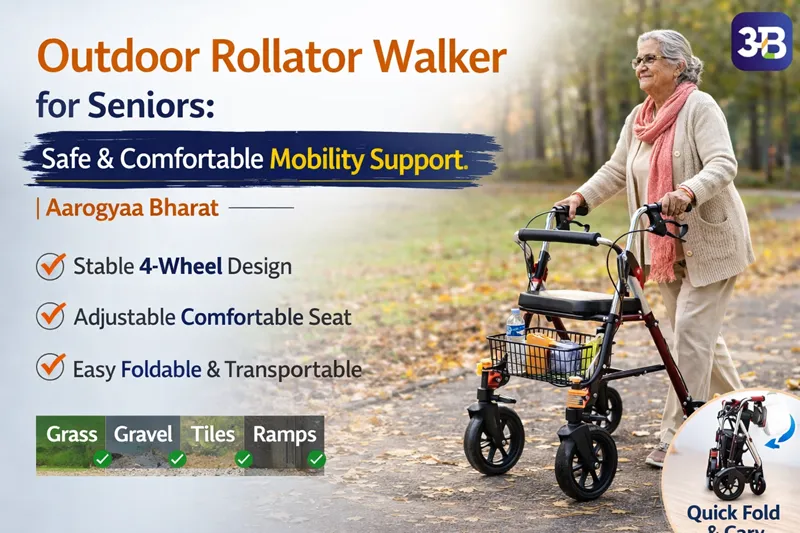
Rollators designed for outdoor use prioritize wheel diameter, tread pattern, and frame reinforcement to manage terrain variability effectively.
Wheel Size and Terrain Adaptability
Wheel diameter is one of the most critical factors for outdoor mobility because larger wheels can roll over minor cracks, gravel patches, and pavement joints without abrupt stopping that may destabilize the user. Smaller indoor wheels may catch on uneven edges, increasing forward tipping risk. All-terrain rubber tread improves traction on slightly wet or dusty surfaces, while shock-absorbing wheel materials reduce vibration and joint strain. In mobility support solutions offered through aarogyaa bharat, outdoor rollators typically include 8-inch or larger front wheels for improved adaptability. Selecting terrain-appropriate wheels reduces fatigue and enhances confidence during longer outdoor walks, which are important for cardiovascular health and rehabilitation recovery.
Brake Control and Downhill Safety
Outdoor environments often include mild slopes or inclined pavements, making reliable brake systems essential for preventing uncontrolled rolling. Ergonomic brake handles must provide smooth yet firm engagement without excessive grip force, especially for seniors with arthritis or reduced hand strength. Locking brakes should hold securely during rest breaks on uneven ground. Cable tension should be inspected regularly as part of home care maintenance planning. Aarogyaa bharat hospital pages and healthcare calculators recommend integrating brake inspection into post-discharge rehab routines, particularly for orthopedic and neurological patients. Strong brake control enhances safety during downhill walking and ensures secure seated rest stops.
Frame Stability and Weight Distribution
Outdoor rollators require reinforced frames capable of absorbing uneven ground impact without flexing or wobbling under load pressure. Wider base frames improve lateral balance and reduce tipping risk when one wheel encounters a raised surface. Crossbar reinforcement adds structural rigidity and enhances long-term durability. In rehab categories, especially for bariatric or higher-weight users, heavy-duty outdoor rollators provide additional safety margin. Aarogyaa bharat mobility support solutions emphasize selecting a walker rated at least 20–25 percent above the user’s body weight to maintain structural integrity during prolonged outdoor use.
Seat and Resting Comfort for Long Walks
Outdoor mobility often involves longer walking distances, making built-in padded seats and backrests essential for safe rest breaks. A reinforced seat ensures stability when seated, especially on slightly uneven surfaces. Backrests improve posture alignment and reduce fatigue. Seniors participating in outdoor rehabilitation programs benefit from rollators that allow controlled rest intervals without requiring additional seating arrangements. Aarogyaa bharat recommends considering seat width and weight capacity as part of comprehensive elderly mobility planning.
Comparing Indoor vs Outdoor Rollators
| Feature | Indoor Rollator | Outdoor Rollator |
|---|---|---|
| Wheel Size | Small to medium | Large (8–10 inch) |
| Frame Reinforcement | Moderate | Reinforced |
| Surface Compatibility | Smooth floors | Rough pavements |
| Brake Strength | Standard | Heavy-duty |
| Weather Resistance | Basic | Enhanced coating |
Outdoor rollators are specifically engineered to manage environmental stress and surface irregularities.
Weather Considerations and Durability
Exposure to moisture, dust, and sunlight requires weather-resistant frame coatings and corrosion-resistant components to ensure long-term durability. Stainless steel or treated aluminum frames resist rusting after rain exposure. Wheels must maintain traction even on slightly damp surfaces. Aarogyaa bharat advises storing outdoor rollators in dry indoor spaces to preserve structural integrity and maintain optimal performance.
Psychological and Physical Benefits of Outdoor Mobility
Safe outdoor mobility improves cardiovascular health, supports muscle strength maintenance, enhances mental well-being, and encourages social engagement among elderly individuals. Fear of falling outdoors often leads to reduced physical activity, accelerating functional decline. A properly selected outdoor rollator restores confidence, promotes active aging, and reduces dependency on caregivers. Aarogyaa bharat integrates outdoor mobility planning into broader home care and rehabilitation frameworks to ensure comprehensive elderly wellness support.
Conclusion
Rollator walkers designed for outdoor use provide enhanced stability, terrain adaptability, brake reliability, and long-distance comfort compared to standard indoor models. Larger wheels, reinforced frames, ergonomic brakes, and weather-resistant materials are essential features for safe outdoor mobility. By combining appropriate walker selection with environmental awareness and guidance from aarogyaa bharat hospital pages, healthcare calculators, and rehab categories, families can ensure safer outdoor movement and improved quality of life for elderly individuals.