In India, the demand for oxygen concentrators has grown
rapidly due to rising air pollution, seasonal respiratory infections, aging
populations, and lingering post-COVID complications. Unfortunately, this demand
has also created a flood of low-quality machines, misleading online listings,
and panic-driven purchases. Many families choose the cheapest available model
or rely on flashy marketing terms like “93% oxygen purity” without
understanding what truly determines medical safety and long-term reliability.
What looks like a ₹10,000-₹20,000 saving at checkout often becomes a ₹1-2 lakh
loss over time due to repeated breakdowns, emergency oxygen cylinder rentals,
hospital readmissions, and constant anxiety.
At Aarogyaa Bharat, we regularly guide families who either
bought the wrong concentrator or were confused by technical jargon that sellers
failed to explain. This detailed buying checklist exists to eliminate that
confusion and provide a doctor-grade, engineer-grade, and caregiver-grade
framework so you can choose an oxygen concentrator that is not only affordable,
but medically safe, technically reliable, and future-proof for long-term home
care.
Why Medical Prescription Is the Foundation of Every
Buying Decision
Oxygen is not a wellness supplement or comfort device; it is
a prescription therapy drug that must be used under medical supervision.
Incorrect oxygen usage can suppress natural respiratory drive, worsen carbon
dioxide retention, delay accurate diagnosis, and create a dangerous false sense
of security that masks serious disease progression. Many families purchase
oxygen concentrators simply because a patient feels breathless, fatigued,
anxious, or weak, but these symptoms can also result from anemia, dehydration,
cardiac failure, electrolyte imbalance, or anxiety disorders that do not
benefit from oxygen therapy at all.
A proper medical prescription should clearly specify the
required oxygen flow rate in liters per minute, the number of hours per day
oxygen is needed, whether therapy is required only at night or continuously,
the target SpO₂ range to maintain, whether humidification is necessary, and
whether oxygen is to be used alone or alongside BiPAP or ventilator support.
Without this clarity, buyers often choose underpowered machines that cannot
sustain oxygen purity at required flow levels or overpowered machines that
unnecessarily increase electricity costs and complexity.
At Aarogyaa Bharat, we always recommend consulting a
pulmonologist or physician before comparing concentrator brands or prices. No
amount of technical excellence can compensate for incorrect medical usage, and
a proper prescription forms the foundation of every safe buying decision.
Understanding Flow Rate Capacity and Long-Term Oxygen
Needs
Flow rate capacity determines whether an oxygen concentrator
can actually meet a patient’s medical needs under real-world conditions. Most
home oxygen concentrators are available in 3 LPM, 5 LPM, and 10 LPM variants,
and choosing the wrong capacity is one of the most common and dangerous buying
mistakes. A 5 LPM concentrator is sufficient for most home oxygen users,
including mild to moderate COPD patients, post-COVID recovery patients, elderly
individuals with nocturnal desaturation, and those requiring part-time oxygen
therapy.
A 10 LPM concentrator becomes medically necessary for
patients with severe respiratory failure, advanced pulmonary fibrosis,
high-flow oxygen requirements, home ICU setups, or those using oxygen in
combination with BiPAP or ventilator support. These scenarios require sustained
high oxygen delivery that lower-capacity machines simply cannot maintain
safely. Buying a lower-capacity machine than prescribed is not a cost-saving
decision it is a medical risk.
Future-proofing the investment is equally important. Many
respiratory conditions are progressive, and a machine that barely meets today’s
needs may become dangerously inadequate within months, forcing an emergency
upgrade when prices and availability may not be favourable. Choosing a slightly
higher-capacity machine can prevent future medical crises and long-term
financial waste.
Oxygen Purity Stability and Why Marketing Claims Are
Misleading
One of the biggest traps in the oxygen concentrator industry
is the obsession with “93% oxygen purity” without explaining how stable that
purity remains across different flow rates and long-duration usage. Low-quality
concentrators often advertise 93% purity at 1 LPM but drop dangerously to 85%-88%
when operating at 4-5 LPM, which means the patient is unknowingly inhaling
oxygen-deficient air even though the machine appears to be functioning
normally.
This creates a silent therapy failure where symptoms worsen
gradually while caregivers assume oxygen therapy is protecting the patient. A
medically safe concentrator must maintain at least 90%-96% oxygen purity
consistently across its full flow range. It must also have a built-in oxygen
purity sensor or Oxygen Percentage Indicator that monitors purity in real time
and triggers alarms if concentration falls below safe thresholds.
Always demand independent purity test certificates,
manufacturer guarantees of ≥90% purity at full flow, and visible purity
indicators on the device interface. Without these features, there is no
reliable way to verify whether the concentrator is actually delivering
therapeutic oxygen or simply circulating slightly enriched room air.
Continuous Duty Rating and Why It Determines Machine
Lifespan
An oxygen concentrator’s duty cycle determines how many
hours it can safely run without overheating, losing oxygen purity, or damaging
internal components. This factor becomes critically important for patients who
require long-duration or 24/7 oxygen therapy. Many low-cost concentrators sold
online are designed only for intermittent use, meaning they are safe for one to
two hours at a time and will overheat, shut down, or degrade in performance if
run continuously.
Using an intermittent-duty machine for overnight therapy,
full-day use, or home ICU care dramatically increases the risk of sudden
breakdowns, oxygen purity collapse, and motor burnout. These failures can
instantly create a life-threatening situation for oxygen-dependent patients.
A concentrator rated for continuous 24-hour operation uses
industrial-grade compressors, reinforced internal tubing, enhanced cooling
systems, and higher airflow tolerance. If the patient requires oxygen for more
than six to eight hours per day, especially overnight or around the clock, a
concentrator explicitly rated for continuous duty use is not optional it is
mandatory.
Noise Level and Its Hidden Impact on Recovery and
Compliance
Noise pollution from oxygen concentrators is often dismissed
as a minor inconvenience, but in reality, it directly affects patient recovery,
therapy compliance, sleep quality, blood pressure, anxiety levels, and
emotional well-being. Loud machines disrupt night-time oxygen therapy by
preventing deep sleep, which is essential for tissue healing and immune
function. They also increase anxiety in elderly or post-surgical patients who
are already psychologically vulnerable.
From a medical perspective, continuous noise stress can
worsen breathlessness perception, elevate heart rate, and reduce oxygen therapy
adherence because patients subconsciously avoid using the machine due to
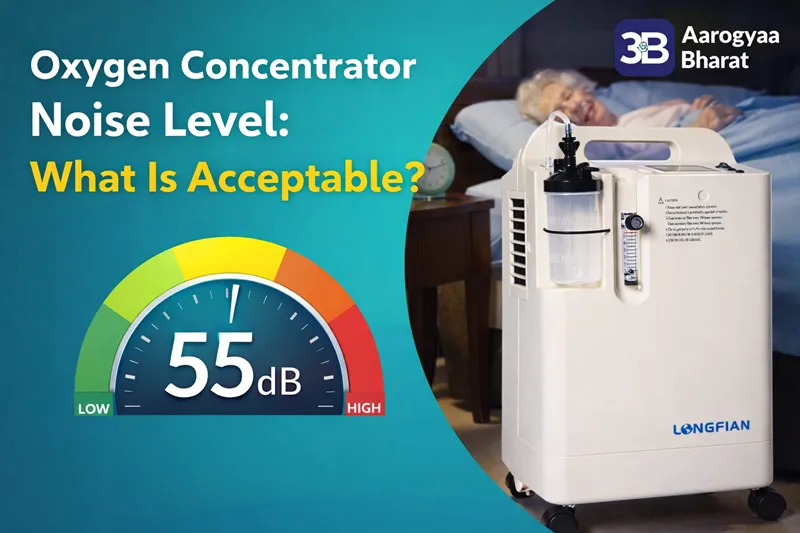
discomfort. High-quality home oxygen concentrators should operate within 35-50
decibels, which is comparable to a quiet fan or soft conversation.
Machines exceeding 55-60 decibels are generally unacceptable
for long-term home care, especially during night-time use. Always verify
certified noise ratings rather than trusting subjective descriptions like
“quiet” or “low-noise” in product listings.
Safety Alarm Systems and Why They Are Non-Negotiable
A medical-grade oxygen concentrator must include multiple
built-in safety alarms that protect the patient when oxygen delivery is
interrupted or compromised. Silent therapy failure can go unnoticed for hours,
especially during sleep, if these alarms are missing. At a minimum, the device
should have alarms for power failure, low oxygen purity, flow interruption or
tubing disconnection, overheating, and internal system faults.
Without these alarms, caregivers have no way of knowing
whether the patient is actually receiving therapeutic oxygen or breathing room
air through a disconnected cannula. Advanced concentrators also display
operating hours, fault codes, maintenance reminders, and real-time purity
levels, making troubleshooting easier and ensuring proactive servicing before
breakdowns occur.
Compromising on safety alarms to save money is one of the
most dangerous decisions a buyer can make because alarm-less machines can turn
small technical faults into major medical emergencies.
Power Backup Compatibility and Emergency Planning
An oxygen concentrator without a reliable power backup
system is not a complete medical solution, especially in India, where voltage
fluctuations and power cuts are still common. A typical 5 LPM concentrator
consumes 300-500 watts, while a 10 LPM machine may consume 600-900 watts. This
means a single 150Ah battery provides only two to three hours of backup for a 5
LPM unit and far less for a 10 LPM model.
For medically safe operation, families must invest in a pure
sine wave inverter, sufficient battery capacity for at least six to twelve
hours of backup, a UPS for zero-interruption switchover, and a backup oxygen
cylinder or portable concentrator for prolonged outages. Power backup planning
should never be treated as an afterthought because oxygen therapy interruptions
can become fatal within minutes for severely dependent patients.
Service Network Reliability and Long-Term Ownership Risk
A famous brand without local service support is practically
useless during emergencies, while a slightly lesser-known brand with strong
service coverage can be far more reliable for long-term home care. Oxygen
concentrators require periodic servicing, filter replacement, and occasional
repairs, and without easy access to spare parts and trained technicians, even
minor faults can render a machine unusable for days or weeks.
Always verify local service centre availability, average
repair turnaround time, spare part accessibility, warranty coverage length, and
on-site service support options before finalizing a purchase. Grey-market
imports and unknown brands often leave families stranded when faults appear,
making long-term reliability just as important as technical performance.
Total Cost of Ownership and Why Cheap Machines Cost More
Many buyers focus only on the sticker price of an oxygen
concentrator without calculating the total cost of ownership, which includes
electricity consumption, power backup investment, maintenance and servicing
costs, spare part replacement, downtime risk, and emergency oxygen cylinder
rentals during breakdowns.
A cheaper machine with poor durability, high noise, and
unstable purity often ends up costing far more over two to five years than a
slightly more expensive model with higher reliability and better service
support. True value lies not in the lowest upfront price, but in the lowest
long-term medical risk and financial burden
Oxygen Concentrator Buying Checklist Table
|
Evaluation
Factor |
Why It
Matters |
|
Doctor-prescribed
flow rate |
Prevents
under- or over-oxygenation |
|
Oxygen purity
stability |
Ensures real
therapeutic oxygen delivery |
|
Continuous
duty rating |
Supports
long-hour or 24/7 usage |
|
Noise below
50 dB |
Protects
sleep quality and therapy compliance |
|
Built-in
safety alarms |
Prevents
silent therapy failure |
|
Power backup
compatibility |
Protects
against outages and voltage issues |
|
Local service
network |
Enables fast
repairs and spare parts |
|
Warranty
coverage |
Reduces
long-term repair costs |
|
Filter
accessibility |
Simplifies
hygiene and maintenance |
|
Total cost of
ownership |
Prevents
hidden financial and medical risk |
Conclusion
An oxygen concentrator is not just a medical appliance it is
a life-support system that determines how safely and comfortably a patient can
breathe at home. Choosing the wrong machine can result in oxygen therapy
failure, sudden breakdowns, emergency hospitalizations, and irreversible health
damage, while choosing the right one can stabilize breathing, restore dignity,
reduce medical expenses, and provide years of peace of mind for families.
By following this detailed buying checklist covering medical
requirements, flow rate capacity, oxygen purity stability, continuous duty
rating, noise comfort, safety alarms, power backup planning, service
reliability, and long-term cost economics you protect not just your money, but
a human life. At Aarogyaa Bharat, we specialize in providing medically
certified oxygen concentrators, transparent guidance, flexible rental plans,
and nationwide service support to ensure that every patient receives the right
oxygen solution at the right time without panic, misinformation, or financial
exploitation.
If you or your loved one is planning to buy an oxygen
concentrator, Aarogyaa Bharat is always here to help you choose wisely, breathe
safely, and live better.